Loading...
Done
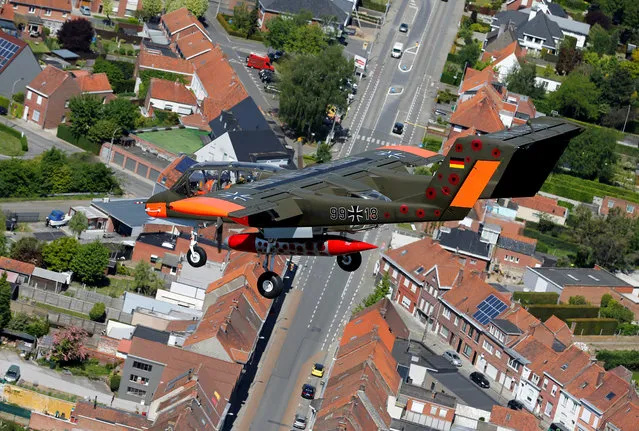
An OV-10 Bronco aircraft, decorated with World War One commemoration motifs, flies over Flanders international airport, ahead of the world's first Short Take Off & Landing competition on sand, in Wevelgem, Belgium May 8, 2018. (Photo by Francois Lenoir/Reuters)

An OV-10 Bronco aircraft, decorated with World War One commemoration motifs, flies over Flanders international airport, ahead of the world's first Short Take Off & Landing competition on sand, in Wevelgem, Belgium May 8, 2018. (Photo by Francois Lenoir/Reuters)
Details
09 May 2018 08:04:00
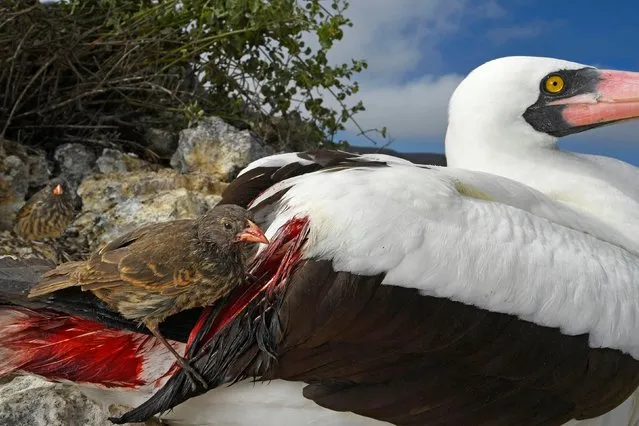
Bloodthirsty by Thomas P Peschak, Germany/South Africa — winner, Behaviour: birds. When rations run short on Wolf Island, in the remote northern Galápagos, the sharp-beaked ground finches become vampires. Their sitting targets are Nazca boobies and other large birds. The finches rely on a scant diet of seeds and insects, which regularly dries up, so they drink blood to survive. ‘I’ve seen more than half a dozen finches drinking from a single Nazca booby,’ says Tom. Rather than leave their nests the boobies tolerate the vampires, and the blood loss doesn’t seem to cause permanent harm. (Photo by Thomas P Peschak/2018 Wildlife Photographer of the Year)

Bloodthirsty by Thomas P. Peschak, Germany/South Africa — winner, Behaviour: birds. When rations run short on Wolf Island, in the remote northern Galápagos, the sharp-beaked ground finches become vampires. Their sitting targets are Nazca boobies and other large birds. The finches rely on a scant diet of seeds and insects, which regularly dries up, so they drink blood to survive. ‘I’ve seen more than half a dozen finches drinking from a single Nazca booby,’ says Tom. Rather than leave their nests the boobies tolerate the vampires, and the blood loss doesn’t seem to cause permanent harm. (Photo by Thomas P. Peschak/2018 Wildlife Photographer of the Year)

Details
19 Oct 2018 00:05:00
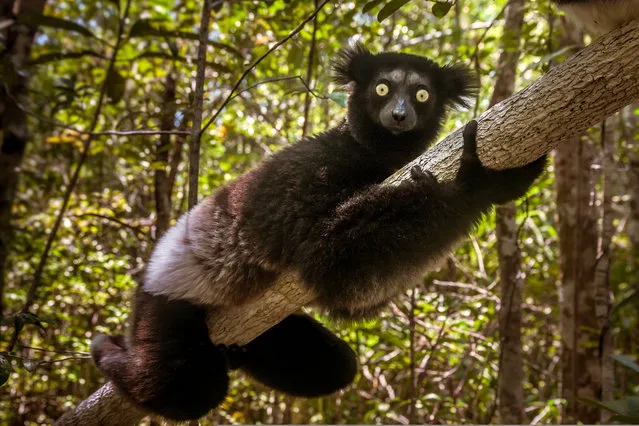
The secretive indri (Indri indri) of Madagascar, the largest living lemur. It is also critically endangered and highly evolutionarily distinct with no close relatives, which makes its branch one of most precarious on the mammal evolutionary tree. In the likely event that the indri goes extinct, we will lose 19m years of unique evolutionary history from the mammal tree of life. (Photo by Pierre-Yves Babelon/Aarhus University)

The secretive indri (Indri indri) of Madagascar, the largest living lemur. It is also critically endangered and highly evolutionarily distinct with no close relatives, which makes its branch one of most precarious on the mammal evolutionary tree. In the likely event that the indri goes extinct, we will lose 19m years of unique evolutionary history from the mammal tree of life. (Photo by Pierre-Yves Babelon/Aarhus University)
Details
18 Nov 2018 00:02:00
A stroller walks his dogs in an autumnally colored forest in Cuxhaven, nothern Germany on November 7, 2018. (Photo by Patrik Stollarz/AFP Photo)

A stroller walks his dogs in an autumnally colored forest in Cuxhaven, nothern Germany on November 7, 2018. (Photo by Patrik Stollarz/AFP Photo)
Details
20 Dec 2018 00:01:00
Tourists take photos from a panoramic viewing deck on Victoria Peak in Hong Kong, China, 26 January 2019. Hong Kong has been ranked the world's freest economy by the Heritage Foundation, a conservative research and educational institution based in Washington, for the 25th consecutive year, but the researchers also said the judiciary had become less effective. (Photo by Jerome Favre/EPA/EFE)

Tourists take photos from a panoramic viewing deck on Victoria Peak in Hong Kong, China, 26 January 2019. Hong Kong has been ranked the world's freest economy by the Heritage Foundation, a conservative research and educational institution based in Washington, for the 25th consecutive year, but the researchers also said the judiciary had become less effective. (Photo by Jerome Favre/EPA/EFE)
Details
29 Jan 2019 09:53:00
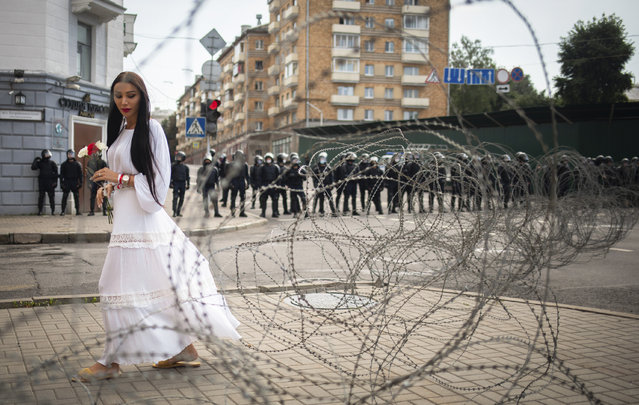
A woman walks past the barbed wire separating Belarusian servicemen and Belarusian opposition supporters during a rally in Minsk, Belarus, Sunday, August 30, 2020. Tens of thousands of demonstrators have gathered in the capital of Belarus, beginning the fourth week of daily protests demanding that the country's authoritarian president resign. The protests began after an Aug. 9 presidential election that protesters say was rigged and officials say gave President Alexander Lukashenko a sixth term in office. (Photo by Tut.By via AP Photo)

A woman walks past the barbed wire separating Belarusian servicemen and Belarusian opposition supporters during a rally in Minsk, Belarus, Sunday, August 30, 2020. Tens of thousands of demonstrators have gathered in the capital of Belarus, beginning the fourth week of daily protests demanding that the country's authoritarian president resign. The protests began after an Aug. 9 presidential election that protesters say was rigged and officials say gave President Alexander Lukashenko a sixth term in office. (Photo by Tut.By via AP Photo)
Details
01 Sep 2020 00:07:00
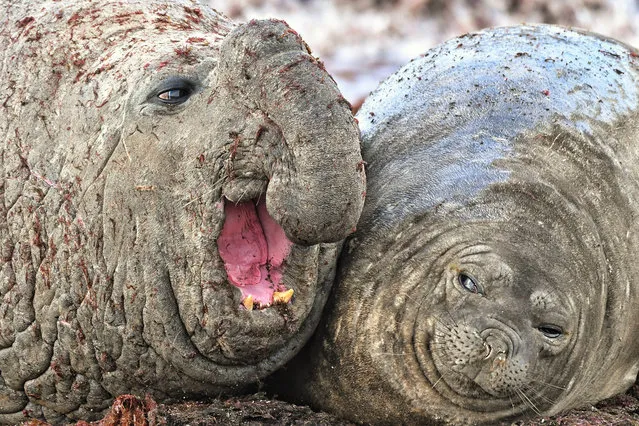
I had to stay late at work, Chubut, Argentina. “South sea elephant in Patagonia (Isla Escondida) They adopt very curious gestures!”. (Photo by Luis Burgue/Comedy Wildlife Photography Awards 2020)

I had to stay late at work, Chubut, Argentina. “South sea elephant in Patagonia (Isla Escondida) They adopt very curious gestures!”. (Photo by Luis Burgue/Comedy Wildlife Photography Awards 2020)
Details
14 Sep 2020 00:03:00
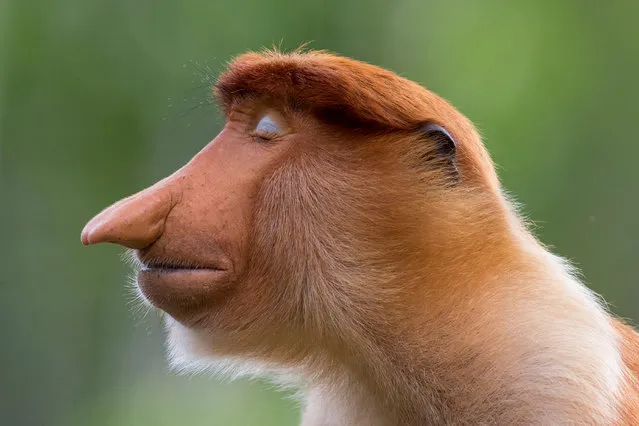
Winner – Animal Portraits: The pose by Mogens Trolle, Denmark. A young male proboscis monkey cocks his head slightly and closes his eyes. Unexpected pale blue eyelids now complement his immaculately groomed auburn hair. He poses for a few seconds as if in meditation. He is a wild visitor to the feeding station at Labuk Bay Proboscis Monkey Sanctuary in Sabah, Borneo – “the most laid-back character”, says Trolle, “quite unlike anything I’ve ever seen on another monkey” – connects us, he hopes, with a fellow primate. (Photo by Mogens Trolle/Wildlife Photographer of the Year 2020)

Winner – Animal Portraits: The pose by Mogens Trolle, Denmark. A young male proboscis monkey cocks his head slightly and closes his eyes. Unexpected pale blue eyelids now complement his immaculately groomed auburn hair. He poses for a few seconds as if in meditation. He is a wild visitor to the feeding station at Labuk Bay Proboscis Monkey Sanctuary in Sabah, Borneo – “the most laid-back character”, says Trolle, “quite unlike anything I’ve ever seen on another monkey” – connects us, he hopes, with a fellow primate. (Photo by Mogens Trolle/Wildlife Photographer of the Year 2020)
Details
16 Oct 2020 00:03:00