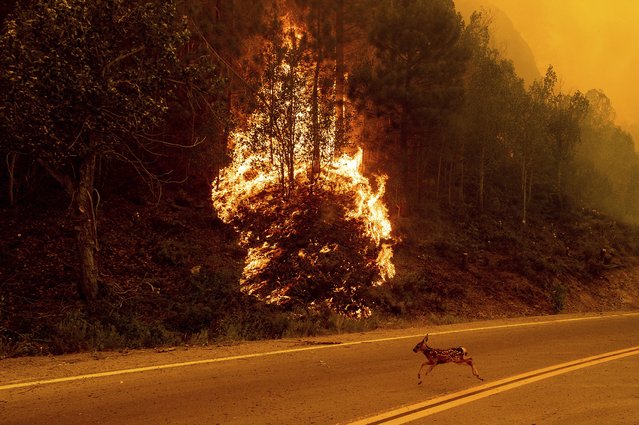
An animal sprints across a road as the Sugar Fire, part of the Beckwourth Complex Fire, burns in Plumas National Forest, Calif., on Thursday, July 8, 2021. (Photo by Noah Berger/AP Photo)
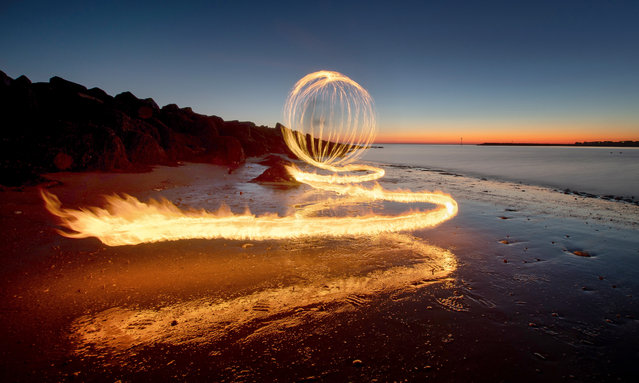
Pictured on December 9, 2022 during the Friday sunset on Martello beach at Clacton in Essex is some light painting with fire created by spinning fire with a 21-second exposure. (Photo by Kevin Jay/Picture Exclusive)
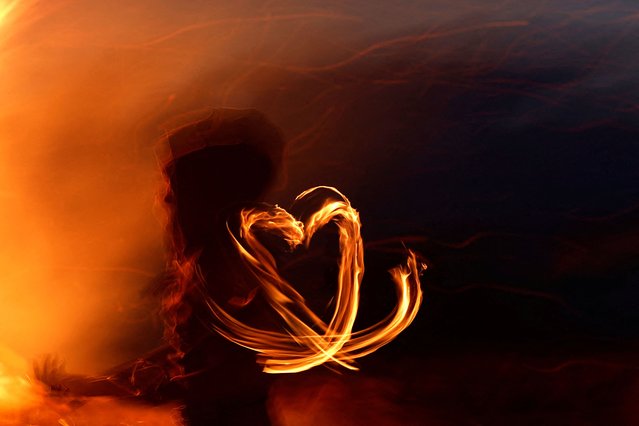
A fire dancer makes a heart shape at the Bealtaine fire festival, marking the beginning of summer at the Hill of Uisneach in Rathnew, Ireland, on May 10, 2025. (Photo by Clodagh Kilcoyne/Reuters)
A Nepalese woman pours milk as she offers prayers to the setting Sun on the banks of the Bagmati River during the Chhath Puja festival in Kathmandu, Nepal, Sunday, November 6, 2016. During Chhath, an ancient Hindu festival, rituals are performed to thank the Sun God for sustaining life on earth. (Photo by Niranjan Shrestha/AP Photo)
English social media influencer Grace Keeling, aka GK Barry, won over jungle viewers on I'm A Celeb with her down-to-earth personality to finish in fifth place. Grace went from being a normal student to having more than 4 million followers on TikTok. (Photo by Mark Hayman)
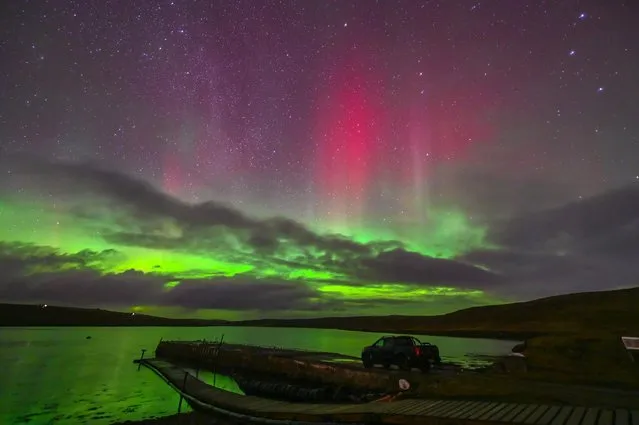
The northern lights as seen from from Yell in the Shetland Islands, Scotland on January 15, 2023. The aurora borealis is caused by collisions between electrically charged particles released from the sun that enter the Earth’s atmosphere and collide with gases such as oxygen and nitrogen. (Photo by Ryan Nisbet/Capture Media Agency)
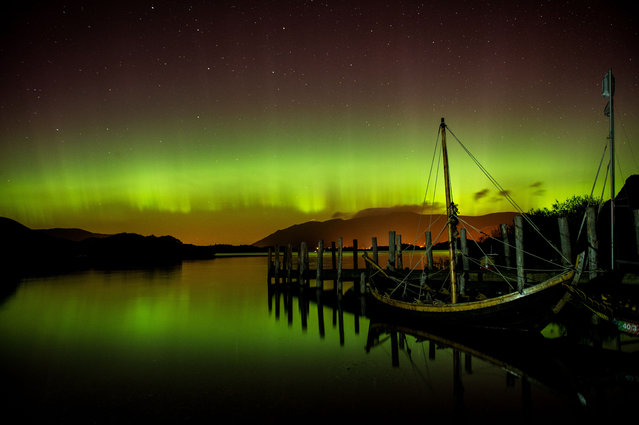
The aurora borealis, or the northern lights occur over Derwentwater, near Keswick, England, Thursday October 8, 2015. The northern lights are the result of collisions between gaseous particles in the Earth's atmosphere with charged particles released from the sun. (Photo by Owen Humphreys/PA Wire via AP Photo)
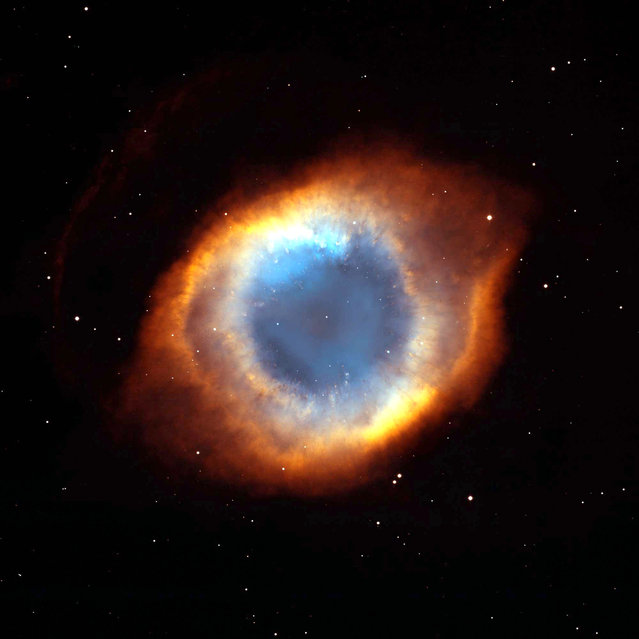
A coil-shaped Helix Nebula showing a fine web of filamentary “bicycle-spoke” features embedded in the colorful red and blue ring of gas. At 650 light-years away, the Helix is one of the nearest planetary nebulae to Earth. A planetary nebula is the glowing gas around a dying, Sun-like star. (Photo by Reuters/NASA)