Loading...
Done
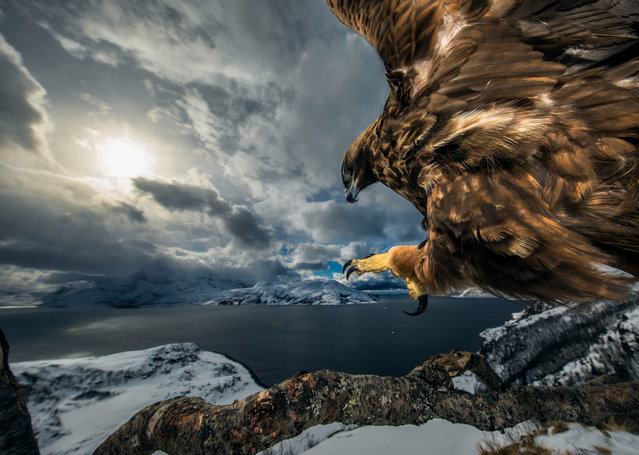
Birds behaviour winner: Land of the Eagle by Audun Rikardsen, Norway. High on a ledge, on the coast near his home in northern Norway, Rikardsen carefully positioned an old tree branch that he hoped would make a perfect golden eagle lookout. To this, he bolted a tripod head with a camera, flashes and motion sensor attached, and built himself a hide a short distance away. From time to time, he left road‑kill carrion nearby. Very gradually – over the next three years – a golden eagle got used to the camera and started to use the branch regularly to survey the coast below. (Photo by Audun Rikardsen/2019 Wildlife Photographer of the Year)

Birds behaviour winner: Land of the Eagle by Audun Rikardsen, Norway. High on a ledge, on the coast near his home in northern Norway, Rikardsen carefully positioned an old tree branch that he hoped would make a perfect golden eagle lookout. To this, he bolted a tripod head with a camera, flashes and motion sensor attached, and built himself a hide a short distance away. From time to time, he left road‑kill carrion nearby. Very gradually – over the next three years – a golden eagle got used to the camera and started to use the branch regularly to survey the coast below. (Photo by Audun Rikardsen/2019 Wildlife Photographer of the Year)
Details
17 Oct 2019 00:03:00
Runner-up. “The City of London, looking towards the Royal Exchange and the Bank of England. The ever-changing London skyline provides many excellent opportunities for cityscape photography, none more exciting than the ebb and flow of traffic at night”. MICK RYAN, JUDGE: “Sophisticated new camera sensors, sharp lenses and the ability to take hundreds of shots in a session and check your work have made night photography much easier than it ever used to be. The results, like this scene, can be spectacular”. (Photo by Mark Caldon/The Guardian)

Runner-up. “The City of London, looking towards the Royal Exchange and the Bank of England. The ever-changing London skyline provides many excellent opportunities for cityscape photography, none more exciting than the ebb and flow of traffic at night”. (Photo by Mark Caldon/The Guardian)
Details
10 Dec 2018 00:03:00


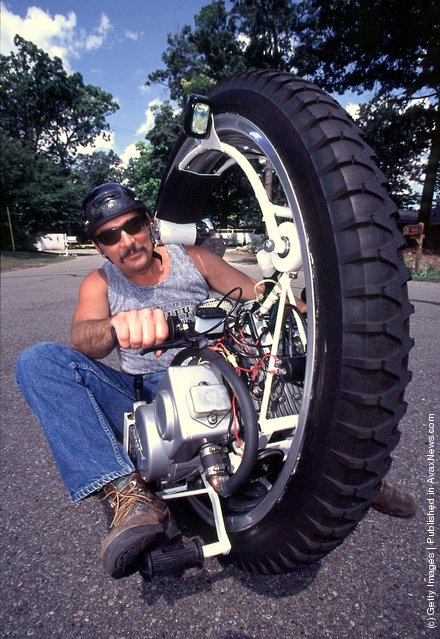
“A monowheel is a one-wheeled single-track vehicle similar to a unicycle. However, instead of sitting above the wheel, the rider sits either within it or next to it. The wheel is a ring, usually driven by smaller wheels pressing against its inner rim. Most are single-passenger vehicles, though multi-passenger models have been built.

Pedal-powered monowheels were built in the late 19th century; most built in the 20th century have been motorized. Some modern builders refer to these vehicles as monocycles, though that term is also sometimes used to describe motorized unicycles. Today, monowheels are generally built and used for fun and entertainment purposes, though from the 1860s through to the 1930s, they were proposed for use as serious transportation”. – Wikipedia

Photo: Cycle inventor Kerry McLean poses for the photographer 2000 in Walled Lake, Michigan. The “Monocycle” is equipped with a 40-horsepower engine, 4ft tire and is expected to reach speeds upwards of 100 mph. (Photo by Bill Pugliano/Liaison)
Details
02 Jul 2011 12:24:00
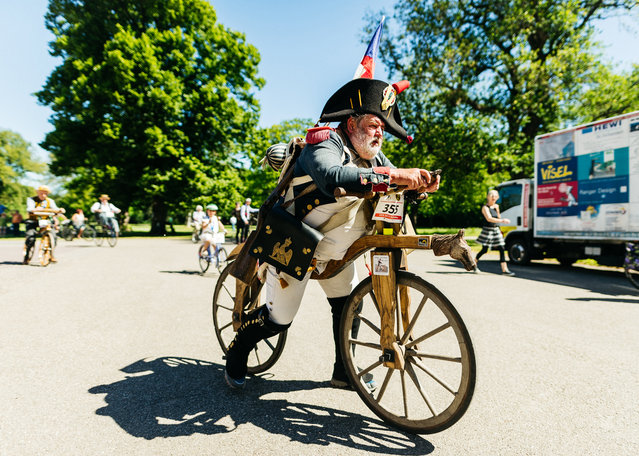
Participants dressed in historical clothing ride high-wheel bicycles during a bicycle ballet event at Schloss Karlsruhe palace during the 2017 International Veteran Cycle Association (IVCA) rally to celebrate the 200th anniversary of the bicycle on May 27, 2017 in Karlsruhe, Germany. (Photo by Alexander Scheuber/Getty Images)

Participants dressed in historical clothing ride high-wheel bicycles during a bicycle ballet event at Schloss Karlsruhe palace during the 2017 International Veteran Cycle Association (IVCA) rally to celebrate the 200th anniversary of the bicycle on May 27, 2017 in Karlsruhe, Germany. Karl Drais, a German inventor, built and tested the first bicycle, called the Draisine, that ran without pedals in 1817. (Photo by Alexander Scheuber/Getty Images)
Details
01 Jun 2017 10:04:00
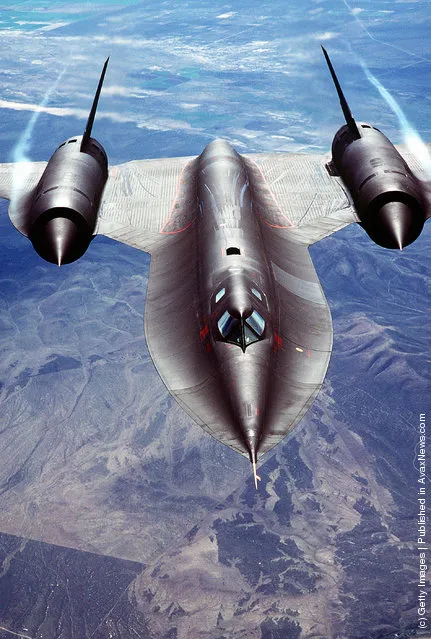
A U.S. Air Force SR-71A, also known as the Blackbird, is put through it's paces during a test flight

“The Lockheed SR-71 “Blackbird” was an advanced, long-range, Mach 3+ strategic reconnaissance aircraft. It was developed as a black project from the Lockheed A-12 reconnaissance aircraft in the 1960s by the Lockheed Skunk Works. Clarence “Kelly” Johnson was responsible for many of the design's innovative concepts. During reconnaissance missions the SR-71 operated at high speeds and altitudes to allow it to outrace threats. If a surface-to-air missile launch was detected, the standard evasive action was simply to accelerate and outrun the missile”. – Wikipedia

Photo: A U.S. Air Force SR-71A, also known as the “Blackbird”, is put through it's paces during a test flight over Beale Air Force Base in California. The aircraft is a strategic reconnaissance plane by Lockheed and is the world's fastest and highest flying operational aircraft. (Photo by Getty Images)
Details
07 Sep 2011 12:17:00


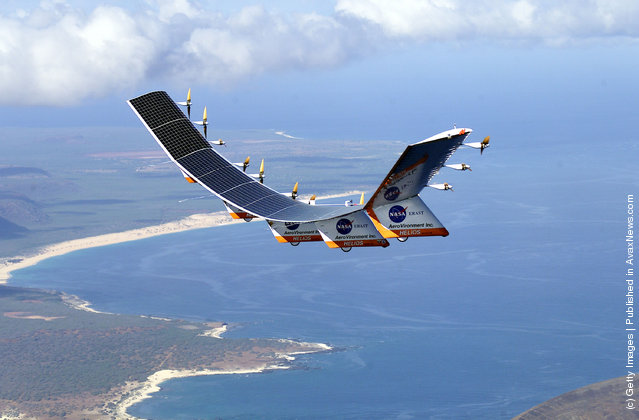
“NASA's Pathfinder, Pathfinder Plus, Centurion and Helios Prototype were an evolutionary series of solar- and fuel-cell-system-powered unmanned aerial vehicles. AeroVironment, Inc. developed the vehicles under NASA's Environmental Research Aircraft and Sensor Technology (ERAST) program. They were built to develop the technologies that would allow long-term, high-altitude aircraft to serve as “atmospheric satellites”, to perform atmospheric research tasks as well as serve as communications platforms”. – Wikipedia

Photo: The solar-electric Helios Prototype flying wing is flies over the Hawaiian islands of Niihau and Lehua during the first solar-powered test flight July 14, 2001 from the U.S. Navy's Pacific Missile Range Facility on Kauai, HI. The 18-hour flight was a functional checkout of the aircraft's systems and performance in preparation for an attempt to reach sustained flight at 100,000 feet altitude later in the summer. (Photo Courtesy of NASA/Getty Images)
Details
14 Jul 2011 09:24:00
The Air2 (Air Squared) floating Bluetooth speaker from Axxess CE is displayed at CES Unveiled, the opening event for the media preview days at the 2015 Consumer Electronics Show, January 4, 2015 in Las Vegas, Nevada. The speaker which levitates over its own base is one of the winners for the CES Innovation Awards and is patent pending. (Photo by Robyn Beck/AFP Photo)

The Air2 (Air Squared) floating Bluetooth speaker from Axxess CE is displayed at CES Unveiled, the opening event for the media preview days at the 2015 Consumer Electronics Show, January 4, 2015 in Las Vegas, Nevada. The speaker which levitates over its own base is one of the winners for the CES Innovation Awards and is patent pending. (Photo by Robyn Beck/AFP Photo)
Details
09 Jan 2015 13:08:00
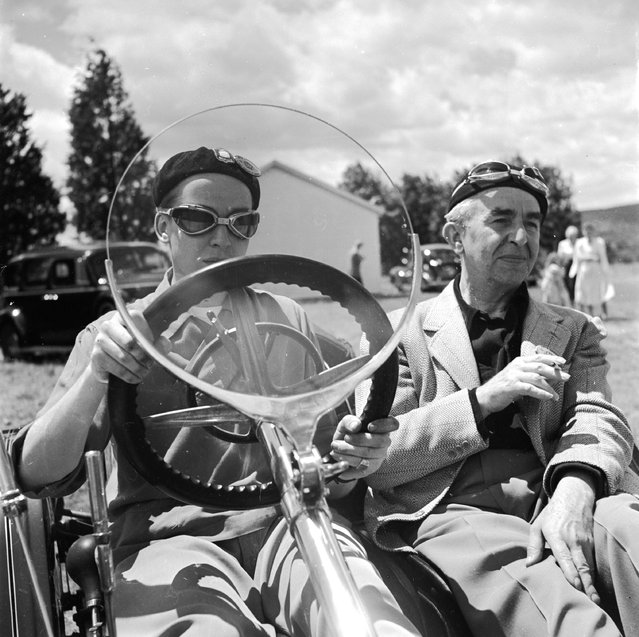
At the 50th anniversary of the Hartford Automobile Club a 1914 Mercer with an economical wind screen, looking like a large magnifying glass, designed to offer minimum wind resistance. Brass is used instead of chrome for the “shiny” parts, circa 1955. (Photo by Three Lions)

At the 50th anniversary of the Hartford Automobile Club a 1914 Mercer with an economical wind screen, looking like a large magnifying glass, designed to offer minimum wind resistance. Brass is used instead of chrome for the “shiny” parts, circa 1955. (Photo by Three Lions)
Details
28 Sep 2012 10:56:00