Loading...
Done
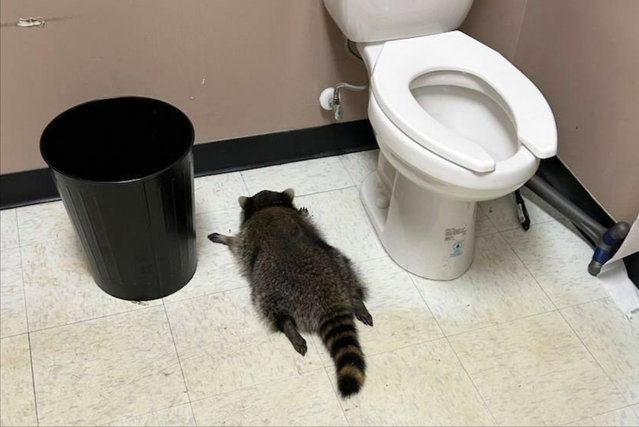
In more “raccoons are getting more like us” news, a drunk raccoon was found in a liquor store in Virginia, US in the first decade of December 2025. The animal had got into the shop via some loose ceiling tiles, knocked bottles of spirits off the shelves, lapped up the contents and passed out in the toilets. Once it had sobered up, it was released back into the wild – no doubt with a crashing hangover. (Photo by AP Photo)

In more “raccoons are getting more like us” news, a drunk raccoon was found in a liquor store in Virginia, US in the first decade of December 2025. The animal had got into the shop via some loose ceiling tiles, knocked bottles of spirits off the shelves, lapped up the contents and passed out in the toilets. Once it had sobered up, it was released back into the wild – no doubt with a crashing hangover. (Photo by AP Photo)
Details
11 Dec 2025 06:38:00
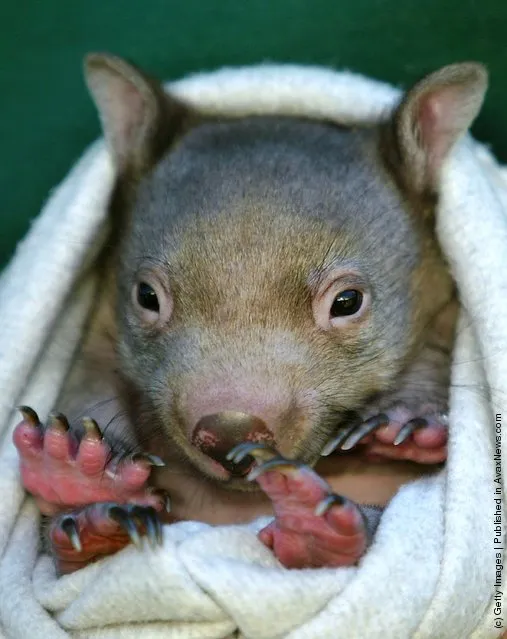
A baby Common Wombat

“Wombats are Australian marsupials; they are short-legged, muscular quadrupeds, approximately 1 metre (39 in) in length with a short, stubby tail. They are adaptable in their habitat tolerances, and are found in forested, mountainous, and heathland areas of south-eastern Australia, including Tasmania, as well as an isolated patch of about 300 ha in Epping Forest National Park in central Queensland”. – Wikipedia

Photo: “Abdul”, a baby Common Wombat, is one of the marsupials on show during the spring baby boom at Taronga Zoo September 1, 2005 in Sydney, Australia. “Abdul” was orphaned when his mother was killed by a car. (Photo by Mark Nolan/Getty Images)
Details
20 Aug 2011 11:23:00
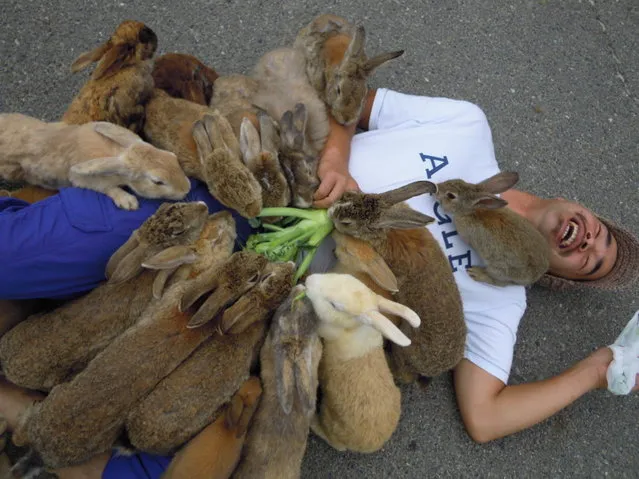
Rabbit Island in Japan

Only after World War II did the secret spill: Ōkunoshima, located in the Inland Sea of Japan between Hiroshima and Shikoku, was the top-secret site for manufacturing chemical warfare. When the factories were closed down, a number of exotic wild rabbits were seen freely roaming the island. They were assumed to have been the test subjects for the chemical weapons, which the military failed to eradicate when the factory was demolished.
Details
17 Feb 2014 12:23:00
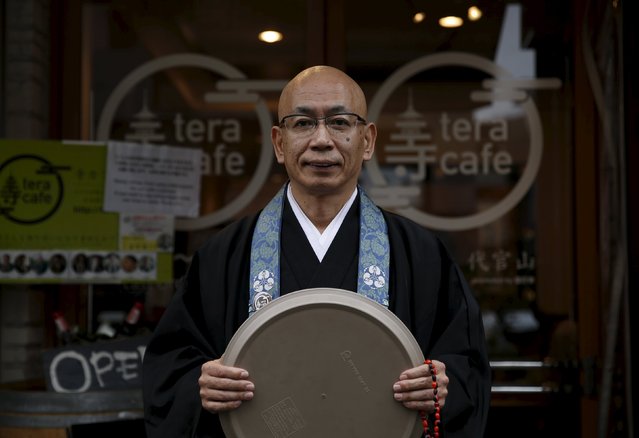
Shokyo Miura, a Buddhist monk and one of the on-site priests, poses for pictures outside Tera Cafe in Tokyo, Japan, April 1, 2016. (Photo by Yuya Shino/Reuters)

Shokyo Miura, a Buddhist monk and one of the on-site priests, poses for pictures outside Tera Cafe in Tokyo, Japan, April 1, 2016. At first glance, the cafe, which also serves alcohol, looks like any other except for an altar next to the countertop bar with a Buddha statue set against a gold backdrop. The menu confirms this is something different. It lists classes for 1,500 yen ($14) in weaving prayer beads, calligraphy with sutras, or lines of scripture, and consultations with a Buddhist priest. (Photo by Yuya Shino/Reuters)
Details
09 Apr 2016 13:21:00
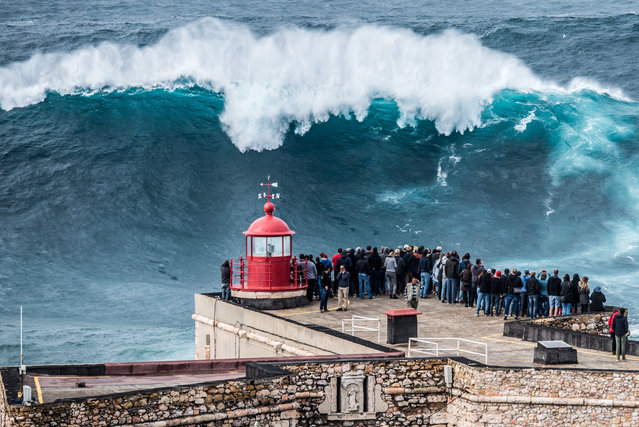
Crowds watch surfers as the first big swell of the year arrives in Nazaré, Portugal on October 28, 2015. (Photo by Pedro Miranda/Demotix/Corbis)

Crowds watch surfers as the first big swell of the year arrives in Nazaré, Portugal on October 28, 2015. (Photo by Pedro Miranda/Demotix/Corbis)
Details
30 Oct 2015 08:07:00
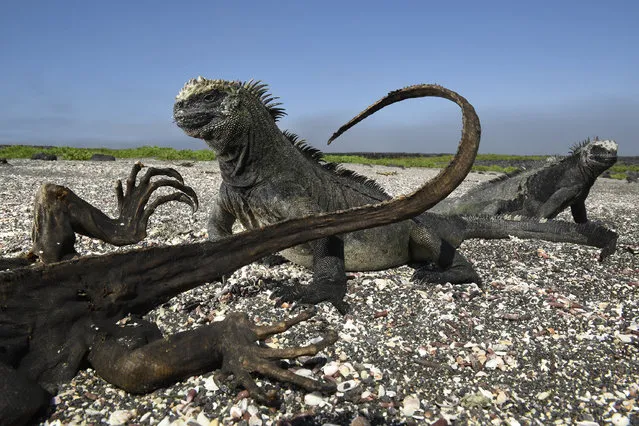
Galapagos – Rocking the Cradle: Four major ocean currents converge along the Galapagos archipelago, creating the conditions for an extraordinary diversity of animal life, April 25, 2016. The islands are home to at least 7,000 flora and fauna species, of which 97 percent of the reptiles, 80 percent of the land birds, 50 percent of the insects and 30 percent of the plants are endemic. The local ecosystem is highly sensitive to the changes in temperature, rainfall and ocean currents that characterize the climatic events known as El Niño and La Niña. These changes cause marked fluctuations in weather and food availability. Many scientists expect the frequency of El Niño and La Niña to increase as a result of climate change, making the Galapagos a possible early-warning location for its effects. (Photo by Thomas P. Peschak for National Geographic/World Press Photo)

Galapagos – Rocking the Cradle: Four major ocean currents converge along the Galapagos archipelago, creating the conditions for an extraordinary diversity of animal life, April 25, 2016. The islands are home to at least 7,000 flora and fauna species, of which 97 percent of the reptiles, 80 percent of the land birds, 50 percent of the insects and 30 percent of the plants are endemic. (Photo by Thomas P. Peschak for National Geographic/World Press Photo)
Details
16 Apr 2018 00:01:00
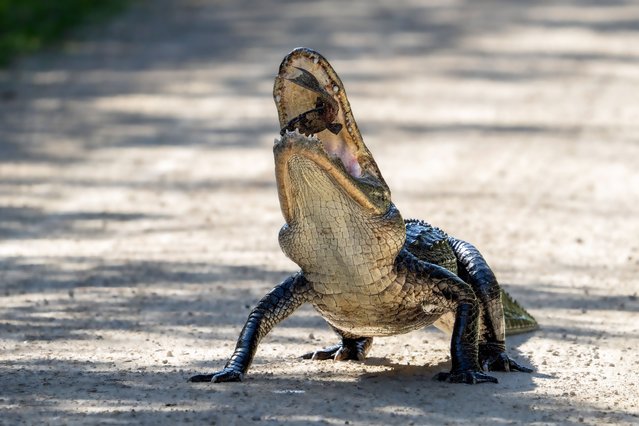
An alligator devours a fish carcass he stole from a raven in Big Cypress National Preserve in Florida on November 24, 2022. The Big Cypress Swamp is a freshwater swampland located near the Everglades National Park. (Photo by Ronen Tivony/SOPA Images/Rex Features/Shutterstock)

An alligator devours a fish carcass he stole from a raven in Big Cypress National Preserve in Florida on November 24, 2022. The Big Cypress Swamp is a freshwater swampland located near the Everglades National Park. (Photo by Ronen Tivony/SOPA Images/Rex Features/Shutterstock)
Details
11 Dec 2022 04:38:00
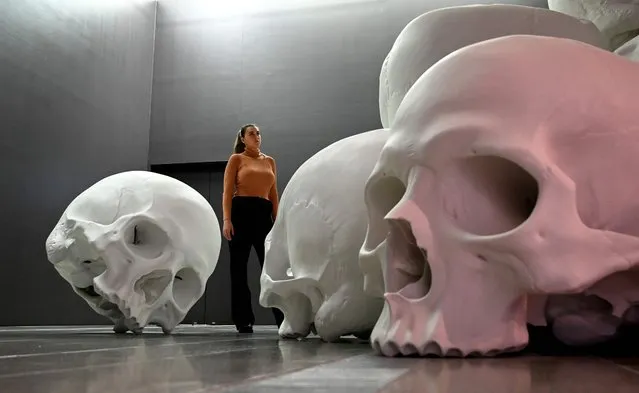
A person looks at Australian artist Ron Muecks large-scale installation “Mass” which comprises more than 100 hand-cast skulls that collectively weigh approximately 5000 kilograms at an exhibition at the National Gallery of Victoria (NGV) in Melbourne on May 18, 2022. (Photo by William West/AFP Photo)

A person looks at Australian artist Ron Muecks large-scale installation “Mass” which comprises more than 100 hand-cast skulls that collectively weigh approximately 5000 kilograms at an exhibition at the National Gallery of Victoria (NGV) in Melbourne on May 18, 2022. (Photo by William West/AFP Photo)
Details
22 Jul 2023 04:15:00