Loading...
Done
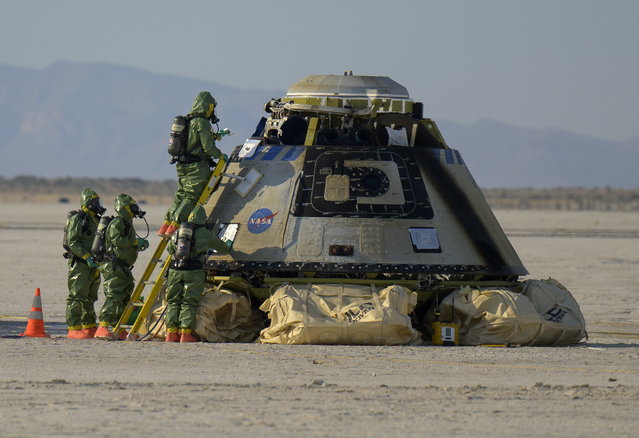
A handout picture made available by the National Aeronautics and Space Administration (NASA) shows, NASA teams working around Boeing’s CST-100 Starliner spacecraft after it landed at White Sands Missile Range’s Space Harbor, in Las Cruces, New Mexico, 25 May 2022. Boeing’s Orbital Flight Test-2 (OFT-2) is Starliner’s second uncrewed flight test to the International Space Station as part of NASA's Commercial Crew Program. OFT-2 serves as an end-to-end test of the system's capabilities. (Photo by Bill Ingalls/NASA/EPA/EFE)

A handout picture made available by the National Aeronautics and Space Administration (NASA) shows, NASA teams working around Boeing’s CST-100 Starliner spacecraft after it landed at White Sands Missile Range’s Space Harbor, in Las Cruces, New Mexico, 25 May 2022. Boeing’s Orbital Flight Test-2 (OFT-2) is Starliner’s second uncrewed flight test to the International Space Station as part of NASA's Commercial Crew Program. OFT-2 serves as an end-to-end test of the system's capabilities. (Photo by Bill Ingalls/NASA/EPA/EFE)
Details
31 May 2022 04:54:00
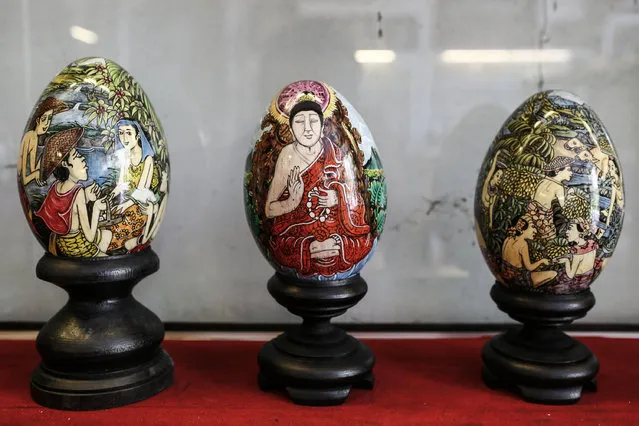
Painted eggshell displayed at Wayan Sadra's workshop on April 14, 2014 in Sukawati, Gianyar, Bali, Indonesia. (Photo by Putu Sayoga/Getty Images)

Painted eggshell displayed at Wayan Sadra's workshop on April 14, 2014 in Sukawati, Gianyar, Bali, Indonesia. 50-year-old Wayan Sadra got the idea to start his eggshell painting business, after his niece who worked in a five star hotel asked for his help to paint on an egg for an Easter egg competition. Now the business he started in 1997 attracts customers for his painted eggs from Germany, France, Italy, and the Netherlands. Sadra usually experiences a surge in sales ahead of Easter. (Photo by Putu Sayoga/Getty Images)
Details
15 Apr 2014 10:40:00
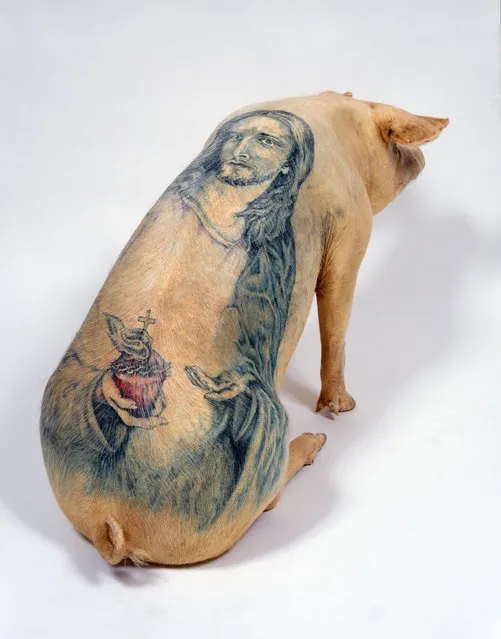
Tattooing Pigs By Wim Delvoye

Wim Delvoye is a notorious tattoo artist, who became famous when he started tattooing live pigs. He first began in 1997 and after animal rights activists found out about what he was doing, he had to move to China to continue his business. There is nothing special about the tattoos that Wim Delvoye creates, they look mediocre at best, and the only reason why he’s famous is his acts of animal cruelty. Nevertheless, Wim states that the pigs feel just fine and are well fed and taken care off. Full anesthesia is used to ensure that the pig doesn’t feel pain during the course of the whole procedure. During this time three tattoo artists work on the tattoo simultaneously to complete it as quickly as possible. Skins of those pigs are then sold for as much as £50k a piece.
Details
02 Apr 2015 09:06:00
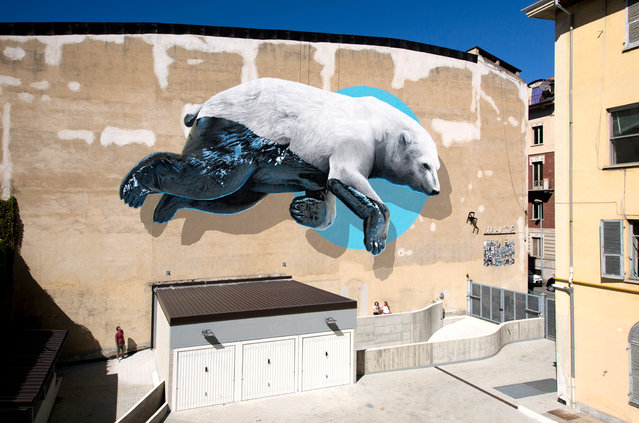
A polar bear whose bottom half is caked in oily black gunk. A whale wrapped in striped fabric: a pseudo straightjacket. These are the messes climate change leaves behind, the things we know are happening but often don’t have the opportunity to see with our own eyes. Swiss street art duo Christian Rebecchi and Pablo Togni, otherwise known as NeverCrew, met in art school when they were 15 and started making work together soon after. As a team, the artists adorn the world with eye-popping and gut-wrenching images depicting the consequences of humanity’s actions on earth. Here: “Black machine” mural painting and installation on the Colosseo theater in Turin, Italy, in September 2015. (Photo by NeverCrew/The Huffington Post)

A polar bear whose bottom half is caked in oily black gunk. A whale wrapped in striped fabric: a pseudo straightjacket. These are the messes climate change leaves behind, the things we know are happening but often don’t have the opportunity to see with our own eyes. Swiss street art duo Christian Rebecchi and Pablo Togni, otherwise known as NeverCrew, met in art school when they were 15 and started making work together soon after. As a team, the artists adorn the world with eye-popping and gut-wrenching images depicting the consequences of humanity’s actions on earth. (Photo by NeverCrew/The Huffington Post)
Details
13 Aug 2016 11:09:00
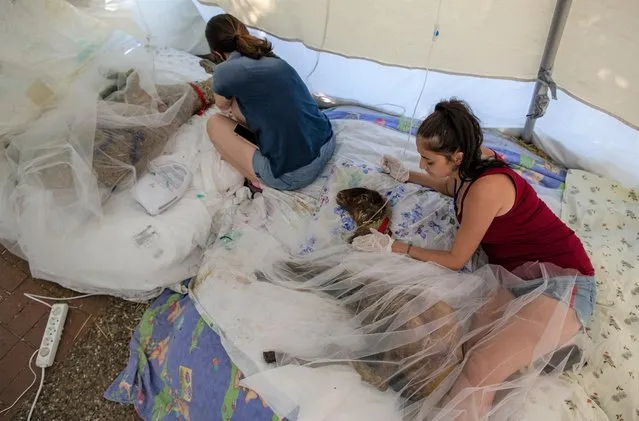
Volunteers care for burned sheeps in a field hospital established by HAYTAP (The Federation of the Animals Rights in Turkey) for animals after a wildfire at the Manavgat district of Antalya, Turkey, 09 August 2021. It is not known how many wild animals living in the forest died in the fires, but about 33,000 farm animals perished. About 30 veterinarians and hundreds of volunteers work around the clock at the field hospital. Sheep, covered in mosquito nets to protect their wounds from flies, lay there in the shade trying to recover, and various animals such as cats, dogs, owls, and cows have been treated or are still being treated there. (Photo by Erdem Sahin/EPA/EFE)

Volunteers care for burned sheeps in a field hospital established by HAYTAP (The Federation of the Animals Rights in Turkey) for animals after a wildfire at the Manavgat district of Antalya, Turkey, 09 August 2021. It is not known how many wild animals living in the forest died in the fires, but about 33,000 farm animals perished. About 30 veterinarians and hundreds of volunteers work around the clock at the field hospital. Sheep, covered in mosquito nets to protect their wounds from flies, lay there in the shade trying to recover, and various animals such as cats, dogs, owls, and cows have been treated or are still being treated there. (Photo by Erdem Sahin/EPA/EFE)
Details
27 Aug 2021 08:30:00
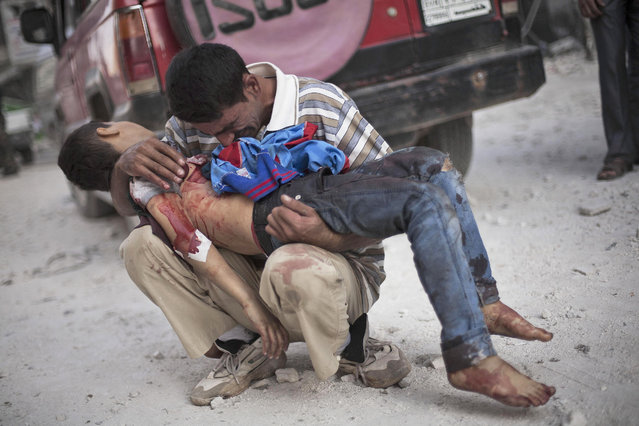
A Syrian man cries while holding the body of his son, killed by the Syrian Army, near Dar El Shifa hospital in Aleppo, Syria, Wednesday, October 3, 2012. (Photo by Manu Brabo/AP Photo)

Manu Brabo was born in Spain in 1981. After studying Photography in The School of Arts and Crafts in Oviedo, he moved to Madrid where he started Journalism in Carlos III University while he was working as a photographer for several humble newspapers and agencies. In 2011, Manu was held captive and then released by by Libyan forces. Brabo, along with fellow AP photographers were awarded the 2013 Pulitzer Prize for Breaking News Photography. Here: a Syrian man cries while holding the body of his son, killed by the Syrian Army, near Dar El Shifa hospital in Aleppo, Syria, Wednesday, October 3, 2012. (Photo by Manu Brabo/AP Photo)
Details
27 Oct 2015 08:04:00
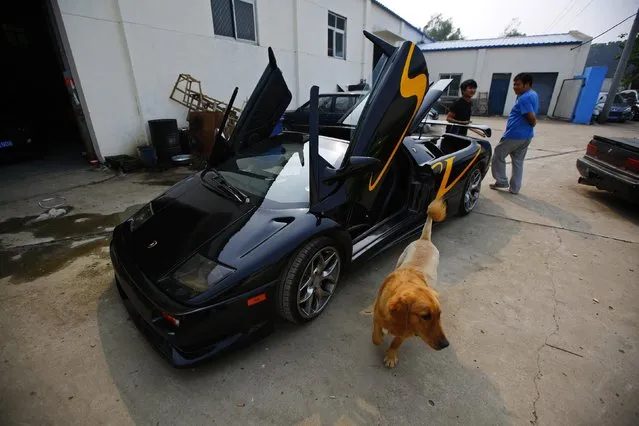
A dog walks past a handmade replica of Lamborghini Diablo outside a garage rented by Wang Yu and Li Lintao on the outskirts of Beijing, August 21, 2014. (Photo by Petar Kujundzic/Reuters)

A dog walks past a handmade replica of Lamborghini Diablo outside a garage rented by Wang Yu and Li Lintao on the outskirts of Beijing, August 21, 2014. Chinese race car enthusiasts Wang Yu and Li Lintao, both in their 30s, have finished designing and making two replicas of the Lamborghini Diablo, which can reach the top speed of 310km/h, and are currently working on a replica of the T-Rex motorcycle. They spent approximately 5 million yuan (around USD 811,899) to buy parts and hire workers, and about 6 years to assemble them with the knowledge they gained from studying mechanology for nearly a decade abroad. Wang and Li went popular after showing their first handmade replica of Lamborghini Diablo at the Beijing International Automobile Exhibition in 2012, and sold their second Lamborghini replica to Alibaba as a collection. (Photo by Petar Kujundzic/Reuters)
Details
26 Aug 2014 09:50:00
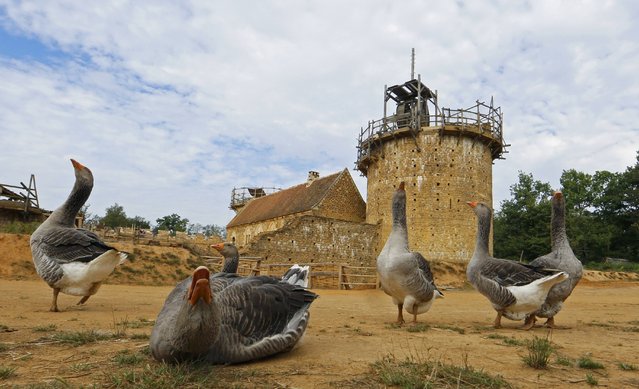
A view of the construction site of the Chateau de Guedelon near Treigny in the Burgundy region of France, September 13, 2016. Blacksmiths, stonemasons and quarry men are hard at work in a Burgundy forest building a 13th-century-style castle using the most basic tools and materials, replicating the methods used hundreds of years ago to better understand them. Forgoing all modern technology, workers use hammers to break stones and forge iron, operate wooden wheels to hoist their materials up to where they are needed, and rely on a quarry for stone, clay and sand as they build up a castle from scratch. Construction on Guedelon Castle in central France began in 1997 after an archaeological survey revealed a medieval fortress hidden inside the walls of nearby Chateau de Saint-Fargeau. Those behind the project hope to answer questions about medieval construction and provide lessons on sustainable building. (Photo by Jacky Naegelen/Reuters)

A view of the construction site of the Chateau de Guedelon near Treigny in the Burgundy region of France, September 13, 2016. Blacksmiths, stonemasons and quarry men are hard at work in a Burgundy forest building a 13th-century-style castle using the most basic tools and materials, replicating the methods used hundreds of years ago to better understand them. (Photo by Jacky Naegelen/Reuters)
Details
15 Sep 2016 09:43:00