Loading...
Done
Kew Gardens employee Lauren Bird Royal examines the flowering of the Titan Arum lily at the Botanical Gardens

“The titan arum or Amorphophallus titanum (from Ancient Greek amorphos, “without form, misshapen” + phallos, “phallus”, and titan, “giant”) is a flowering plant with the largest unbranched inflorescence in the world. The titan arum's inflorescence is not as large as that of the Talipot palm, Corypha umbraculifera, but the inflorescence of the Talipot palm is branched rather than unbranched”. – Wikipedia

Photo: Kew Gardens employee Lauren Bird Royal examines the flowering of the Titan Arum lily at the Botanical Gardens at Kew on September 30, 2005 in London, England. For the first time in horticultural history, the Titan Arum lily can be seen at all three active stages in its lifecycle – in flower, fruit and leaf.The flowering corm is nearly three metres tall and weighs 91kg and is very rarely seen outside of the rainforests of Sumatra, Indonesia. (Photo by Scott Barbour/Getty Images)
Details
20 Sep 2011 11:13:00


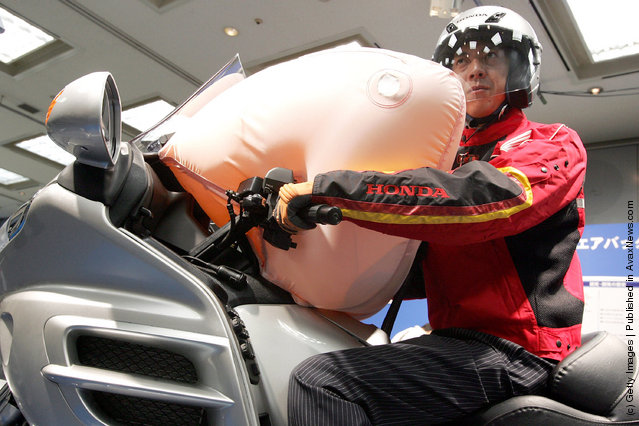
“The technology was designed to address the risk associated with head-on or nearly head-on motorcycle collisions, which account for a large percentage of motorcycle crashes. The airbag was designed to deploy during a severe frontal collision in which a rider could be thrown forward from the motorcycle. Once deployed, the airbag stands upright in front of the rider to help absorb the rider’s kinetic energy prior to leaving the motorcycle”. – Ohio.Honda.com

Photo: Honda Motor Co., Ltd.'s world's first production motorcycle airbag system is introduced at a press conference at Honda's HQ on September 8, 2005 in Tokyo, Japan. The motorcycle airbag system to be installed to lessen the injuries of the rider is comprised of the airbag module that include the airbag and the inflator, crash sensors that monitor acceleration changes and an ECU that performs calculation to determine when a collision is occuring. (Photo by Junko Kimura/Getty Images)
Details
20 Jun 2011 14:29:00


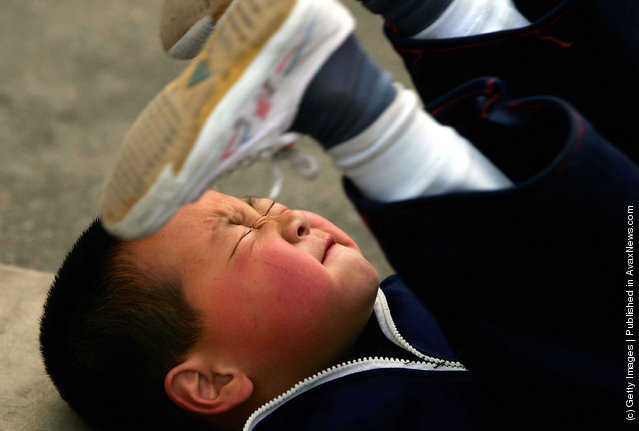
Wang Zeyu, 4, a fee-paying enthusiast of kung fu, practises during a training class at a kung fu school near the Shaolin Temple April 10, 2005 in Dengfeng, Henan Province, China. Zeyu's father sent him to the school from his home in Jiangsu Province, thousands kilometres away from Dengfeng, when he was just 3 years old. And his father must pay 9,800 yuan (US$1195) for one year's tuition at the school, a huge amount for most Chinese. There are more than 80 kung fu schools that line the road from the city of Dengfeng to the Shaolin Temple with hundreds and thousands of young kung-fu lovers from all over the country and beyond studying here. All the schools use the Shaolin name to attract students as the Shaolin Temple is the birthplace of Chinese Kung Fu. (Photo by Cancan Chu/Getty Images)
Details
06 Jul 2011 11:21:00
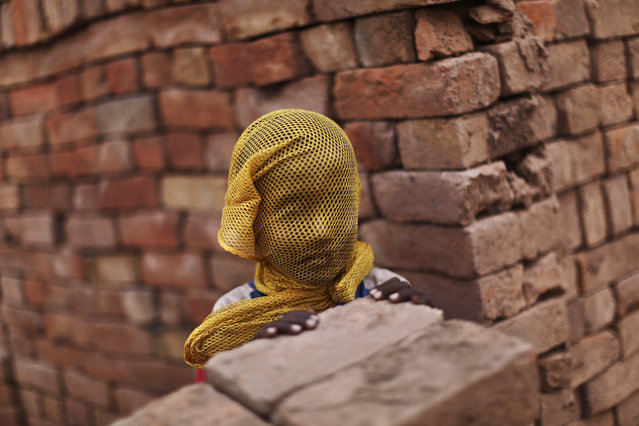
A Pakistani boy who lives near by a brick factory, covers his face with a scarf to avoid a sand storm, on the outskirts of Islamabad, Pakistan, Wednesday, June 6, 2012. (Photo by Muhammed Muheisen/AP Photo)

“Muhammed’s work has received many international awards, among others Breaking News Pulitzer Prize of 2005 for covering war in Iraq, POYI, Picture of the year 2007, of Saudi Arabia of the Annual Muslim pilgrimage, best Multimedia of the Annual Israeli photo contest of 2007, honorable mention Atlanta photojournalism seminar of 2008 and photo of the year of the Annual Israeli photo contest of 2008 with two first prizes and two second prizes in different categories, two prizes in the Atlanta photojournalism seminar of 2009, 6 prizes in the Annual Israeli photo contest of 2009”. – Associated Press
Details
11 Aug 2014 11:22:00
A year after hundreds of thousands of migrants and refugees snaked their way across southeastern Europe and onto television screens worldwide, the roads through the Balkans are now clear, depriving an arguably worsening tragedy of its poignant visibility. Europe's migrant crisis is at the very least numerically worse than it was last year. More people are arriving and more are dying. (Photo by Antonio Bronic/Reuters)

A year after hundreds of thousands of migrants and refugees snaked their way across southeastern Europe and onto television screens worldwide, the roads through the Balkans are now clear, depriving an arguably worsening tragedy of its poignant visibility. Reuters photographer, Antonio Bronic revisiting the people-packed locations where he and his colleagues captured last year's diaspora, found empty roads, unencumbered railway tracks and bucolic countryside. (Photo by Antonio Bronic/Reuters)


Details
12 Aug 2016 12:10:00
Anti-racist Loldiers of Odin clowns speak with police as they take to the streets against anti-immigration marchers in Tampere, Finland January 23, 2016. Police prevented the groups from confronting each other. On the northern fringes of Europe, Finland has little history of welcoming large numbers of refugees, unlike neighbouring Sweden. But as with other European countries, it is now struggling with a huge increase in asylum seekers and the authorities are wary of any anti-immigrant vigilantism. (Photo by Kalle Parkkinen/Reuters/Lehtikuva)

Anti-racist Loldiers of Odin clowns speak with police as they take to the streets against anti-immigration marchers in Tampere, Finland January 23, 2016. Police prevented the groups from confronting each other. On the northern fringes of Europe, Finland has little history of welcoming large numbers of refugees, unlike neighbouring Sweden. But as with other European countries, it is now struggling with a huge increase in asylum seekers and the authorities are wary of any anti-immigrant vigilantism. (Photo by Kalle Parkkinen/Reuters/Lehtikuva)
Details
24 Jan 2016 15:49:00
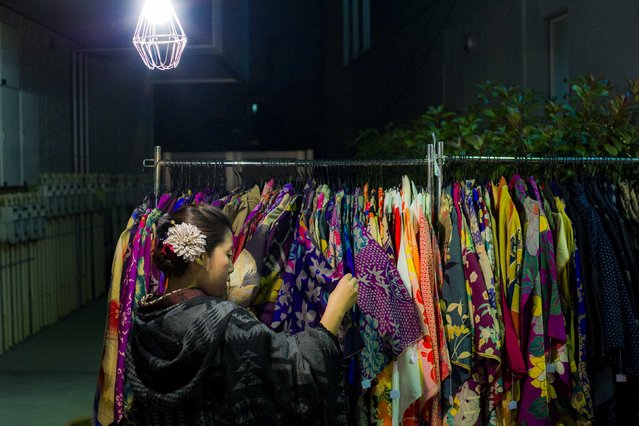
A woman browses through kimonos for sale at Boroichi flea market in Tokyo December 15, 2014. In the 16th century, Boroichi was a place for farmers to buy and sell rags, known as boro, for mending clothes and weaving sandals. Now in its 436th year, the original spirit lingers, with about 700 stands hawking fabric, used clothes and piles of rags. Others sell kitchen tools, pottery, seaweed and spices. (Photo by Thomas Peter/Reuters)

A woman browses through kimonos for sale at Boroichi flea market in Tokyo December 15, 2014. In the 16th century, Boroichi was a place for farmers to buy and sell rags, known as boro, for mending clothes and weaving sandals. Now in its 436th year, the original spirit lingers, with about 700 stands hawking fabric, used clothes and piles of rags. Others sell kitchen tools, pottery, seaweed and spices. About 200,000 people flock to the market, which is only open for four mid-winter days a year – two in December and two in January. (Photo by Thomas Peter/Reuters)
Details
19 Dec 2014 12:50:00
In this June 20, 2014, file photo, lobsters are processed at the Sea Hag Seafood plant in St. George, Maine. More and more American and Canadian-caught lobsters have been turning up at fancy restaurants in China, marketed as “Boston lobster”, say Maine-based processors. One processing firm owner says it's now the biggest live lobster important day of the year after Christmas in Europe. (Photo by Robert F. Bukaty/AP Photo)

In this June 20, 2014, file photo, lobsters are processed at the Sea Hag Seafood plant in St. George, Maine. More and more American and Canadian-caught lobsters have been turning up at fancy restaurants in China, marketed as “Boston lobster”, say Maine-based processors. One processing firm owner says it's now the biggest live lobster important day of the year after Christmas in Europe. (Photo by Robert F. Bukaty/AP Photo)
Details
18 Feb 2015 13:11:00