Loading...
Done
Grumpy Cat in Las Vegas, America on August 5, 2014. Grumpy Cat aka Tardar Sauce has died  on May 14, 2019 at home in Arizona at the age of seven due to complications from a urinary tract infection. Her family's statement said: “Besides being our baby and a cherished member of the family, Grumpy Cat has helped millions of people smile all around the world - even when times were tough. Her spirit will continue to live on through her fans everywhere. Grumpy's Family – Tabatha, Bryan and Chyrstal”. (Photo by Mediapunch/Shutterstock)

Grumpy Cat in Las Vegas, America on August 5, 2014. Grumpy Cat aka Tardar Sauce has died on May 14, 2019 at home in Arizona at the age of seven due to complications from a urinary tract infection. Her family's statement said: “Besides being our baby and a cherished member of the family, Grumpy Cat has helped millions of people smile all around the world – even when times were tough. Her spirit will continue to live on through her fans everywhere. Grumpy's Family – Tabatha, Bryan and Chyrstal”. (Photo by Mediapunch/Shutterstock)
Details
19 May 2019 00:03:00
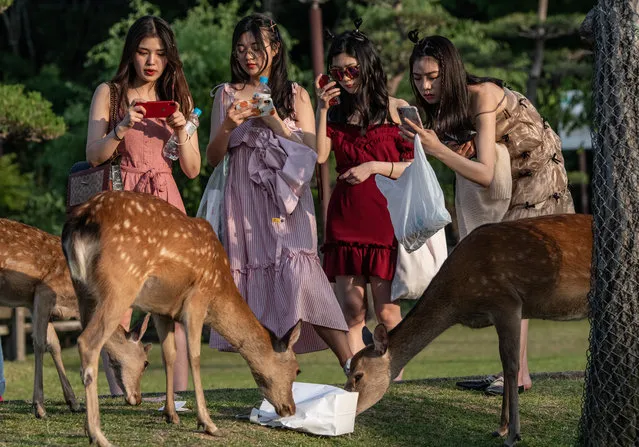
Tourists take photographs as a wild sika deer eats a bag on June 6, 2019 in Nara, Japan. Nara's free-roaming deer have become a huge attraction for tourists. However, an autopsy on a deer that was recently found dead near one of the city's famous temples discovered 3.2kg of plastic in its stomach and caused concern at the effect of tourism as Japan struggles to cope with a huge increase in domestic and international tourists. Alongside a growing Japanese tendency to holiday domestically, a record 31 million people visited the country in 2018 up 8.7 percent from the previous year, with many people now worrying about the environmental impact caused by such large visitor numbers. (Photo by Carl Court/Getty Images)

Tourists take photographs as a wild sika deer eats a bag on June 6, 2019 in Nara, Japan. Nara's free-roaming deer have become a huge attraction for tourists. However, an autopsy on a deer that was recently found dead near one of the city's famous temples discovered 3.2kg of plastic in its stomach and caused concern at the effect of tourism as Japan struggles to cope with a huge increase in domestic and international tourists. (Photo by Carl Court/Getty Images)
Details
19 Jun 2019 00:03:00
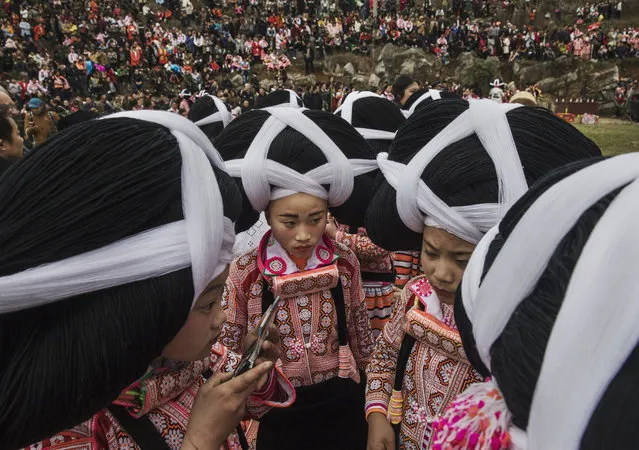
Girls of the Long Horn Miao ethnic minority group wear headdresses as they prepare gather for Tiaohua or Flower Festival as part of the Lunar New Year on February 6, 2017 in Longga village, Guizhou province, southern China. The Long Horn Miao are recognized for their declining practice of wrapping a blend of linen, wool, and the hair of their ancestors around animal horns or a wooden clip to make headdresses. Many young women say they now wear the headdresses only for special occasions and festivals, as the ornaments, which are attached by the horns to their real hair, have proved impractical for modern daily life in a fast changing world. China officially recognizes 56 different ethnic minorities, and statistics show over 7 million Chinese identifying themselves as Miao. But the small Long Horn Miao community counts only around 5000 people living in 12 villages, whose age-old traditions, language, and culture are fading. It is increasingly difficult in a modernizing China, as young people are drawn from remote rural villages to opportunities in bigger cities amongst wide-scale urbanization. Farming and labour remain the mainstays of life for the Long Horn Miao, leaving the area relatively poor in comparison with many parts of China. The government has invested significant amounts into local infrastructure and the tourism industry to try to bolster the local economy. (Photo by Kevin Frayer/Getty Images)

Girls of the Long Horn Miao ethnic minority group wear headdresses as they prepare gather for Tiaohua or Flower Festival as part of the Lunar New Year on February 6, 2017 in Longga village, Guizhou province, southern China. (Photo by Kevin Frayer/Getty Images)
Details
13 Feb 2017 00:01:00
Eryn, owned by Tom Chudleigh in Canada. New global research has revealed that ‘shed-scapism’ is sweeping the world with more people than ever ditching their tools and transforming their sheds into zen dens. The research comes as the Cuprinol Shed of the Year competition joins forces with aspirational shed fan site, Cabin p*rn, to launch the first ever global category. We have a stunning suite of imagery of 9 sheds from across the world - from Norway to Slovenia, British Colombia to Colorado who have all submitted their sheds in the hopes of being crowned the first ever Global Shed of the Year. (Photo by Cuprinol/Rex Features/Shutterstock)

Eryn, owned by Tom Chudleigh in Canada. New global research has revealed that ‘shed-scapism’ is sweeping the world with more people than ever ditching their tools and transforming their sheds into zen dens. The research comes as the Cuprinol Shed of the Year competition joins forces with aspirational shed fan site, Cabin p*rn, to launch the first ever global category. We have a stunning suite of imagery of 9 sheds from across the world - from Norway to Slovenia, British Colombia to Colorado who have all submitted their sheds in the hopes of being crowned the first ever Global Shed of the Year. (Photo by Cuprinol/Rex Features/Shutterstock)
Details
15 Mar 2017 00:02:00
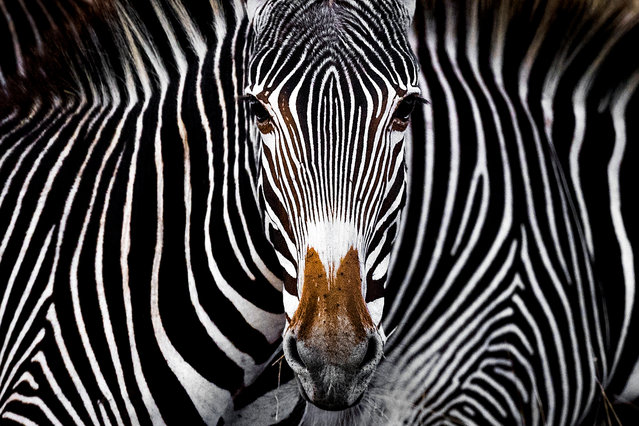
The Grevy’s Illusion by Yaron Schmid, USA: a Grevy’s zebra staring at the camera in Lewa, Kenya. Third place – wildlife. (Photo by Yaron Schmid/The Nature Conservancy Global Photo Contest 2019)

The Grevy’s Illusion by Yaron Schmid, USA: a Grevy’s zebra staring at the camera in Lewa, Kenya. Third place – wildlife. (Photo by Yaron Schmid/The Nature Conservancy Global Photo Contest 2019)
Details
24 Sep 2019 00:05:00
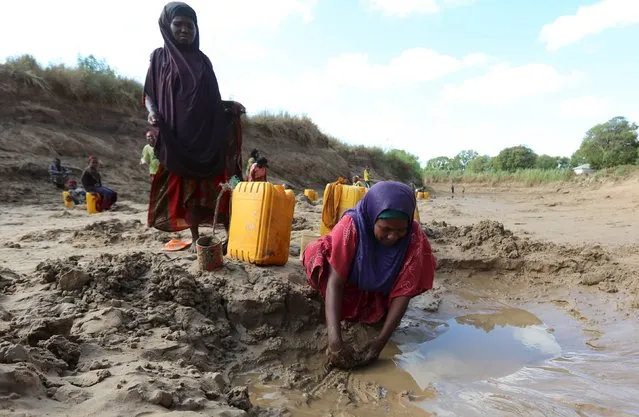
People collect water from shallow wells dug along the Shabelle River bed, which is dry due to drought in Somalia's Shabelle region, March 19, 2016. The cabinet ministers of the federal republic of Somalia have held on Thursday their weekly meeting in Mogadishu and discussed on the drought situation in parts of the country and its humanitarian consequences. Chaired by the acting PM and justice minister Abdullah Ahmed Jama (Ilka-Jir), the cabinet noted with deep concern the the prevailing situation in Somalia, with one of the worst ever drought in two decades. (Photo by Feisal Omar/Reuters)

People collect water from shallow wells dug along the Shabelle River bed, which is dry due to drought in Somalia's Shabelle region, March 19, 2016. The cabinet ministers of the federal republic of Somalia have held on Thursday their weekly meeting in Mogadishu and discussed on the drought situation in parts of the country and its humanitarian consequences. Chaired by the acting PM and justice minister Abdullah Ahmed Jama (Ilka-Jir), the cabinet noted with deep concern the the prevailing situation in Somalia, with one of the worst ever drought in two decades. (Photo by Feisal Omar/Reuters)
Details
20 Mar 2016 11:38:00
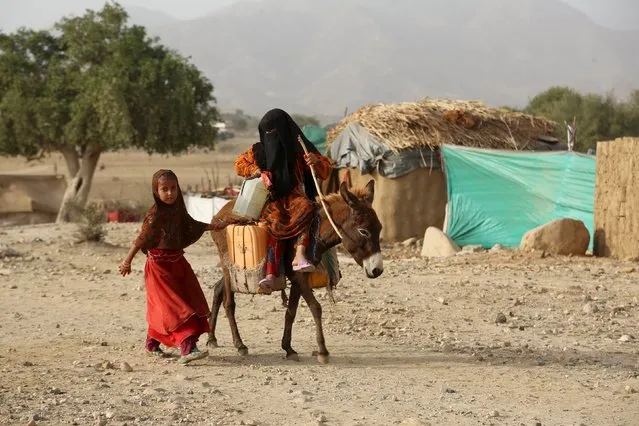
A girl rides a donkey as another walks by at the Shawqaba camp for internally displaced people who were forced to leave their villages by the war in Yemen's northwestern province of Hajjah March 12, 2016. In northwest Yemen, one of the poorest countries in the Middle East, about 400 families uprooted by the war have been stuck in the Shawqaba camp in Hajjah province for the past year. Residents live in poorly built huts that protect them neither from summer heat nor winter cold in a camp that lacks the most basic services. (Photo by Abduljabbar Zeyad/Reuters)

A girl rides a donkey as another walks by at the Shawqaba camp for internally displaced people who were forced to leave their villages by the war in Yemen's northwestern province of Hajjah March 12, 2016. In northwest Yemen, one of the poorest countries in the Middle East, about 400 families uprooted by the war have been stuck in the Shawqaba camp in Hajjah province for the past year. Residents live in poorly built huts that protect them neither from summer heat nor winter cold in a camp that lacks the most basic services. (Photo by Abduljabbar Zeyad/Reuters)
Details
09 Apr 2016 13:16:00
Kyaiktiyo, Burma, 1978. The Golden Rock at Shwe Pyi Daw (the Golden Country), the Buddhist holy place. Hiroji Kubota writes: “I was desperate to keep a distance from America for a while; luckily, I found Burma and its gentle and compassionate people. In the spring of 1978, on the top of the hill where I took this photo, I had two Leica bodies: the one with Tri-X and the other with Kodachrome 64. Soon after, I realised that the colour one looked very colourful and was more powerful. That was my decisive moment, to become a colour photographer”. (Photo by Hiroji Kubota/Magnum Photos)

Kyaiktiyo, Burma, 1978. The Golden Rock at Shwe Pyi Daw (the Golden Country), the Buddhist holy place. Hiroji Kubota writes: “I was desperate to keep a distance from America for a while; luckily, I found Burma and its gentle and compassionate people. In the spring of 1978, on the top of the hill where I took this photo, I had two Leica bodies: the one with Tri-X and the other with Kodachrome 64. Soon after, I realised that the colour one looked very colourful and was more powerful. That was my decisive moment, to become a colour photographer”. (Photo by Hiroji Kubota/Magnum Photos)
Details
10 Jun 2016 13:30:00