Loading...
Done
A winter swimming enthusiast dives into a partly frozen lake in a partly frozen lake in Shenyang, in northeastern China's Liaoning province on January 25, 2022. (Photo by AFP Photo/China Stringer Network)

A winter swimming enthusiast dives into a partly frozen lake in a partly frozen lake in Shenyang, in northeastern China's Liaoning province on January 25, 2022. (Photo by AFP Photo/China Stringer Network)
Details
31 Jan 2022 06:41:00
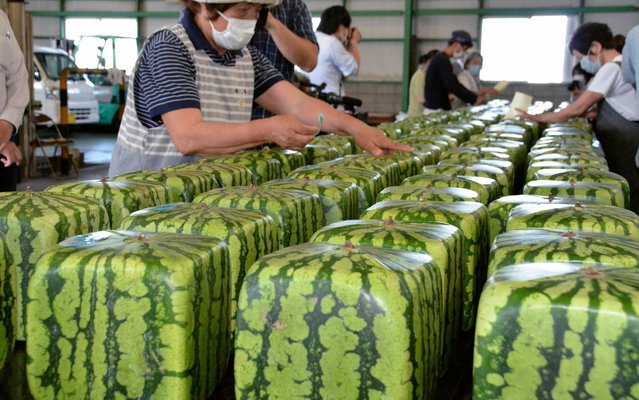
Japan Agricultural Cooperation Kagawa employees arrange cubic watermelons to be shipped within the country, in Zentsuji city, Kagawa prefecture, western Japan, Wednesday, June 24, 2020. The about 18x18x18-centimeter (7x7x7-inch) square watermelons, grown in transparent square containers, will be sold for about 10,000 yen ($94) each. (Photo ny Maiko Hirai/Kyodo News via AP Photo)

Japan Agricultural Cooperation Kagawa employees arrange cubic watermelons to be shipped within the country, in Zentsuji city, Kagawa prefecture, western Japan, Wednesday, June 24, 2020. The about 18x18x18-centimeter (7x7x7-inch) square watermelons, grown in transparent square containers, will be sold for about 10,000 yen ($94) each. (Photo ny Maiko Hirai/Kyodo News via AP Photo)
Details
08 Jul 2020 00:05:00
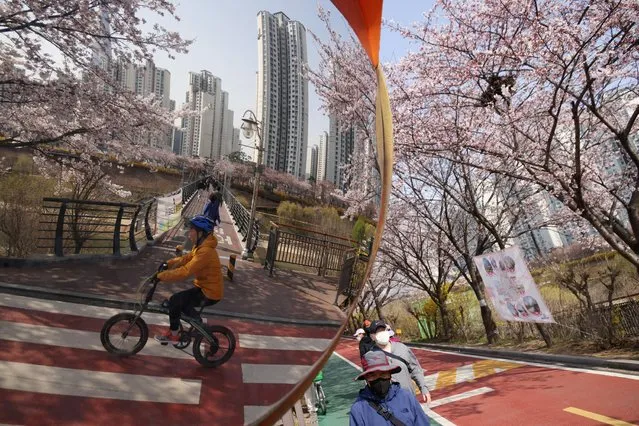
People take a walk among cherry blossoms at a park in Seoul, South Korea on April 6, 2022. (Photo by Kim Hong-Ji/Reuters)

People take a walk among cherry blossoms at a park in Seoul, South Korea on April 6, 2022. (Photo by Kim Hong-Ji/Reuters)
Details
29 Apr 2022 01:54:00
A cow covered with foam scavenges in the waste left on the banks of the polluted Yamuna river in New Delhi on October 10, 2020. (Photo by Sajjad Hussain/AFP Photo)

A cow covered with foam scavenges in the waste left on the banks of the polluted Yamuna river in New Delhi on October 10, 2020. (Photo by Sajjad Hussain/AFP Photo)
Details
21 Oct 2020 00:03:00
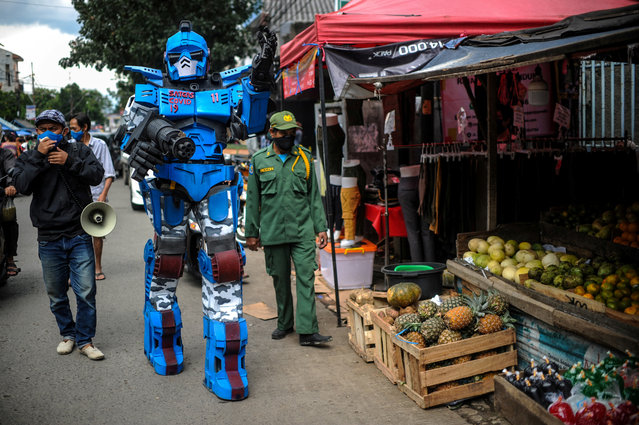
A man wearing a Transformers costume appeals to the citizens to stay at a home amid coronavirus disease (COVID-19) outbreak, in Bandung, West Java Province, Indonesia, May 4, 2020. (Photo by Raisan Al Farisi/Antara Foto via Reuters)

A man wearing a Transformers costume appeals to the citizens to stay at a home amid coronavirus disease (COVID-19) outbreak, in Bandung, West Java Province, Indonesia, May 4, 2020. (Photo by Raisan Al Farisi/Antara Foto via Reuters)
Details
16 May 2020 00:01:00
A person dressed as the mascot of Tokyo Tower wears a face shield while waiting to greet patrons at the entrance of the 332.9m (1,092ft.) high tower on May 28, 2020, as the city's landmark reopened following the lifting on May 25 of the state of emergency, imposed due to the COVID-19 novel coronavirus outbreak. (Photo by Philip Fong/AFP Photo)

A person dressed as the mascot of Tokyo Tower wears a face shield while waiting to greet patrons at the entrance of the 332.9m (1,092ft.) high tower on May 28, 2020, as the city's landmark reopened following the lifting on May 25 of the state of emergency, imposed due to the COVID-19 novel coronavirus outbreak. (Photo by Philip Fong/AFP Photo)
Details
19 Jun 2020 00:01:00
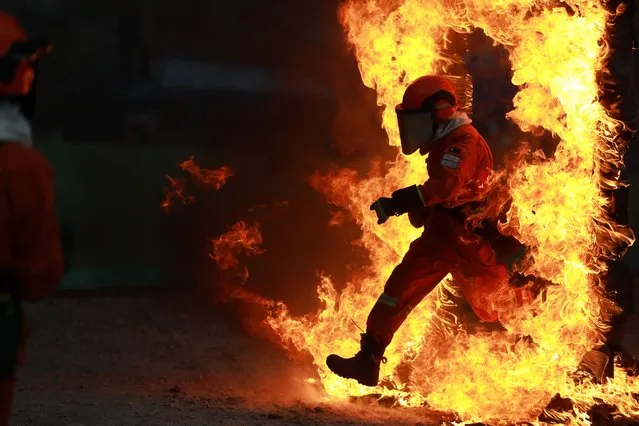
A firefighter passes through fire in a firefighting drill on December 7, 2021 in Aba Tibetan and Qiang Autonomous Prefecture, Sichuan Province of China. (Photo by Zeng Peng/VCG via Getty Images)

A firefighter passes through fire in a firefighting drill on December 7, 2021 in Aba Tibetan and Qiang Autonomous Prefecture, Sichuan Province of China. (Photo by Zeng Peng/VCG via Getty Images)
Details
08 Dec 2021 09:14:00
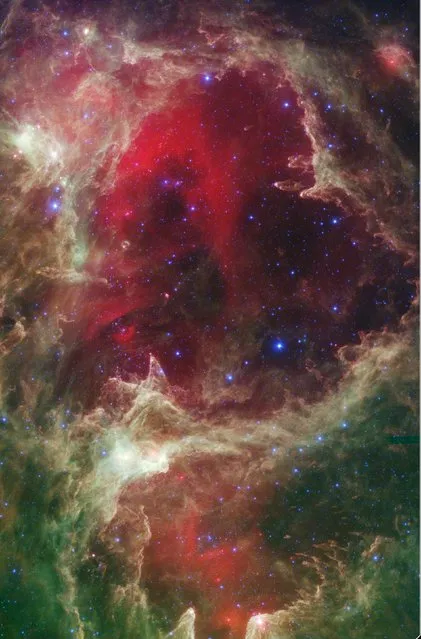
An infrared portrait from NASA's Spitzer Space Telescope which shows generations of stars is seen in this undated NASA handout image released February 14, 2013. In this wispy star-forming region, called W5, the oldest stars can be seen as blue dots in the centers of the two hollow cavities (other blue dots are background and foreground stars not associated with the region). Red shows heated dust that pervades the region's cavities, while green highlights dense clouds. (Photo by NASA/Reuters/JPL-Caltech/Harvard-Smithsonian/Handout)

An infrared portrait from NASA's Spitzer Space Telescope which shows generations of stars is seen in this undated NASA handout image released February 14, 2013. In this wispy star-forming region, called W5, the oldest stars can be seen as blue dots in the centers of the two hollow cavities (other blue dots are background and foreground stars not associated with the region). Red shows heated dust that pervades the region's cavities, while green highlights dense clouds. (Photo by NASA/Reuters/JPL-Caltech/Harvard-Smithsonian/Handout)
Details
03 Mar 2013 08:44:00