Loading...
Done
Children dressed in festival costume sit on the huge paper doll of historical Japanese figure named Hashi-Benkeii on the carts during the Mikuini annual festival on May 20, 2014 in Sakai, Japan. The annual festival takes place from May 19-21 and is attended by thousands of visitors. During the festival people dressed in traditional Japanese costumes pull carts carrying 6 meter high dolls of Japanese historical figures through the narrow streets. The origins of the festival are unclear but its history can be traced back more than 250 years. (Photo by Buddhika Weerasinghe/Getty Images)

Children dressed in festival costume sit on the huge paper doll of historical Japanese figure named Hashi-Benkeii on the carts during the Mikuini annual festival on May 20, 2014 in Sakai, Japan. The annual festival takes place from May 19-21 and is attended by thousands of visitors. During the festival people dressed in traditional Japanese costumes pull carts carrying 6 meter high dolls of Japanese historical figures through the narrow streets. The origins of the festival are unclear but its history can be traced back more than 250 years. (Photo by Buddhika Weerasinghe/Getty Images)
Details
21 May 2014 08:49:00
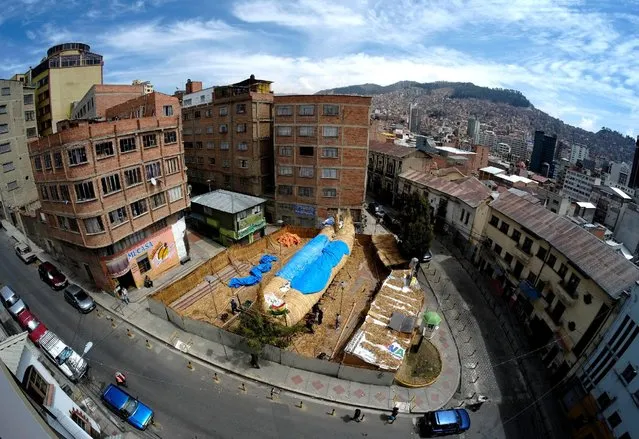
Aerial view of the “Viracocha III”, a boat made only from the totora reed, as it is being prepared to cross the Pacific from Chile to Australia on an expected six-month journey, La Paz, Bolivia, October 19, 2016. An expedition in a boat made only of reeds crafted by indigenous Bolivians is getting ready to cross the Pacific from South America to Australia, in a fresh attempt to prove that ancient mariners were capable of making the journey. Phil Buck, a 51-year-old explorer from the United States, already has led two similar expeditions and will captain the “Viracocha III” set to depart from northern Chile in February on an expected six-month journey. (Photo by David Mercado/Reuters)

Aerial view of the “Viracocha III”, a boat made only from the totora reed, as it is being prepared to cross the Pacific from Chile to Australia on an expected six-month journey, La Paz, Bolivia, October 19, 2016. An expedition in a boat made only of reeds crafted by indigenous Bolivians is getting ready to cross the Pacific from South America to Australia, in a fresh attempt to prove that ancient mariners were capable of making the journey. (Photo by David Mercado/Reuters)
Details
20 Oct 2016 10:53:00
An Armenian serviceman fires a cannon towards Azerbaijan positions in the self-proclaimed Republic of Nagorno-Karabakh, Azerbaijan, Tuesday, September 29, 2020. (Photo by Sipan Gyulumyan/Armenian Defense Ministry Press Service/PAN Photo via AP Photo)

An Armenian serviceman fires a cannon towards Azerbaijan positions in the self-proclaimed Republic of Nagorno-Karabakh, Azerbaijan, Tuesday, September 29, 2020. (Photo by Sipan Gyulumyan/Armenian Defense Ministry Press Service/PAN Photo via AP Photo)
Details
01 Oct 2020 00:07:00
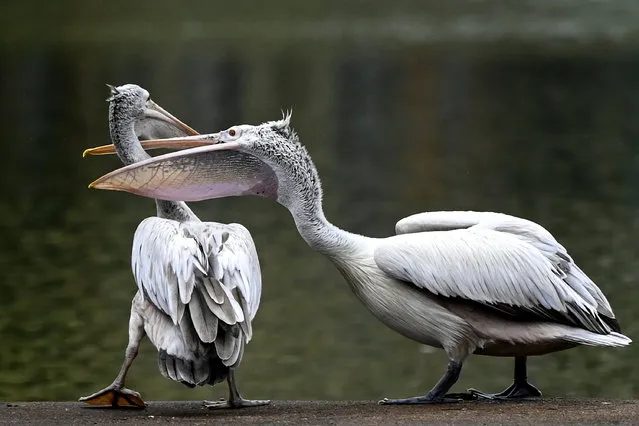
Spot-billed pelican interact on the banks of an artificial lake in Colombo on September 28, 2021. (Photo by Ishara S. Kodikara/AFP Photo)

Spot-billed pelican interact on the banks of an artificial lake in Colombo on September 28, 2021. (Photo by Ishara S. Kodikara/AFP Photo)
Details
11 Nov 2021 08:34:00
Two women react to the camera as Nightclub Circus hosts the first dance event, which will welcome 6,000 clubbers to the city's Bramley-Moore Dock warehouse on April 30, 2021 in Liverpool, England. The event is part of the national Events Research Programme which will provide data on how events could be permitted to safely reopen. (Photo by Anthony Devlin/Getty Images)

Two women react to the camera as Nightclub Circus hosts the first dance event, which will welcome 6,000 clubbers to the city's Bramley-Moore Dock warehouse on April 30, 2021 in Liverpool, England. The event is part of the national Events Research Programme which will provide data on how events could be permitted to safely reopen. (Photo by Anthony Devlin/Getty Images)
Details
01 May 2021 09:04:00
A girl poses in antlers ahead of a curfew on pub in Nottingham, a city in central England’s Midlands region on September 21, 2020 as Freshers' Week got underway. Revellers were also pictured out in Birmingham, which was plunged into a local lockdown amid a surge in coronavirus cases. (Photo by Ashley Kirk/The Sun)

A girl poses in antlers ahead of a curfew on pub in Nottingham, a city in central England’s Midlands region on September 21, 2020 as Freshers' Week got underway. Revellers were also pictured out in Birmingham, which was plunged into a local lockdown amid a surge in coronavirus cases. (Photo by Ashley Kirk/The Sun)
Details
07 Feb 2021 07:35:00
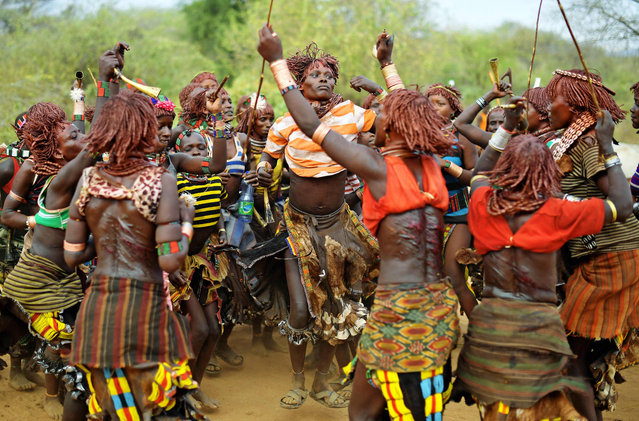
Hamar women dance before a bull jumping ceremony in Ethiopia's southern Omo Valley region near Turmi on September 19, 2016. The Hamar are a Nilotic ethnic group in Ethiopia. The construction of the Gibe III dam, the third largest hydroelectric plant in Africa, and large areas of very “thirsty” cotton and sugar plantations and factories along the Omo river are impacting heavily on the lives of tribes living in the Omo Valley who depend on the river for their survival and way of life. Human rights groups fear for the future of the tribes if they are forced to scatter, give up traditional ways through loss of land or ability to keep cattle as globalisation and development increases. (Photo by Carl De Souza/AFP Photo)

Hamar women dance before a bull jumping ceremony in Ethiopia's southern Omo Valley region near Turmi on September 19, 2016. The Hamar are a Nilotic ethnic group in Ethiopia. The construction of the Gibe III dam, the third largest hydroelectric plant in Africa, and large areas of very “thirsty” cotton and sugar plantations and factories along the Omo river are impacting heavily on the lives of tribes living in the Omo Valley who depend on the river for their survival and way of life. (Photo by Carl De Souza/AFP Photo)
Details
02 Oct 2016 08:45:00
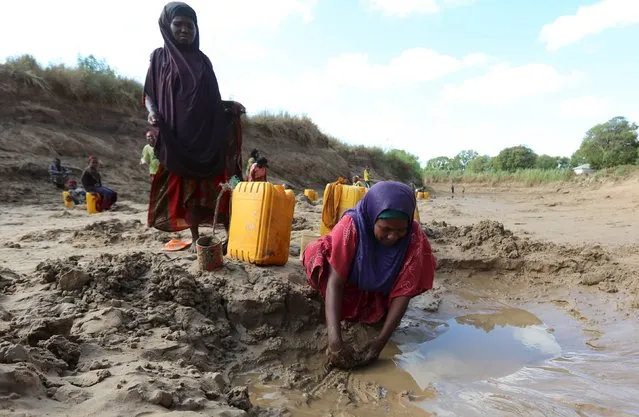
People collect water from shallow wells dug along the Shabelle River bed, which is dry due to drought in Somalia's Shabelle region, March 19, 2016. The cabinet ministers of the federal republic of Somalia have held on Thursday their weekly meeting in Mogadishu and discussed on the drought situation in parts of the country and its humanitarian consequences. Chaired by the acting PM and justice minister Abdullah Ahmed Jama (Ilka-Jir), the cabinet noted with deep concern the the prevailing situation in Somalia, with one of the worst ever drought in two decades. (Photo by Feisal Omar/Reuters)

People collect water from shallow wells dug along the Shabelle River bed, which is dry due to drought in Somalia's Shabelle region, March 19, 2016. The cabinet ministers of the federal republic of Somalia have held on Thursday their weekly meeting in Mogadishu and discussed on the drought situation in parts of the country and its humanitarian consequences. Chaired by the acting PM and justice minister Abdullah Ahmed Jama (Ilka-Jir), the cabinet noted with deep concern the the prevailing situation in Somalia, with one of the worst ever drought in two decades. (Photo by Feisal Omar/Reuters)
Details
20 Mar 2016 11:38:00