Loading...
Done
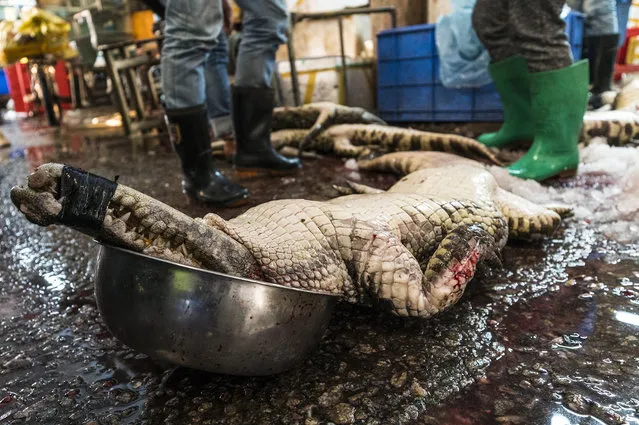
A dead crocodile is seen on Huangsha Seafood Market in Guangzhou, Guandong Province, China, 22 January 2018. Tsukiji Market of China or Huangsha Seafood Market is biggest one in Southern China and one of the biggest in China, as there are literally hundreds of different varieties of fish and seafood scattered throughout the market. Since the proximity of the fish market is so close to the Zhujiang River, it's quite easy for the large fishing vessels and fishermen to unload their fresh catch right at the market, which ensures that the fish and seafood remain fresh. Fish and other seafood are coming there from all around the globe. Seafood Market is full of different kinds of live fish, live shellfish, and live seafood on display in crystal clear tanks and it's common to see 5-star chefs, retailers and expats to source for fresh and high-quality seafood supplies for reasonable prices. While it is a wholesale fish market, since many Guangzhou restaurants and businesses come to purchase their seafood here, the public is welcome to come and even purchase. Many local Chinese have the vendors slice up fresh salmon fillets to take home or carry seafood into one of the nearby specialty restaurants, where they will cook if for them and serve it with vegetables and other side dishes of their choice. One of the biggest attractions for both, tourists and buyers, on market are crocodiles, which are brought there alive in wooden cases with taped jaws so they can?t accidentally bite. They are from crocodile farms from Guangdong, China and from Vietnam. Crocodile meat is popular in most Asian countries and it is consider as delicate one. Crocodiles weight from 10 to 25 kg and bigger ones are about 2 years old. They cost about 70 RMB (8.90 EURO) when bout as whole, or if you buy as parts most expensive and appreciated parts are paws 120 RMB (15.26 EURO) per kg, and tail 100 RMB (12.72 EURO) per kg. (Photo by Aleksandar Plavevski/EPA/EFE)

A dead crocodile is seen on Huangsha Seafood Market in Guangzhou, Guandong Province, China, 22 January 2018. Tsukiji Market of China or Huangsha Seafood Market is biggest one in Southern China and one of the biggest in China, as there are literally hundreds of different varieties of fish and seafood scattered throughout the market. (Photo by Aleksandar Plavevski/EPA/EFE)
Details
17 Apr 2020 00:05:00
Guilty Crown ギルティクラウン 罪惡王冠 楪 祈 いのり ゆずりは Inori

Japanese Cosplay Photoshoot, taken on August 2-6, 2012. Photo: Guilty Crown ギルティクラウン 罪惡王冠 楪 祈 いのり ゆずりは Inori. (Photo by EE Fai)
Details
11 Aug 2012 11:37:00
Self-portrait. (Photo by Flowertrip)

Self-portrait. (Photo by Flowertrip)
Details
15 Aug 2012 02:38:00


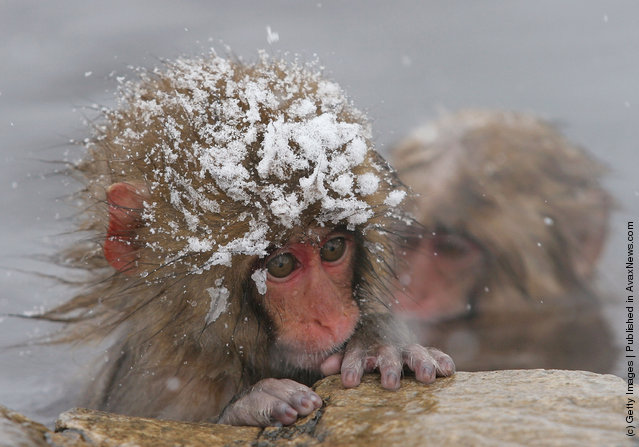
Japanese macaque monkeys enjoy sitting in the hot springs at Jigokudani-Onsen (Hell Valley) on January 23, 2005 in Jigokudani, Nagano-Prefecture, Japan. Japanese Macaques, also known as snow monkeys are the most northerly nonhuman primate in the world. In 1963 a female Macaque ventured into the hot springs to retrieve some soybeans. This behaviour was adopted by other monkeys, and eventually by the entire troop. This Macaque troop regularly visits the Jigokudani-Onsen springs to escape the cold. The hot springs are said to help relieve nerve pain and fatigue. (Photo by Koichi Kamoshida/Getty Images)
Details
20 May 2011 08:04:00
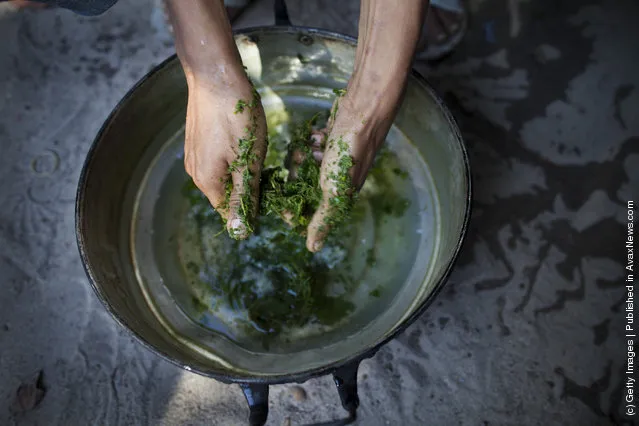
Thai drug user mixes the popular cheap narcotic drink

A Thai drug user mixes the popular cheap narcotic drink as it is cooked over a fire on September 1, 2011 in Narwathiwat, southern Thailand. (Photo by Paula Bronstein/Getty Images)
Details
04 Sep 2011 13:18:00
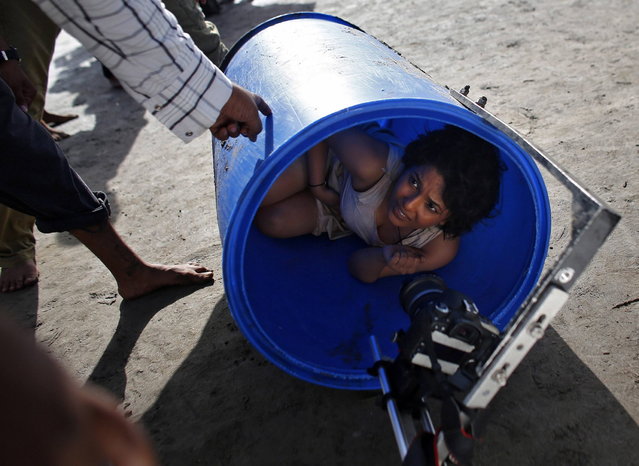
Bollywood actress Chitrashi Rawat lies in a plastic drum as she is briefed by a crew member during the shoot for the film “Black Home” at a beach on the outskirts of Mumbai April 26, 2013. (Photo by Danish Siddiqui/Reuters)

Bollywood actress Chitrashi Rawat lies in a plastic drum as she is briefed by a crew member during the shoot for the film “Black Home” at a beach on the outskirts of Mumbai April 26, 2013. (Photo by Danish Siddiqui/Reuters)
Details
08 May 2013 03:17:00
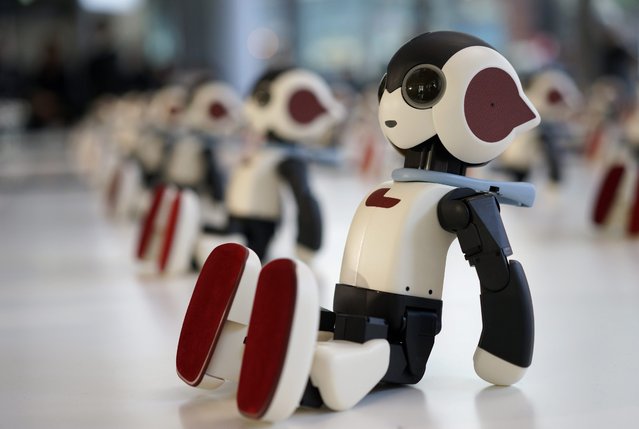
A humanoid robot named “Robi” sits during a promotional event for the launch of a weekly Robi Magazine in Tokyo, Japan, 20 January 2015. Created by roboticist Tomotaka Takahashi, the 34-centimeter tall humanoid robot can recognize and respond to more than 200 words and phrases, walk and dance. (Photo by Franck Robichon/EPA)

A humanoid robot named “Robi” sits during a promotional event for the launch of a weekly Robi Magazine in Tokyo, Japan, 20 January 2015. Created by roboticist Tomotaka Takahashi, the 34-centimeter tall humanoid robot can recognize and respond to more than 200 words and phrases, walk and dance. Parts of the robot will be put on sale in a weekly magazine to be fully assembled with 70 issues. (Photo by Franck Robichon/EPA)
Details
21 Jan 2015 13:19:00


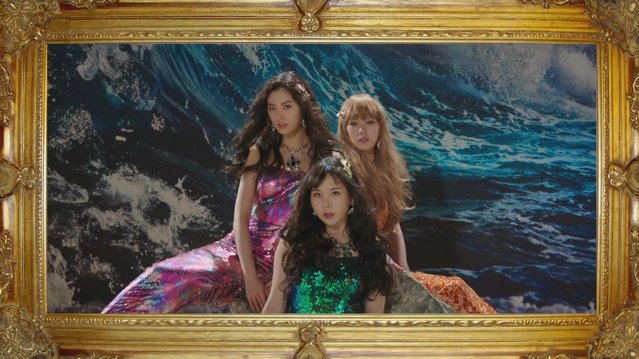
Orange Caramel (오렌지 캬라멜) – 까탈레나 (Catallena) – Korean. Is it worth eating live beings? This is a philosophical question: the history of our species and the ontology of being are saying that it's more likely yes, and on the other hand your mind and empathy are more likely to be against this idea. Or at least like in this Korean clip – eat, but with tears in your eyes.
Details
12 Sep 2017 09:18:00