Loading...
Done
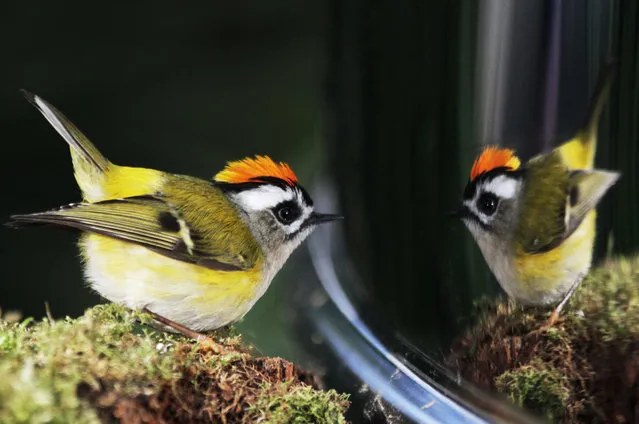
Golden-Crowned Kinglet

Golden-crowned Kinglets boldly bear their flashy lemon-yellow crest and a black eyebrow stripe. Taking a good look at them might be rather challenging, since they spend most of their time in the dense fir foliage or spruce. However, if you’re patient enough to find them, listen for their shrill, thin song. Though these “little Kings” are only a tad bit larger than a hummingbird, they can survive easily extreme cold by huddling close together. They breed in montane west and the far north and only visit North America during winter.
Details
21 Jan 2015 13:20:00
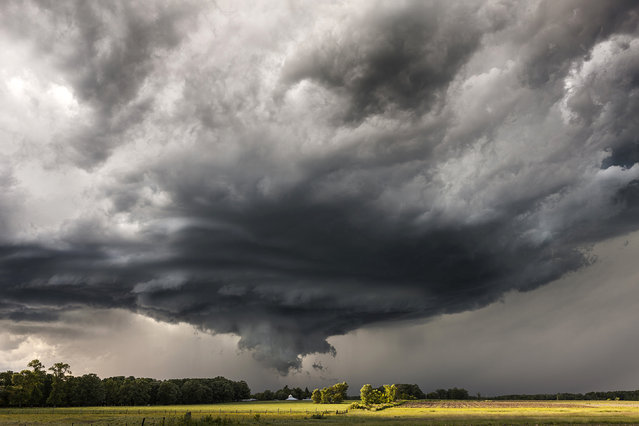
Supercell in Minnesota, near Browerville, Minnesota in 2014. (Photo by Camille Seaman/Caters News)

These stunning images show the phwoar-some power of some of Americas most extreme weather. Camille Seaman’s wondrous work features huge super cells, crashing lightning and gale-force winds. The roaming photographer has chased storms across the US from Iowa to Wyoming and from Minnesota to Texas. Her favorite places to chase are Kansas, Nebraska and South Dakota – notorious hotspots for spectacular storms. Here: Supercell in Minnesota, near Browerville, Minnesota in 2014. (Photo by Camille Seaman/Caters News)
Details
26 Jan 2015 12:10:00
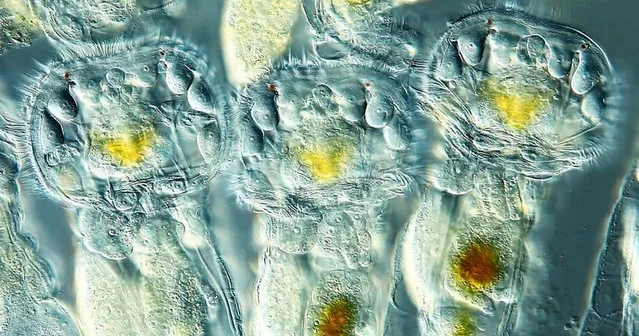
Olympus BioScapes Digital Imaging Competition 2012

Microscope images forge an extraordinary bond between science and art, said Hidenao Tsuchiya, Olympus America's Vice President and General Manager for the Scientific Equipment Group. We founded this competition to focus on the fascinating stories coming out of today's life science research laboratories. The thousands of images that people have shared with the competition over the years reflect some of the most exciting work going on in research today – work that can help shed light on the living universe and ultimately save lives. We look at BioScapes and these beautiful images as sources of education and inspiration to us and the world
Details
23 Dec 2012 15:57:00
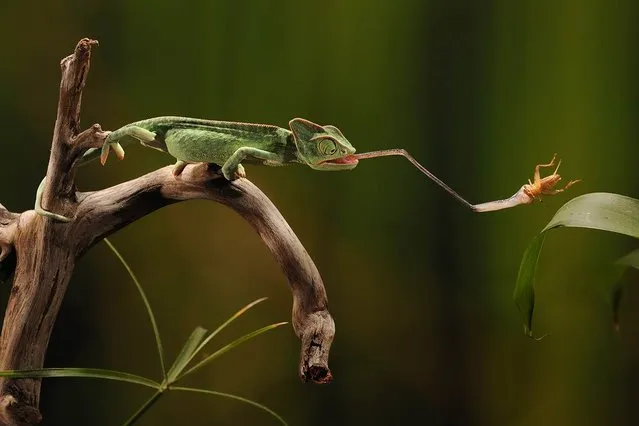
A veiled chameleon extends its tongue to catch a cricket

“Scott Linstead is an internationally published, freelance wildlife photographer/writer. His clients include Natural History Magazine, Hewlett Packard, Ranger Rick Magazine and a number of wildlife publications in North America and Europe. Scott's column on the techniques of bird photography appears in every issue of Outdoor Photography Canada”.

Photo: A veiled chameleon extends its tongue to catch a cricket. Canadian wildlife photographer Scott Linstead, formerly an aerospace engineer and high school teacher, uses a device called Phototrap “to not only photograph the elusive, but also the unimaginably quick”. (Photo by Scott Linstead)
Details
22 May 2012 11:32:00
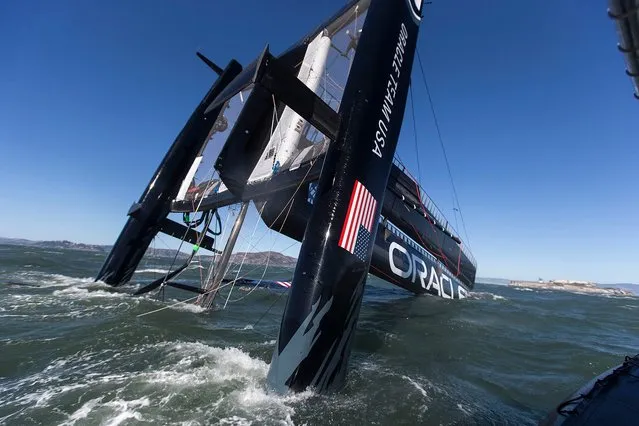
Oracle Team USA Capsizes Its Biggest, Baddest Boat

In this photo taken October 16, 2012 and provided by Oracle Team USA, crew members of the capsized Oracle Team USA AC72 boat are rescued after being swept past the Golden Gate Bridge in San Francisco. The America's Cup champion syndicate is assessing the damage to its 72-foot catamaran, after it capsized and was swept by a strong current more than four miles past the Golden Gate Bridge before rescue boats could control it. (Photo by Guilain Grenier/Oracle Team USA/Associated Press)
Details
18 Oct 2012 09:11:00
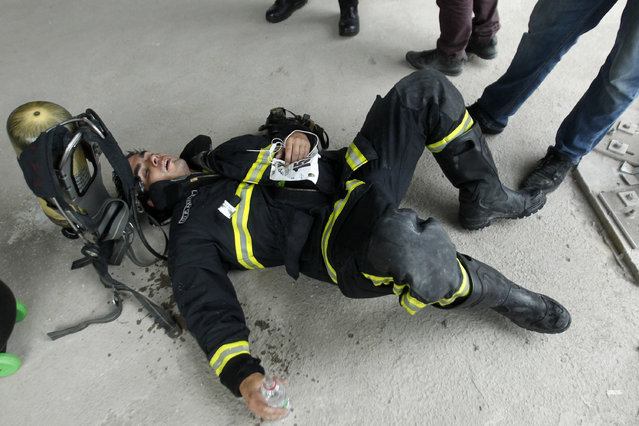
A firefighter recovers after climbing the 1800 steps of the Costanera Centre Tower as part of the “Race for Life” aimed at encouraging organ donation in Chile, in Santiago, on October 16, 2016. (Photo by Claudio Reyes/AFP Photo)

A firefighter recovers after climbing the 1800 steps of the Costanera Centre Tower as part of the “Race for Life” aimed at encouraging organ donation in Chile, in Santiago, on October 16, 2016. More than 500 volunteer firefighters are expected to climb the 1800 steps of the tallest building in South America to promote and encourage organ donation in the country. (Photo by Claudio Reyes/AFP Photo)
Details
26 Oct 2016 10:46:00


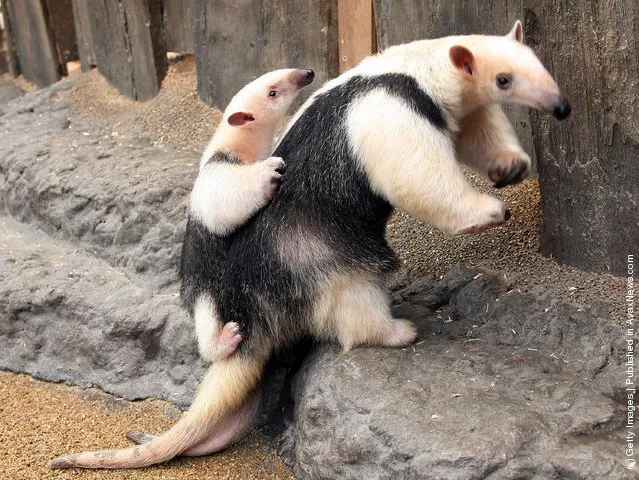
“The Southern Tamandua, Collared Anteater or Lesser Anteater (Tamandua tetradactyla) is a species of anteater from South America. It is a solitary animal, found in many habitats from mature to highly disturbed secondary forests and arid savannas. It feeds on ants, termites and bees. It has very strong foreclaws that can be used to break insect nests or to defend itself”. – Wikipedia

Photo: A three-month-old baby Southern Tamandua “Konbu” lies on its mother Tae's back at Sunshine International Aquarium on July 7, 2009 in Tokyo, Japan. Baby Southern Tamandua feels safe and comfortable holding onto something and normally stays on the mother's back until around 3 months old. (Photo by Junko Kimura/Getty Images)
Details
19 May 2011 10:31:00


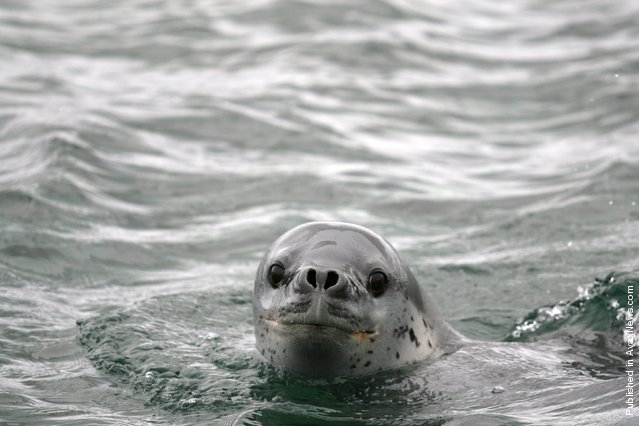
“The leopard seal (Hydrurga leptonyx), also referred to as the sea leopard, is the second largest species of seal in the Antarctic (after the southern elephant seal). It is most common in the southern hemisphere along the coast of Antarctica and on most sub-Antarctic islands, but can also be found on the coasts of southern Australia, Tasmania, South Africa, New Zealand, Lord Howe Island, Tierra del Fuego, the Cook Islands, and the Atlantic coast of South America. It can live twenty-six years, possibly more. Orcas and large sharks are the only natural predators of leopard seals”. – Wikipedia

Photo by: Gilad Rom; Source: Flickr
Details
13 Nov 2011 11:24:00