Loading...
Done
The Taipei first girls high school marching band perform at the 134th rose parade in Pasadena, California on January 2, 2023. (Photo by Michael Owen Baker/AP Photo)

The Taipei first girls high school marching band perform at the 134th rose parade in Pasadena, California on January 2, 2023. (Photo by Michael Owen Baker/AP Photo)
Details
12 Jan 2023 01:12:00
The night view of the National Assembly Building and Yeouido in Yeongdeungpo District, Seoul taken on the December 27, 2024. The lights shine in a cross shape thanks to the cross filter used. (Photo by Koh Woon-ho)

The night view of the National Assembly Building and Yeouido in Yeongdeungpo District, Seoul taken on the December 27, 2024. The lights shine in a cross shape thanks to the cross filter used. (Photo by Koh Woon-ho)
Details
14 Jan 2025 05:26:00
A harp seal pup

“The harp seal or saddleback seal is a species of earless seal native to the northernmost Atlantic Ocean and adjacent parts of the Arctic Ocean. Newborn pups weigh around 11 kilograms (24 lb) and are 80–85 centimetres (31–33 in) long. After birth, the mother only feeds that pup. During the 12 day nursing period, the mother does not eat, losing up to 3 kilograms (7 lb) per day. Harp seal milk contains up to 48% fat, so pups gain over 2.2 kilograms (4.9 lb) per day. During this time, the juvenile's “greycoat” grows in beneath the white neonatal coat, and it weighs 80 pounds (36 kg)”. – Wikipedia

Photo: A harp seal pup lies on an ice floe in the Gulf of Saint Lawrence March 24, 2008 in Charlottetown, Canada. (Photo by Joe Raedle/Getty Images)
Details
19 Sep 2011 15:49:00
Bonobo apes, primates unique to Congo and humankind's closest relative, groom one another at a sanctuary just outside the capital Kinshasa, Congo on October 31, 2006. (Photo by Finbarr O'Reilly/Reuters)

Bonobo apes, primates unique to Congo and humankind's closest relative, groom one another at a sanctuary just outside the capital Kinshasa, Congo on October 31, 2006. (Photo by Finbarr O'Reilly/Reuters)
Details
08 Feb 2017 00:01:00
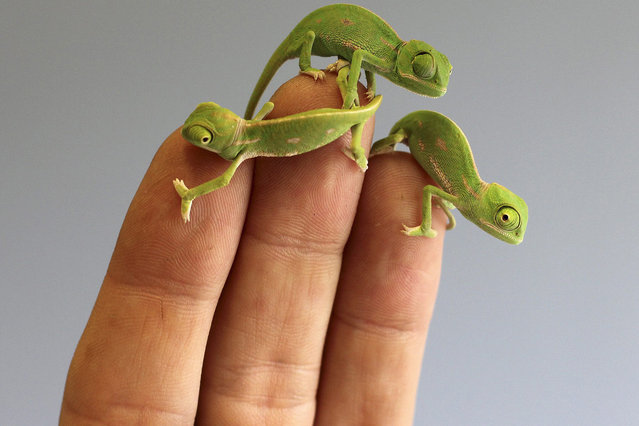
A handout image released by the Taronga Zoo shows Veiled Chameleon hatchlings at Taronga Zoo in Sydney, Australia, 11 March 2015. Taronga has welcomed more than 20 baby chameleons, with the last of three clutches of eggs hatching this week. Veiled Chameleons, or Chamaeleo calyptratus, are native to Saudi Arabia and Yemen and can live up to five years. (Photo by EPA/Taronga Zoo)

A handout image released by the Taronga Zoo shows Veiled Chameleon hatchlings at Taronga Zoo in Sydney, Australia, 11 March 2015. Taronga has welcomed more than 20 baby chameleons, with the last of three clutches of eggs hatching this week. Veiled Chameleons, or Chamaeleo calyptratus, are native to Saudi Arabia and Yemen and can live up to five years. (Photo by EPA/Taronga Zoo)
Details
21 Mar 2015 13:13:00
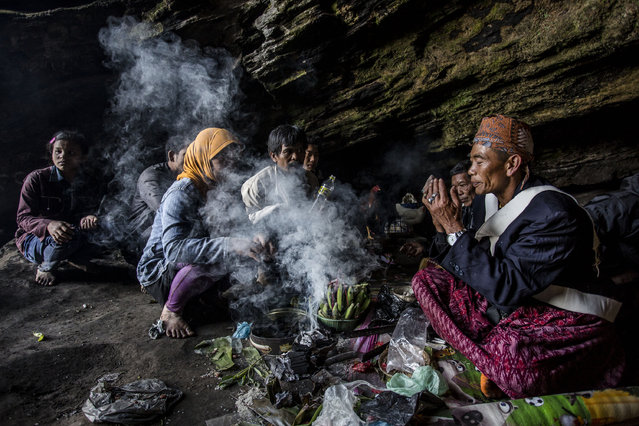
A Tenggerese shaman praying for worshippers at Widodaren cave during the Tenggerese Hindu Yadnya Kasada festival on July 31, 2015 in Probolinggo, East Java, Indonesia. The festival is the main festival of the Tenggerese people and lasts about a month. On the fourteenth day, the Tenggerese make the journey to Mount Bromo to make offerings of rice, fruits, vegetables, flowers and livestock to the mountain gods by throwing them into the volcano's caldera. (Photo by Ulet Ifansasti/Getty Images)

A Tenggerese shaman praying for worshippers at Widodaren cave during the Tenggerese Hindu Yadnya Kasada festival on July 31, 2015 in Probolinggo, East Java, Indonesia. The festival is the main festival of the Tenggerese people and lasts about a month. On the fourteenth day, the Tenggerese make the journey to Mount Bromo to make offerings of rice, fruits, vegetables, flowers and livestock to the mountain gods by throwing them into the volcano's caldera. The origin of the festival lies in the 15th century when a princess named Roro Anteng started the principality of Tengger with her husband Joko Seger, and the childless couple asked the mountain Gods for help in bearing children. The legend says the Gods granted them 24 children but on the provision that the 25th must be tossed into the volcano in sacrifice. The 25th child, Kesuma, was finally sacrificed in this way after initial refusal, and the tradition of throwing sacrifices into the caldera to appease the mountain Gods continues today. (Photo by Ulet Ifansasti/Getty Images)

Details
01 Aug 2015 12:07:00
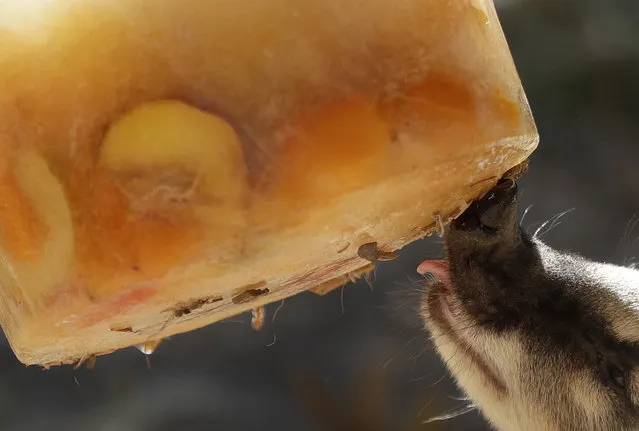
A lemur licks a block of ice containing fruit at Rome's Bioparco zoo, Wednesday, July 5, 2017. Zookeepers at the Bioparco often give animals ice blocks with either fruit or meat on hot summer days. (Photo by Gregorio Borgia/AP Photo)

A lemur licks a block of ice containing fruit at Rome's Bioparco zoo, Wednesday, July 5, 2017. Zookeepers at the Bioparco often give animals ice blocks with either fruit or meat on hot summer days. (Photo by Gregorio Borgia/AP Photo)
Details
09 Jul 2017 07:44:00
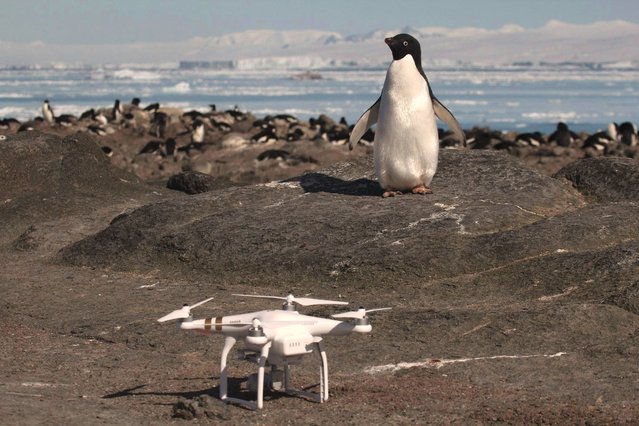
This undated handout photograph released by Stony Brook University/ Louisiana State University on March 2, 2018, shows an Adélie penguin (R) looking at a drone at breeding colony on Heroina Island, Danger Islands, Antarctica. A thriving “hotspot” of some 1.5 million Adelie penguins has been discovered on the remote Danger Islands in the east Antarctic, surprised scientists announced on March 2, 2018. (Photo by Rachael Herman/AFP Photo/Louisiana State University AND Stony Brook University)

This undated handout photograph released by Stony Brook University/ Louisiana State University on March 2, 2018, shows an Adélie penguin looking at a drone at breeding colony on Heroina Island, Danger Islands, Antarctica. A thriving “hotspot” of some 1.5 million Adelie penguins has been discovered on the remote Danger Islands in the east Antarctic, surprised scientists announced on March 2, 2018. (Photo by Rachael Herman/AFP Photo/Louisiana State University AND Stony Brook University)
Details
04 Mar 2018 00:03:00