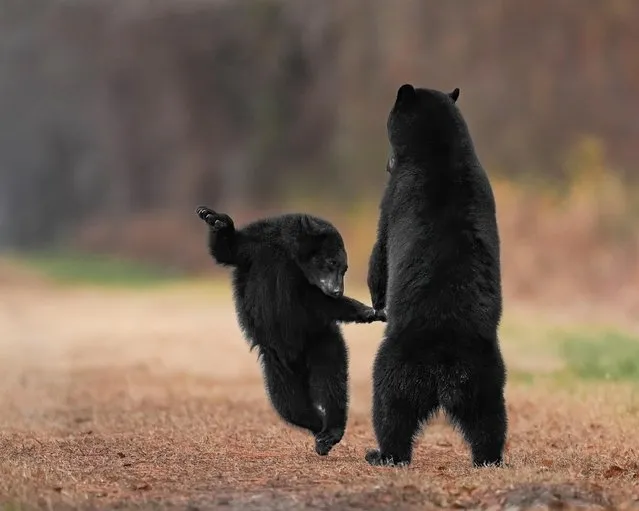
A black bear cub performs for its mum at the Pocosin Lakes National Wildlife park in North Carolina, US in January 2022. (Photo by Jennifer Hadley/Animal News Agency)
In this Tuesday, August 2, 2016 photo released by Xinhua News Agency, people stand on a platform as the Transit Elevated Bus TEB-1 conducting a test run after it unveiled in Qinhuangdao, north China's Hebei Province. The 72-feet long and 25-feet wide Transit Elevated Bus (TEB) powered by electricity can carry more than hundreds passengers, is designed to go over the normal traffic to help ease traffic congestion without having to dig new tunnels or build elevated rail tracks. (Photo by Luo Xiaoguang/Xinhua via AP Photo)
Women activists wearing veils gather at during a rally organised by the collective #NousToutes against feminicides at Place du Pantheon in Paris on October 9, 2022. (Photo by Julien de Rosa/AFP Photo)
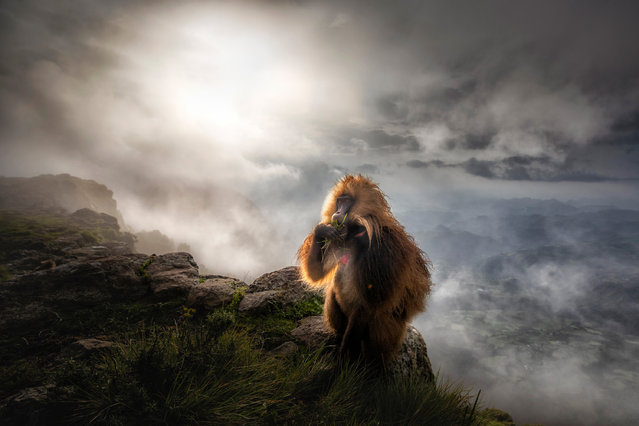
Highly commended, mammals: Gelada after the storm – Marco Gaiotti (Italy). “Gelada baboons are the only monkey species in the world that feed on grasses. They are native to the tableland of Ethiopia. Every morning large family groups wander from their sleeping places in the steep rock face, up to 1,000 metres high, to the feeding grounds at the tablelands. This image clearly depicts their feeding strategy: they pull out bunches of grass, sort the stalks and then lift them to their mouth. This shot was taken towards the end of the rainy season after a heavy storm”. (Photo by Marco Gaiotti/2019 GDT European Wildlife Photographer of the Year)
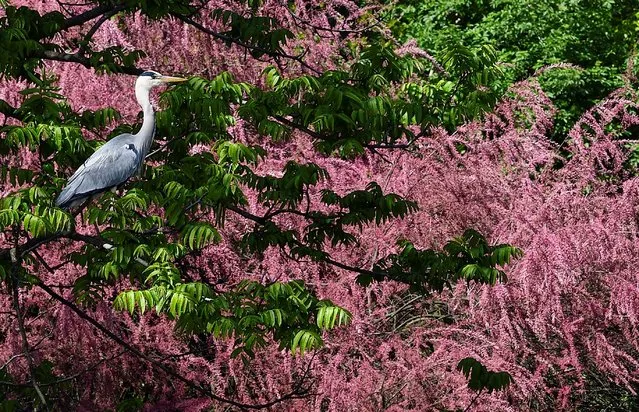
A grey heron is seen at the Sempione park, after Lombardy was downgraded from a red to an orange zone, loosening the coronavirus disease (COVID-19) restrictions including allowing non-essential shops to re-open, in Milan, Italy, April 13, 2021. (Photo by Flavio Lo Scalzo/Reuters)
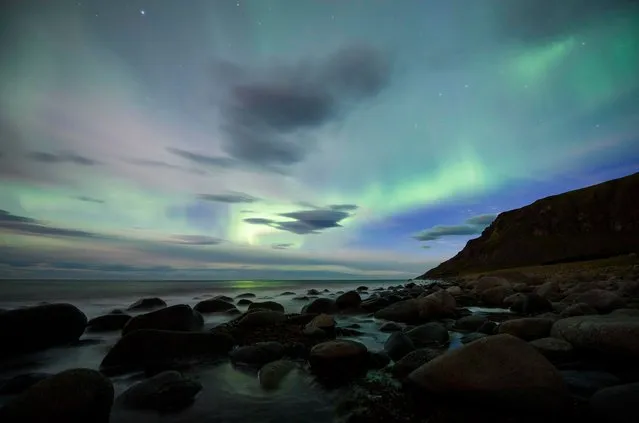
The northern lights, or aurora borealis, illuminate the sky over Flakstad beach on Lofoten Islands in the Arctic Circle on September 5, 2017. (Photo by Jonathan Nackstrand/AFP Photo)