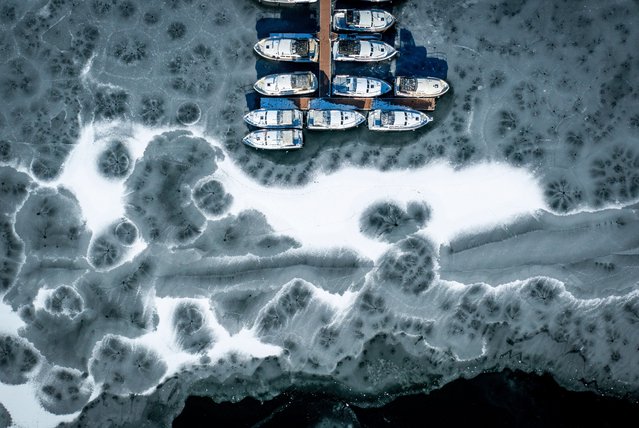
Houseboats and charter boats are docked in the ice in the harbor at Fischerhof Eldenburg in the Mecklenburg Lake District, northern Germany, Wednesday, February 19, 2025. (Photo by Jens Büttner/dpa)
An urban Opossum covered in light snow visits a suburban Chicago deck on December 10, 2025. (Photo by H Rick Bamman/ZUMA Press Wire/Rex Features/Shutterstock)
Volunteers throw a mixture of water, neem herb and turmeric as an alleged natural disinfectant on a street in a residential area during a government-imposed nationwide lockdown as a preventive measure against the COVID-19 coronavirus, in Chennai on April 7, 2020. (Photo by Arun Sankar/AFP Photo)
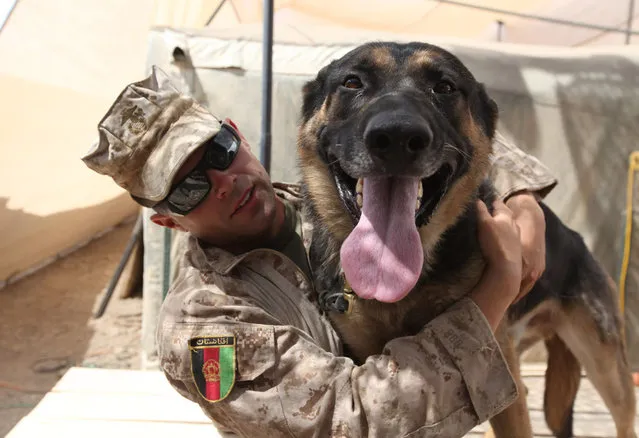
Throughout the course of the long war in Afghanistan, Coalition troops have relied on thousands of military working dogs to help keep them safe, and make their jobs easier. The dogs are trained to detect explosives, to find illegal drugs, to search for missing comrades, or target enemy combatants. Not only are they active on the front lines, but behind the lines they serve as therapy dogs, service dogs, and loyal companions. They also share the same risks as the ground troops, suffering injuries and sometimes death on the battlefields. Gathered here are images of these dogs and their handlers in Afghanistan and back home, from over the past several years, part of the ongoing series here on Afghanistan.
Exhibition's guides pose on a tank during the Army-2022 International Military-Technical Forum at the Russian Armed Forces' Patriot Park in Kubinka, outside Moscow, on August 16, 2022. (Photo by Natalia Kolesnikova/AFP Photo)
An Iraqi soldier plays with an accordion found on the street while on patrol in the western neighborhood of Tamuz in Mosul on May 23, 2017, after the area was retaken during the ongoing offensive against Islamic State (IS) group fighters. (Photo by Ahmad Al-Rubaye/AFP Photo)
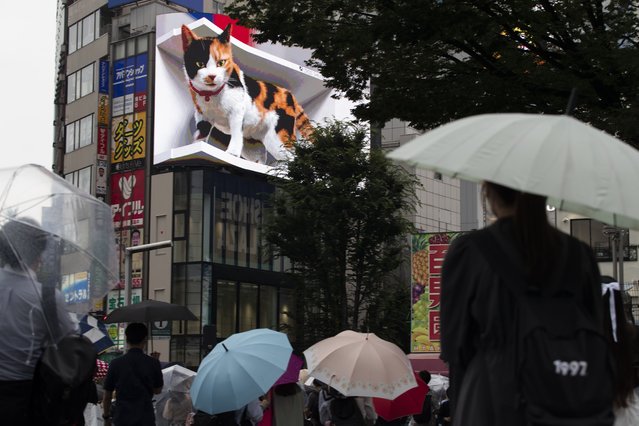
People walk by a 3D video advertisement display of a giant cat that was recently installed in the famed Shinjuku shopping district in Tokyo on Friday, July 9, 2021. (Photo by Hiro Komae/AP Photo)
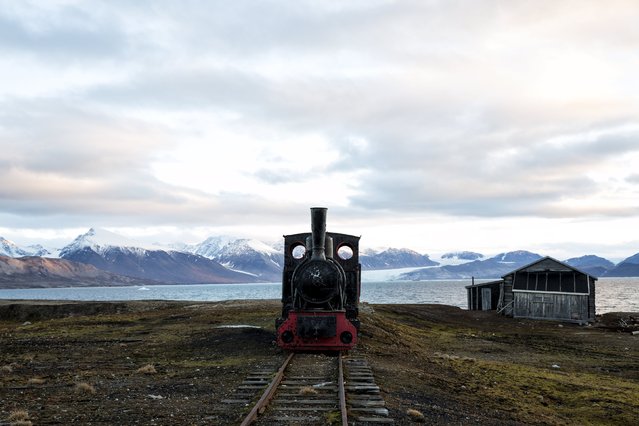
An old locomotive train that was used for transporting coal is preserved as a monument at Ny-Alesund, in Svalbard, Norway, October 11, 2015. A Norwegian chain of islands just 1,200 km (750 miles) from the North Pole is trying to promote new technologies, tourism and scientific research in a shift from high-polluting coal mining that has been a backbone of the remote economy for decades. (Photo by Anna Filipova/Reuters)