Monkeys climb onto tourists during the annual Monkey Festival, after officials start capturing monkeys, in Lopburi province, Thailand, on November 24, 2024. (Photo by Patipat Janthong/Reuters)
To an outsider, their passion is at times illegal and often on the verge of life and death. But climbing rooftops of high-rise buildings and exploring abandoned facilities is in the blood of these young Muscovites. The small group calls itself “Rudex”, which stands for “roof and decay exploration”, and is akin a Western youth craze known as urbex or “urban exploration” of man-made structures. Here: Urban explorer Vad Him of Rudex team jumps whilst on a rooftop in Moscow, Russia, August 14, 2017. (Photo by Maxim Shemetov/Reuters)
With Haystack Rock in the background, Julie Amschler, of Springfield, Mo., walks along the beach on Thursday, June 13, 2024, in Cannon Beach, Ore. (Photo by Jenny Kane/AP Photo)
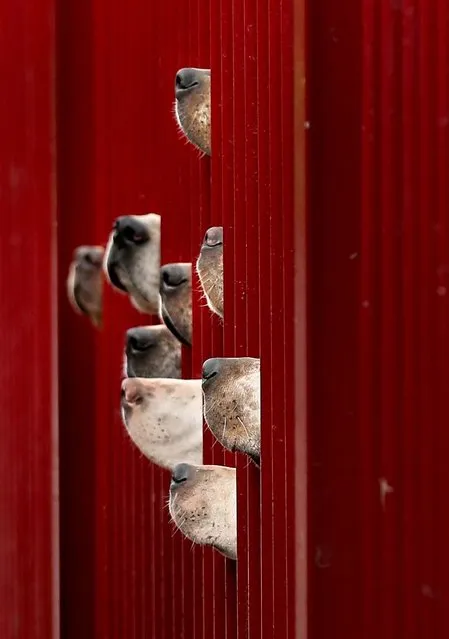
Hounds of The Cheshire Forest Hunt push their snouts through the bars of their kennels as they eagerly await their morning walk in preparation for the start of the new hunting season, in Knutsford, England, on Oktober 31, 2013. The hunting season traditionally starts around November 1st. Although a ban on hunting has been in force since February 2005, many supporters of fox hunting are continuing to call for a repeal of the ban, saying the current law is hard to interpret and enforce. (Photo by Christopher Furlong/Getty Images)
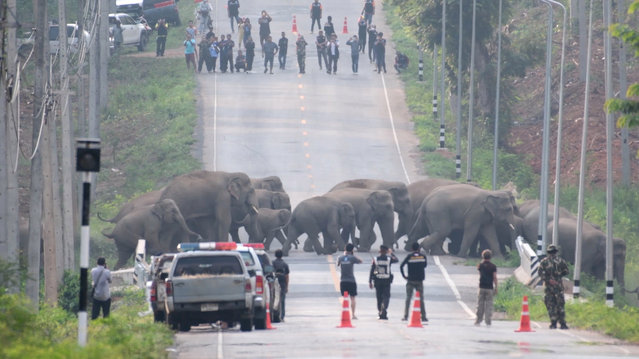
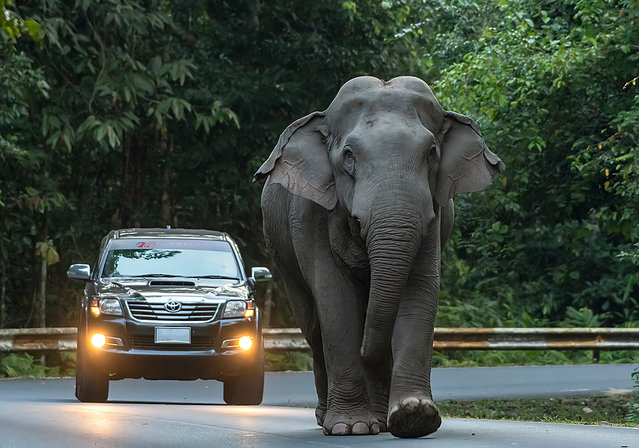
An Asian elephant called “Plai Deaw” goes for a walk on a mountain road in Nakhon Nayok, Thailand on July 11, 2022. The bull has become well known in the area for his taste for venturing out from the deep forest and emerging among cars and village homes. Thailand has an estimated 2,000 Asian elephants living in the wild but there is often conflict when they come into contact with humans on roads and in villages. A similar number of elephants are kept captive where they work in zoos and are hired out for religious festivals and weddings. (Photo by Mongkol Pitakmoo/ViralPress)
Rabbits are seen in a cage, which is placed by authority as a test of the living conditions near the site of last week's blasts at Binhai new district in Tianjin, China, August 19, 2015. According to local media, the animals were alive after being placed near the blasts site for two hours. Four new fires have broken out at the site where two huge blasts last week killed 116 people, Chinese state media reported Friday soon after officials said safety hazards were found at almost 70 percent of firms handling dangerous chemicals in Beijing. (Photo by Reuters/Stringer)