Loading...
Done


An image produced by the Hubble telescope of the perfectly “edge-on” galaxy, or NGC 4013, March 1, 2001. This new Hubble picture reveals, with great detail, huge clouds of dust and gas extending along, as well as far above, the galaxy's main disk. NGC 4013 is a spiral galaxy, similar to the Milky Way, lying some 55 million light-years from Earth in the direction of the constellation Ursa Major. Viewed face-on, it would look like a nearly circular pinwheel, but NGC 4013 happens to be seen edge-on from our vantage point. Even at 55 million light-years, the galaxy is larger than Hubble's field of view, and the image shows only a little more than half of the object, albeit with unprecedented detail. (Photo Courtesy of NASA/Newsmakers)
Details
28 Feb 2015 22:33:00
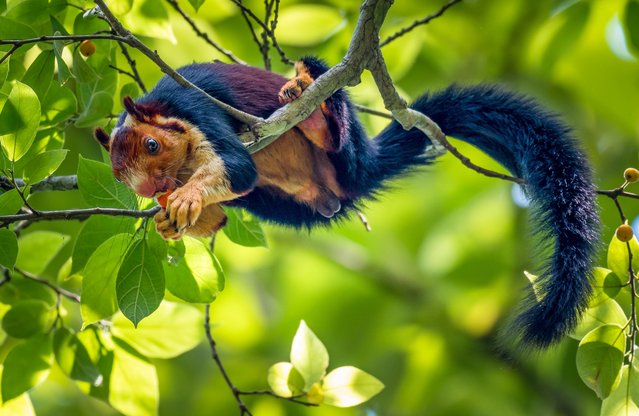
Its main predators are the birds of prey and the leopard. The Giant Squirrel is mostly active in the early hours of the morning and in the evening, resting in the midday. They are typically solitary animals that only come together for breeding. (Photo by Kaushik Vijayan/South West News Service)

The Malabar Giant squirrel – double the size of their grey relatives and measuring up to 36 inches (91.5 cm) from head to tail – lives deep in the forests of India. The athletic animals can leap an incredible 20 feet (6 m) between trees. Photographer Kaushik Vijayan, 39, snapped the animals in their native habit to produce these stunning images. Kaushik, from Kerala State, India, said: “Up until that point I had never heard about a squirrel like that or seen one. The sight was an absolute feast for my eyes. The squirrels fascinated me and I got excited to capture this beauty on my camera”. (Photo by Kaushik Vijayan/South West News Service)
Details
04 Apr 2019 00:03:00


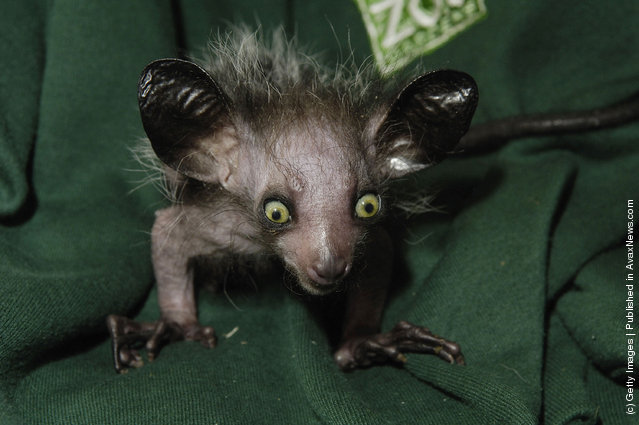
“The aye-aye (Daubentonia madagascariensis) is a lemur, a strepsirrhine primate native to Madagascar that combines rodent-like teeth and a special thin middle finger to fill the same ecological niche as a woodpecker. It is the world's largest nocturnal primate, and is characterized by its unusual method of finding food; it taps on trees to find grubs, then gnaws holes in the wood and inserts its narrow middle finger to pull the grubs out. The only other animal species known to find food in this way is the striped possum. From an ecological point of view the aye-aye fills the niche of a woodpecker as it is capable of penetrating wood to extract the invertebrates within”. – Wikipedia

Photo: In this handout image from Bristol Zoo is seen the first captive bred aye-aye in the UK named “Kintana” (meaning star in Malagasy) April 15, 2005 at Bristol Zoo Gardens, England. The zoo announced today only the second baby aye-aye to be hand-reared in the world (the first was in Jersey Zoo) and has now made his first public appearance since his birth on 11 February 2005. (Photo by Rob Cousins/Bristol Zoo via Getty Images)
Details
13 Apr 2011 13:33:00
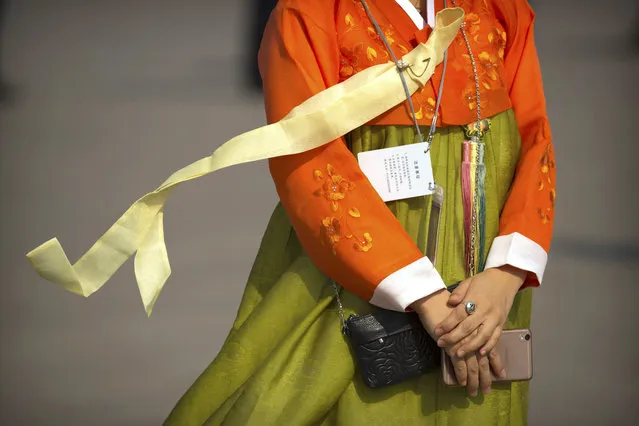
In this Friday, March 3, 2017 photo, a ribbon on a staff member's outfit blows in the breeze as she arrives for the opening session of the Chinese People's Political Consultative Congress (CPPCC) at the Great Hall of the People in Beijing. (Photo by Mark Schiefelbein/AP Photo)

In this Friday, March 3, 2017 photo, a ribbon on a staff member's outfit blows in the breeze as she arrives for the opening session of the Chinese People's Political Consultative Congress (CPPCC) at the Great Hall of the People in Beijing. The annual session of China's ceremonial legislature is designed to awe onlookers with its size and sweep, yet the experience is also made up of tiny moments, details that point to the personalities of the participants and the event's unique, sometimes quirky, traits that a casual observer might easily miss. (Photo by Mark Schiefelbein/AP Photo)
Details
15 Mar 2017 00:05:00
An Afghan policeman stands guard as smoke and flames rise from the site of a huge blast struck near the entrance of Kabul's international airport, in Kabul on August 10, 2015. A huge blast struck near the entrance of Kabul's international airport on August 10 during the peak lunchtime period, officials said, warning that heavy casualties were expected. (Photo by Shah Marai/AFP Photo)

An Afghan policeman stands guard as smoke and flames rise from the site of a huge blast struck near the entrance of Kabul's international airport, in Kabul on August 10, 2015. A huge blast struck near the entrance of Kabul's international airport on August 10 during the peak lunchtime period, officials said, warning that heavy casualties were expected. “The explosion occurred at the first check point of Kabul airport”, said deputy Kabul police chief Sayed Gul Agha Rouhani. (Photo by Shah Marai/AFP Photo)
Details
11 Aug 2015 13:27:00
The National Geographic Photo Ark is a travelling exhibition of photographer Joel Sartore’s quest to create a photo archive of biodiversity around the world. So far, Sartore has captured studio portraits of more than 6,000 species – a number that he hopes to double. On 1 July, the ark will open at Melbourne zoo – the first time it has been exhibited in the southern hemisphere. More than 50 portraits will be on display, including many of Australian endangered animals being protected by programs at the zoo itself. These captions have been edited from text supplied by Melbourne zoo. Here: Barking owl. So-named because its call sounds like a barking dog, these birds are native to Australia, Indonesia and Papua New Guinea. In Victoria they are listed as an endangered species, and in 2003 there were estimated to be fewer than 50 breeding pairs. The main threat to the species in Victoria is loss of habitat, especially large trees with hollows in which they can nest and on which many of their prey depend. Apart from a bark, they may utter a chilling scream when they feel threatened. (Photo by Joel Sartore/National Geographic Photo Ark/The Guardian)

The National Geographic Photo Ark is a travelling exhibition of photographer Joel Sartore’s quest to create a photo archive of biodiversity around the world. So far, Sartore has captured studio portraits of more than 6,000 species – a number that he hopes to double. On 1 July, the ark will open at Melbourne zoo – the first time it has been exhibited in the southern hemisphere. More than 50 portraits will be on display, including many of Australian endangered animals being protected by programs at the zoo itself. These captions have been edited from text supplied by Melbourne zoo. Here: Barking owl. (Photo by Joel Sartore/National Geographic Photo Ark/The Guardian)
Details
01 Jul 2017 07:45:00
Mayu adjusts Koiku’s kimono, as Koiku wears a protective face mask while posing for a photograph, before they work at a party where they will entertain with other geisha at Japanese luxury restaurant Asada in Tokyo, Japan, June 23, 2020. The coronavirus pandemic has made Tokyo's geisha fear for their centuries-old profession as never before. Though the number of geisha - famed for their witty conversation, beauty and skill at traditional arts - has been falling for years, they were without work for months due to Japan's state of emergency and now operate under awkward social distancing rules. Engagements are down 95 percent, and come with new rules: no pouring drinks for customers or touching them even to shake hands, and sitting 2 meters apart. Masks are hard to wear with their elaborate wigs, so they mostly don't. “I was just full of anxiety”, said Mayu, 47. “I went through my photos, sorted my kimonos ... The thought of a second wave is terrifying”. (Photo by Kim Kyung-Hoon/Reuters)

Mayu adjusts Koiku’s kimono, as Koiku wears a protective face mask while posing for a photograph, before they work at a party where they will entertain with other geisha at Japanese luxury restaurant Asada in Tokyo, Japan, June 23, 2020. (Photo by Kim Kyung-Hoon/Reuters)
Details
23 Jul 2020 00:03:00
An astonishing set of snaps of a thrill-seeker's sky-high catwalk show on the edge of some of the world's tallest buildings has turned her into a social media sensation. Daredevil Angelina Nikolau, 23, from Russia, has spent weeks travelling around China and Hong Kong posing for jaw-dropping skyscraper selfies hundreds of feet above the ground. Her vertigo inducing results – uploaded to Instagram – have made her an instant star on the internet. Angelina is described by Russian media as “self-taught photographer, adventurer and roofer from Moscow”. Roofing – also known as rooftopping – is where people get as close as possible to the edge of a skyscraper's highest point to take selfies. (Photo by Kirill Oreshkin/CEN)

An astonishing set of snaps of a thrill-seeker's sky-high catwalk show on the edge of some of the world's tallest buildings has turned her into a social media sensation. Daredevil Angelina Nikolau, 23, from Russia, has spent weeks travelling around China and Hong Kong posing for jaw-dropping skyscraper selfies hundreds of feet above the ground. Her vertigo inducing results – uploaded to Instagram – have made her an instant star on the internet. (Photo by Kirill Oreshkin/CEN)
Details
22 Sep 2016 09:52:00