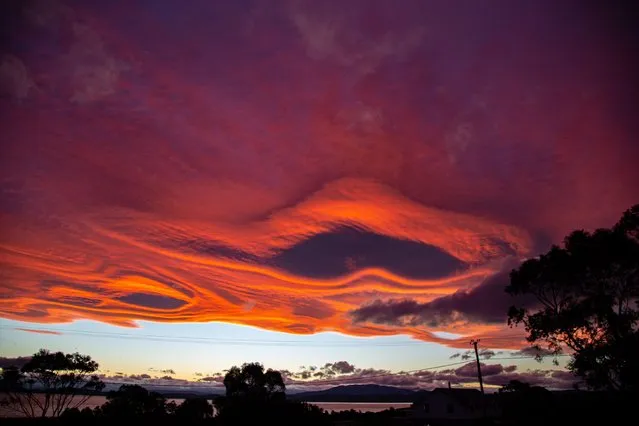
Wayne Painter, 70, saw the sun set beneath lenticular clouds 20km wide in Tasmania, Australia in November 2021. Some likened the image to a near-miss with Mars. (Photo by Wayne Painter/Kennedy News)
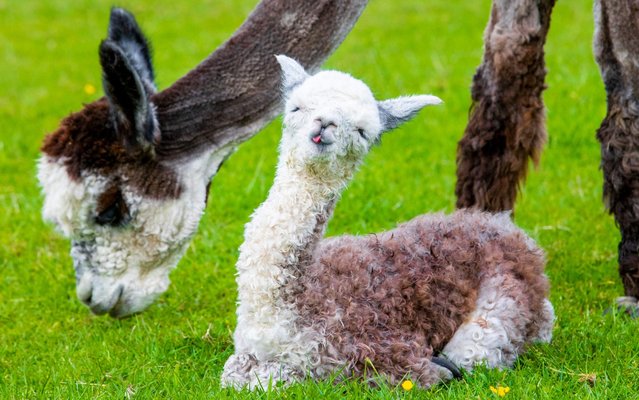
Staff at a Scottish farm say they are “absolutely delighted” to have welcomed a baby alpaca into the world this morning, June 6, 2019. Mum, Nunavut, gave birth to the baby boy huacaya alpaca, which has not yet been named, weighing 9.6kg. Stuart Ramsay, the owner of Velvet Hall Alpacas, in Innerleithen, Scottish Borders said he was surprised when the baby was born an “unusual rose grey colour”. (Photo by South West News Service)
Audrey Lu and Misha Mitrofanov of the United States compete in the Pairs Short Program during day 1 of the ISU Grand Prix of Figure Skating Rostelecom Cup at Megasport Arena on November 15, 2019 in Moscow, Russia. (Photo by Maxim Shemetov/Reuters)
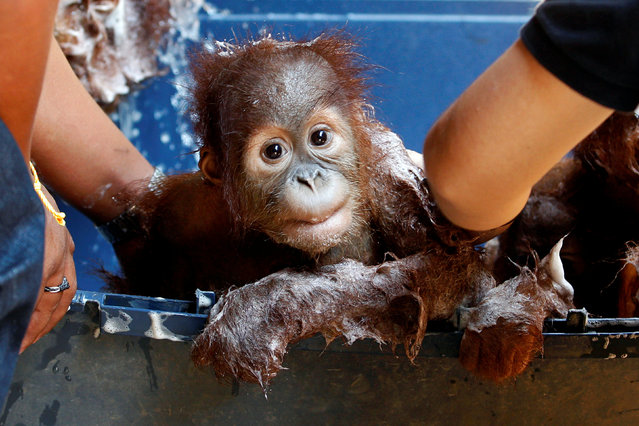
A baby Sumatran orangutan is bathed after arriving at a wildlife center at Ratchaburi province in Thailand September 13, 2017. (Photo by Kerek Wongsa/Reuters)
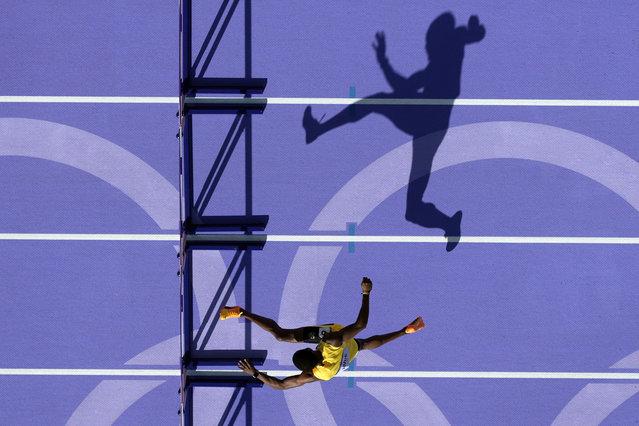
Jaheel Hyde, of Jamaica, competes in a men's 400-meter hurdles heat at the 2024 Summer Olympics, Monday, August 5, 2024, in Saint-Denis, France. (Photo by David J. Phillip/AP Photo)
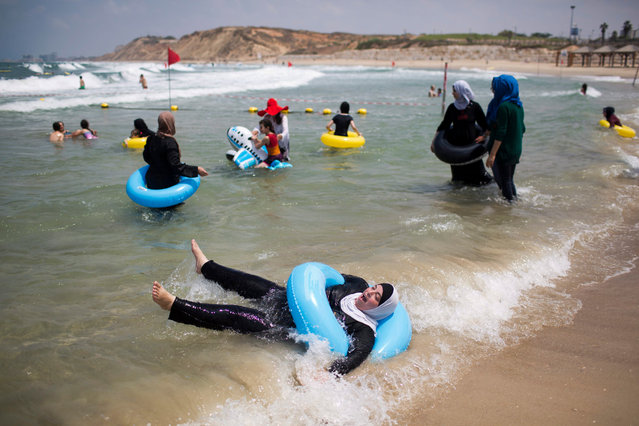
Palestinians kids from the West Bank Palestinian village Umm Al Rajaj cross the Meitar checkpoint into Israel on their way to the beach of Tel Aviv for the first time, Israel, 10 August 2016. A group of humanitarian Israeli women called in Arabic “Min Al Baher” (from the sea) voluntarily arranges authorizations and transportation for Palestinians families that live in the West Bank to cross into Israel in order to visit the sea for the first time. (Photo by Abir Sultan/EPA)
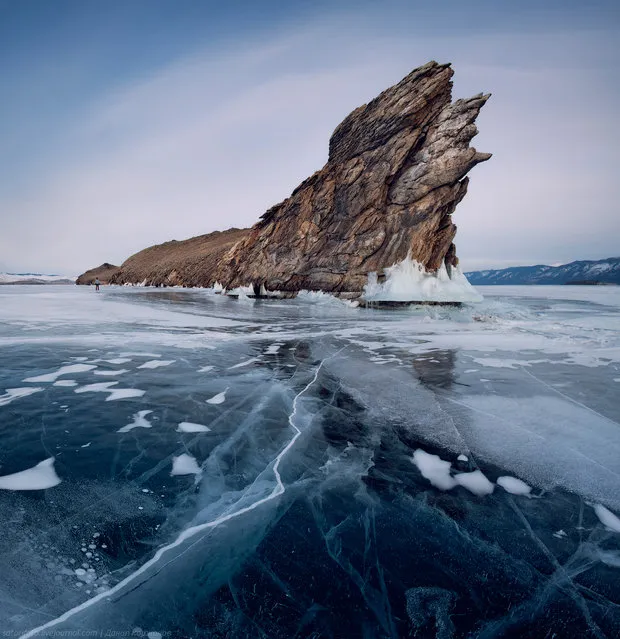
Lake Baikal is the world's oldest lake, at 25 million years (possibly older), and deepest, averaging 744.4 metres (2,442 ft).
Located in the south of the Russian region of Siberia, between Irkutsk Oblast to the northwest and the Buryat Republic to the southeast, it is the most voluminous freshwater lake in the world, containing roughly 20% of the world's unfrozen surface fresh water.
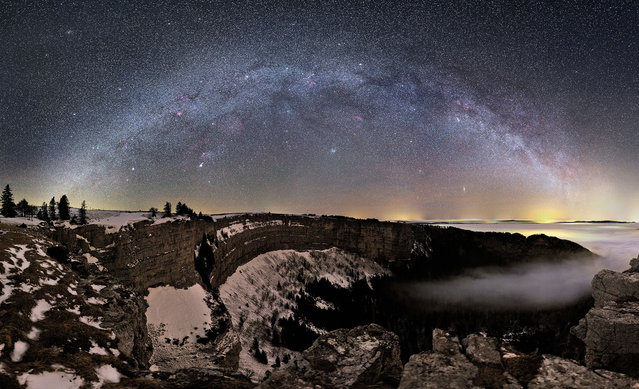
The Milky Way is the galaxy in which Earth is contained. This name derives from its appearance as a dim “milky” glowing band arching across the night sky, in which the naked eye cannot distinguish individual stars. The term “Milky Way” is a translation of the Classical Latin via lactea, from the Hellenistic Greek γαλαξίας κύκλος (pr. galaxías kýklos, “milky circle”). The Milky Way appears like a band because it is a disk-shaped structure being viewed from inside. The fact that this faint band of light is made up of stars was proven in 1610 when Galileo Galilei used his telescope to resolve it into individual stars. In the 1920s, observations by astronomer Edwin Hubble showed that the Milky Way is just one of many galaxies.