Loading...
Done
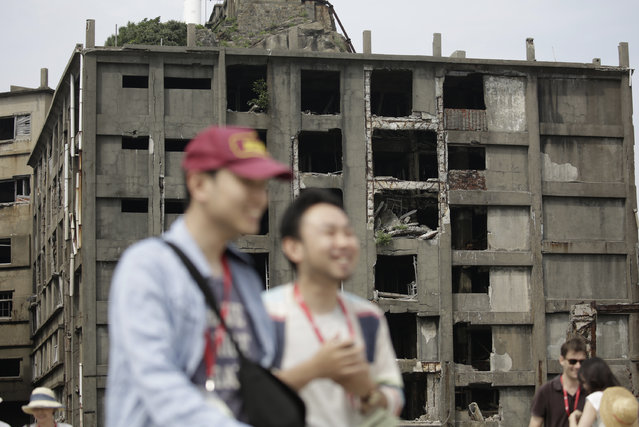
In this June 29, 2015 photo, forlorn buildings are seen at Hashima Island, commonly known as Gunkanjima, which means “Battleship Island”, off Nagasaki, Nagasaki Prefecture, southern Japan. (Photo by Eugene Hoshiko/AP Photo)

In this June 29, 2015 photo, forlorn buildings are seen at Hashima Island, commonly known as Gunkanjima, which means “Battleship Island”, off Nagasaki, Nagasaki Prefecture, southern Japan. The island is one of 23 old industrial facilities seeking UNESCO's recognition as world heritage “Sites of Japan's Meiji Industrial Revolution” meant to illustrate Japan's rapid transformation from a feudal farming society into an industrial power at the end of the 19th century. UNESCO's World Heritage Committee is expected to approve the proposal during a meeting being held in Bonn, Germany, through July 9. (Photo by Eugene Hoshiko/AP Photo)
Details
01 Jul 2015 13:41:00
An Indian Hindu devotee pours milk on a snake as an offering during the annual Nag Panchami festival, dedicated to the worship of snakes outside the Nagvasuki temple, in Allahabad, on July 28, 2017. (Photo by Sanjay Kanojia/AFP Photo)

An Indian Hindu devotee pours milk on a snake as an offering during the annual Nag Panchami festival, dedicated to the worship of snakes outside the Nagvasuki temple, in Allahabad, on July 28, 2017. Officially the snake charmers' profession is banned in India, but many in the country offered prayers and milk blessings to cobras and other deadly serpents on July 28 in an annual tribute. The 800,000 charmers and their young apprentices come to the fore for the Nag Panchami festival which dates back several centuries. (Photo by Sanjay Kanojia/AFP Photo)
Details
31 Jul 2017 09:17:00
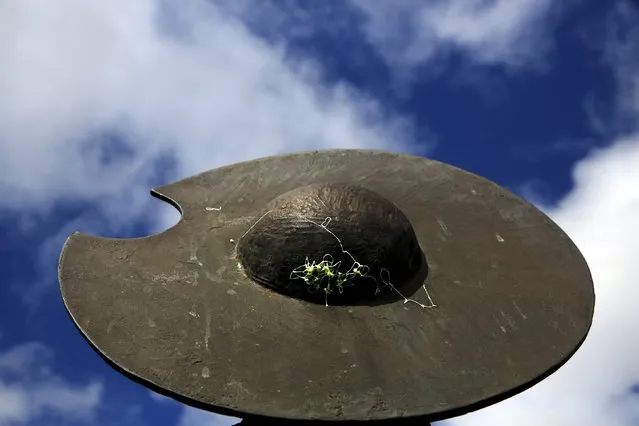
A sculpture of Don Quixote shows him wearing the basin he mistook for the enchanted helmet of the fictional Moorish king Mambrino in Alcazar de San Juan, Spain, April 5, 2016. (Photo by Susana Vera/Reuters)

A sculpture of Don Quixote shows him wearing the basin he mistook for the enchanted helmet of the fictional Moorish king Mambrino in Alcazar de San Juan, Spain, April 5, 2016. The arid central Spanish region of La Mancha is the setting for “Don Quixote”, the seventeenth-century novel by Miguel de Cervantes. Four hundred years after his death, references to the characters of Don Quixote, his loyal squire Sancho Panza and his beautiful lady Dulcinea abound in the surrounding villages from sweet treats to theatre productions involving livestock. Cervantes did not give away the name of the birthplace of Don Quixote, a middle-aged gentleman who becomes obsessed with chivalrous ideals. But many identify the village of Argamasilla de Alba as his hometown. The anniversary of Cervantes’ death is marked on the 23 April. (Photo by Susana Vera/Reuters)
Details
21 Apr 2016 12:32:00
Winti spiritual leader Ramon Mac-Nack (2nd L) looks on as as his bride Melissa Karwafodi (2nd R) hands a gourd to a Maroon priest (L) as they are wedded in the first Winti marriage ever to be held in public, in district Para, Suriname, November 16, 2015. (Photo by Ranu Abhelakh/Reuters)

Winti spiritual leader Ramon Mac-Nack (2nd L) looks on as as his bride Melissa Karwafodi (2nd R) hands a gourd to a Maroon priest (L) as they are wedded in the first Winti marriage ever to be held in public, in district Para, Suriname, November 16, 2015. The Winti religion, which formed centuries ago out of elements of different religious traditions that African slaves brought with them to Suriname, was considered a form idolatry and prohibited by law since the days of slavery until it was finally officially recognized in 1971. (Photo by Ranu Abhelakh/Reuters)
Details
27 Nov 2015 05:51:00
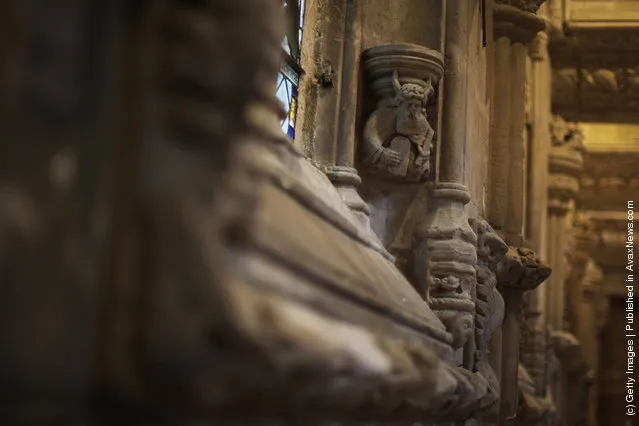
The interior of Rosslyn Chapel on February 9, 2012 in Roslin, Scotland

“Rosslyn Chapel, properly named the Collegiate Chapel of St. Matthew, was founded on a small hill above Roslin Glen as a Roman Catholic collegiate church (with between four and six ordained canons and two boy choristers) in the mid-15th century. Rosslyn Chapel and the nearby Roslin Castle are located at the village of Roslin, Midlothian, Scotland”. – Wikipedia

Photo: The interior of Rosslyn Chapel on February 9, 2012 in Roslin, Scotland. Built between 1446 and 1484 it is a category A listed building, covered in ornate stonework and carvings of individual figures and scenes. People travel from all over the world to visit the chapel which many have described as an architectural wonder and a library in stone. Many theories, myths and legends associated with the Chapel have given it a unique sense of mystery and wonder. (Photo by Jeff J. Mitchell/Getty Images)
Details
10 Feb 2012 10:13:00


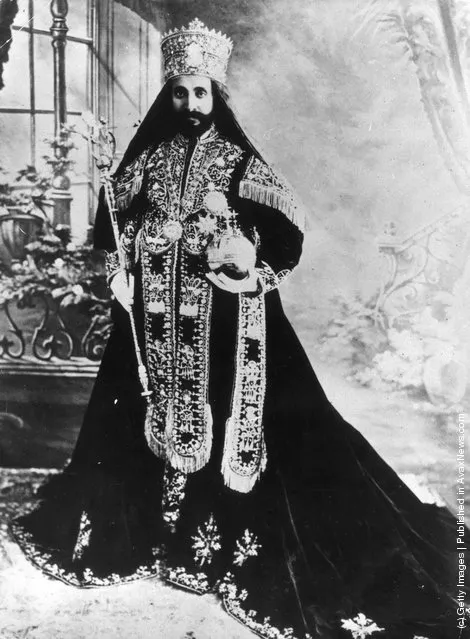
“Haile Selassie I (23 July 1892 – 27 August 1975), born Tafari Makonnen, was Ethiopia's regent from 1916 to 1930 and Emperor of Ethiopia from 1930 to 1974. The heir to a dynasty that traced its origins to the 13th century, and from there by tradition back to King Solomon and Queen Makeda, Empress of Axum, known in the Abrahamic tradition as the Queen of Sheba. Haile Selassie is a defining figure in both Ethiopian and African history.

Haile Selassie is revered as the returned Messiah of the Bible, God incarnate, among the Rastafari movement, the number of followers of which is estimated between 200,000 and 800,000. Begun in Jamaica in the 1930s, the Rastafari movement perceives Haile Selassie as a messianic figure who will lead a future golden age of eternal peace, righteousness, and prosperity. He himself remained an Ethiopian Orthodox Christian throughout his life”. – Wikipedia

Photo: Negusa Negasti, Emperor of Ethiopia Haile Selassie I, known as “Lord of Lords”, “The Conquering Lion of the tribe of Judah”, “Light of the world”, “Elect of God”, in full ceremonial regalia following his coronation. (Photo by Hulton Archive/Getty Images)
Details
21 Jun 2011 11:04:00
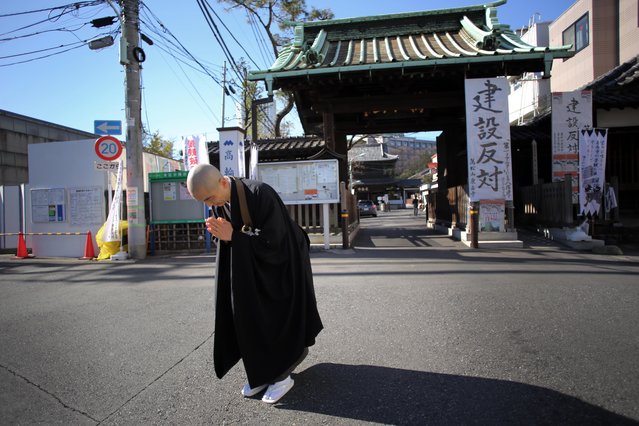
In this January 8, 2015 photo, a monk Kenmyo Muta bows at the condominium construction site and the gate of Sengakuji temple in Tokyo. (Photo by Eugene Hoshiko/AP Photo)

In this January 8, 2015 photo, a monk Kenmyo Muta bows at the condominium construction site and the gate of Sengakuji temple in Tokyo. The “47 ronin” samurai who inspired the long-loved saga of loyalty and honor eulogized in films, books and plays are fighting a new kind of battle in urban Japan. An apartment complex is going up next to the curved tile-roofed Sengakuji temple where the three-century-old graves of the ronin, or masterless samurai, lie. The banner reads: “We only hope to protect landscape of Sengakuji temple”. (Photo by Eugene Hoshiko/AP Photo)
Details
16 Jan 2015 13:01:00
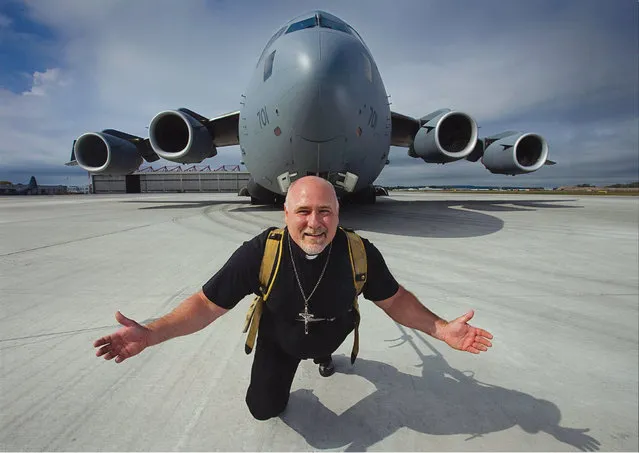
Powerlifting Pastor Kevin Fast

Kevin Fast, 51, holds several Guinness World Records including the heaviest plane pulled by a man and has lifted 22 women with his back. The Reverend Dr Kevin Fast is officially God's gift to powerlifting after being named as the world's strongest priest. The Canadian pastor, 51, has been performing incredible stunts of heavy lifting for years after being inspired by 19th Century strongman Louis Cyr. He holds several Guinness World Records including the heaviest aircraft pulled by a man, which weighed in at a whopping 189 tonnes, heaviest truck pulled by an arm wrestling move, heaviest vehicle pulled over 100ft and the longest duration holding 500kg with the shoulders.
Details
06 Oct 2014 17:10:00