Loading...
Done


“The saguaro (scientific name Carnegiea gigantea) is a large, tree-sized cactus species in the monotypic genus Carnegiea. It is native to the Sonoran Desert in the U.S. state of Arizona, the Mexican state of Sonora, a small part of Baja California in the San Felipe Desert and an extremely small area of California, U.S. The saguaro blossom is the State Wildflower of Arizona”. – Wikipedia

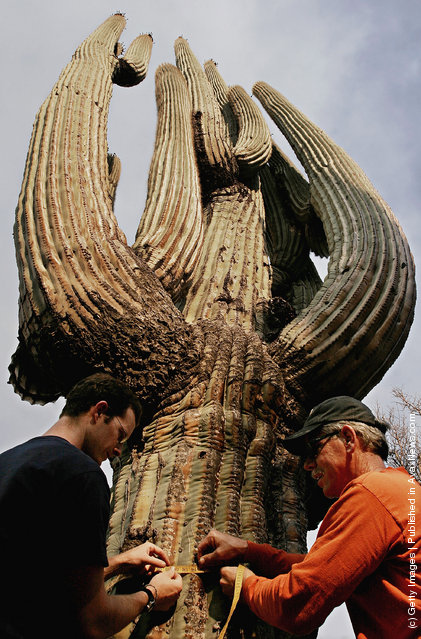
Photo: Daniel Appel (L), a firefighter with Engine 84 from the Lassen National Forest in California and Mike Hallen, (R), Arizona representative of the National Register of Big Trees, measure the circumference of this Saguaro cactus called the "Grand One," in the Tonto National Forest on July 1, 2005 35 miles north of Phoenix, near Carefree, Arizona. The cactus, estimated to be more than 200 years old, measures a circumference of 7 feet, 10 inches (2.4 meters) and stands 46 feet high (14 meters). The cactus was burned in the Cave Creek Complex fire and may not survive. It was once the largest Saguaro in the world, two others have been found recently that have tied it's measurements. The fire has burned more than 214,000 acres of the Sonoran desert. (Photo by Jeff Topping/Getty Images)
Details
26 Jul 2011 12:27:00
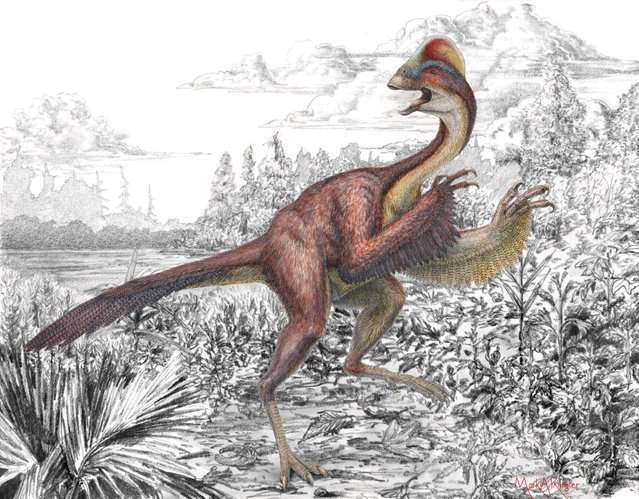
Life reconstruction of the new oviraptorosaurian dinosaur species Anzu wyliei in its 66 million-year-old environment in western North America as seen in an undated handout illustration by Mark A. Klinger, Carnegie Museum of Natural History. Some 18,000 species, great and small, were discovered in 2014, adding to the 2 million already known, scientists said on May 21, 2015 as they released a “Top 10” list that highlights the diversity of life. (Photo by Mark A. Klingler/Reuters/Carnegie Museum of Natural History)

Life reconstruction of the new oviraptorosaurian dinosaur species Anzu wyliei in its 66 million-year-old environment in western North America as seen in an undated handout illustration by Mark A. Klinger, Carnegie Museum of Natural History. Some 18,000 species, great and small, were discovered in 2014, adding to the 2 million already known, scientists said on May 21, 2015 as they released a “Top 10” list that highlights the diversity of life. Anzu wyliei, one of the top 10, dubbed “the chicken from hell”, is extinct. The feathered dinosaur whose partial skeletons were unearthed in the Dakotas was a contemporary of T. rex and Triceratops. (Photo by Mark A. Klingler/Reuters/Carnegie Museum of Natural History)
Details
22 May 2015 12:31:00


Ucil, a trained monkey, takes part in a street performance on June 1, 2011 in Jakarta, Indonesia. The street performances usually involve the monkeys wearing masks, such as dolls' heads or attire to mimic humans, with the monkeys trained to act out human activities such as shopping, riding bicycles or other simulations of human behaviour. Poverty drives the handlers to exploit the monkeys in the hope of earning small change, but the effect and cruelty to the monkeys is a cause that charities such as the Jakarta Animal Aid Network are increasingly taking up. (Photo by Ulet Ifansasti/Getty Images)
Details
02 Jun 2011 12:14:00
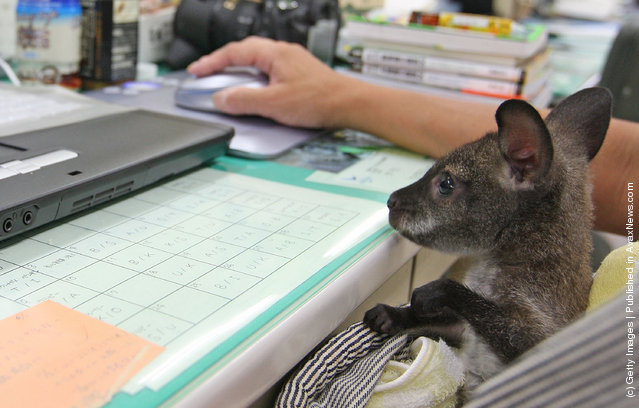
A baby wallaby

“Very small forest-dwelling wallabies are known as pademelons (genus Thylogale) and dorcopsises (genera Dorcopsis and Dorcopsulus). The name wallaby comes from the Eora Aboriginal tribe who were the original inhabitants of the Sydney area. Wallabies are herbivores whose diet consists of a wide range of grasses, vegetables, leaves, and other types of foliage”. – Wikipedia

Photo: A baby wallaby sits in a zoo attendant's lap at Edogawa Natural Zoo on August 4, 2009 in Tokyo, Japan. The staff of the zoo have raised the young wallaby after her mother neglected her. (Photo by Junko Kimura/Getty Images)
Details
07 Sep 2011 13:33:00
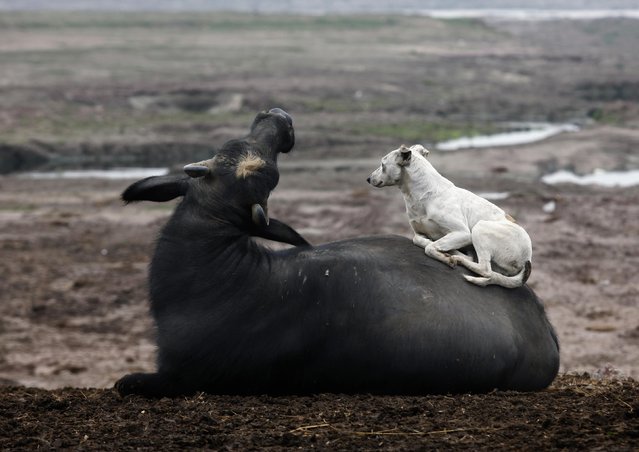
A dog rests on a buffalo near Ravi River in Lahore, Pakistan, on Febuary 4, 2013. (Photo by Mohsin Raza/Reuters)

A dog rests on a buffalo near Ravi River in Lahore, Pakistan, on Febuary 4, 2013. (Photo by Mohsin Raza/Reuters)

P.S. All pictures are presented in high resolution. To see Hi-Res images – just TWICE click on any picture. In other words, click small picture – opens the BIG picture. Click BIG picture – opens VERY BIG picture (if available; this principle works anywhere on the site AvaxNews).
Details
17 Feb 2013 17:02:00
Racegoers react as they leave after the second day of the Grand National meeting at Aintree, northern England April 5, 2013. (Photo by Nigel Roddis/Reuters)

Racegoers react as they leave after the second day of the Grand National meeting at Aintree, northern England April 5, 2013. (Photo by Nigel Roddis/Reuters)

ATTENTION: VISUAL COVERAGE OF SCENES OF INJURY AND DEATH

P.S. All pictures are presented in high resolution. To see Hi-Res images – just TWICE click on any picture. In other words, click small picture – opens the BIG picture. Click BIG picture – opens VERY BIG picture (if available; this principle works anywhere on the site AvaxNews)
Details
06 Apr 2013 11:31:00
Flossis By Rosalie

Flossis by the artist Rosalie are known far beyond the boundaries of Dьsseldorf, Germany. In this city on the Rhine, the Flossis became famous. Many buildings’ outer walls are decorated with these figures. Flossis by Rosalie come in different variants of small to large and they are popular among young and old. Flossis are made of resin and resist temperatures under -15 degrees. Below that, they should be brought to the warm inside of the building. The currently most sold Flossi, is the “type I” in red, like shown in the following illustration.
Details
12 Jun 2013 12:30:00
Illustrations From Everyday Objects By Hyemi Jeong Part 2

Adorable creations of Canadian illustrator Hyemi Jeong, based in Toronto, who is having fun with the small everyday objects with cute and creative illustrations.


See Also: Part 1 _ Part 3
Details
15 Sep 2014 12:40:00