Loading...
Done
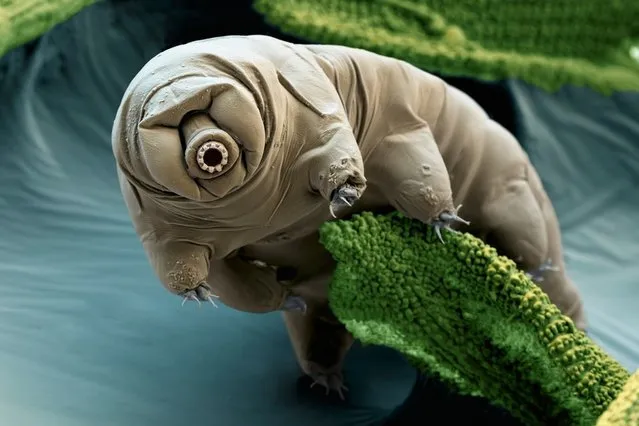
Tardigrades (commonly known as waterbears or moss piglets). (Photo by SPL/East News)

“Tardigrades (commonly known as waterbears or moss piglets) are small, water-dwelling, segmented animals with eight legs. Tardigrades were first discovered in 1773 by Johann August Ephraim Goeze, who called them kleiner Wasserbär, meaning “little water bear” in German. The name Tardigrada means “slow walker” and was given by Lazzaro Spallanzani in 1777. The name water bear comes from the way they walk, reminiscent of a bear's gait. The biggest adults may reach a body length of 1.5 millimetres (0.059 in), the smallest below 0.1 mm. Freshly hatched tardigrades may be smaller than 0.05 mm”. – Wikipedia. Photo: Tardigrades. (Photo by SPL/East News)
Details
26 Sep 2012 09:55:00
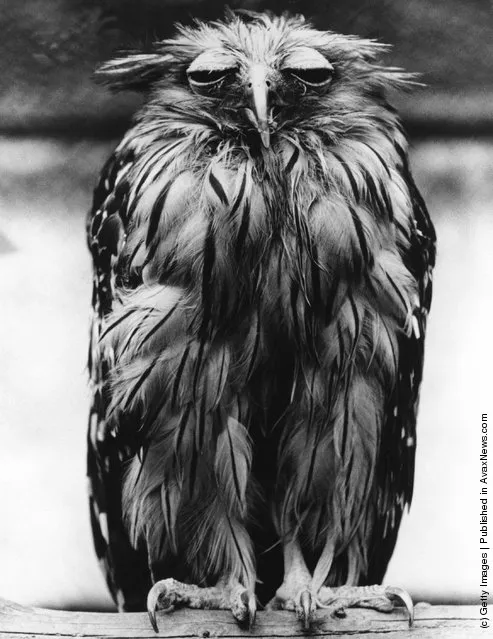
1973: A tired-looking Javan Fish Owl

A tired-looking Javan Fish Owl. (Photo by Fox Photos/Getty Images). 5th December 1973
Details
13 Oct 2011 11:33:00
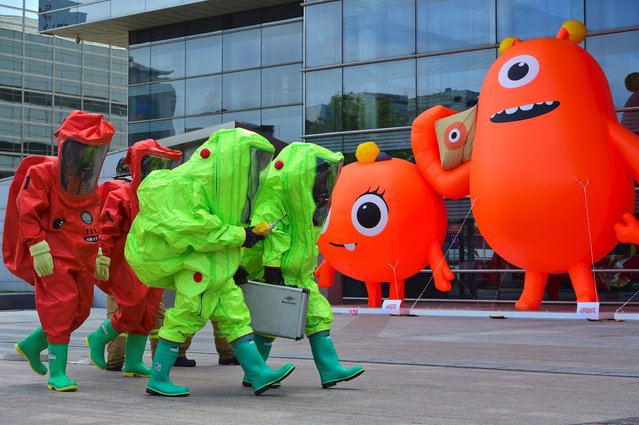
South Korean rescue members wearing chemical protective suits walk past a monster character (R) during an anti-terror drill as part of a disaster management exercise at the COEX shopping and exhibition center in Seoul on May 20, 2016. South Korea is holding its 2016 Safe Korea anti-disaster exercise this week against terrorist threats and natural disasters. (Photo by Jung Yeon-Je/AFP Photo)

South Korean rescue members wearing chemical protective suits walk past a monster character (R) during an anti-terror drill as part of a disaster management exercise at the COEX shopping and exhibition center in Seoul on May 20, 2016. South Korea is holding its 2016 Safe Korea anti-disaster exercise this week against terrorist threats and natural disasters. (Photo by Jung Yeon-Je/AFP Photo)
Details
21 May 2016 11:28:00
A girl smiles as her hair is blown by a strong wind in the Chinatown area in Yokohama, near Tokyo, Friday, January 27, 2017. (Photo by Koji Sasahara/AP Photo)

A girl smiles as her hair is blown by a strong wind in the Chinatown area in Yokohama, near Tokyo, Friday, January 27, 2017. (Photo by Koji Sasahara/AP Photo)
Details
29 Jan 2017 11:49:00
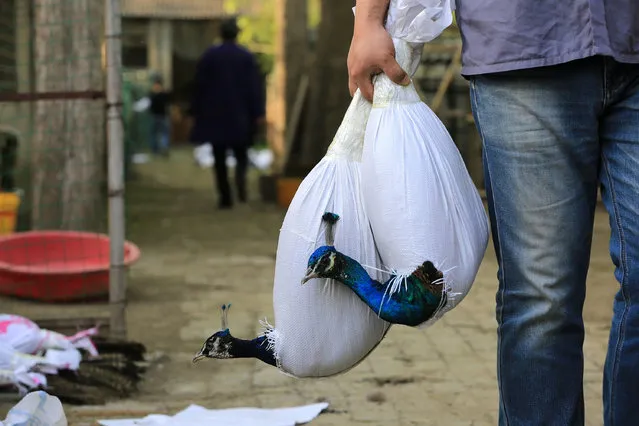
Peacocks are seen covered in bags as a protection of their plume during transportation, in Xiangyang, Hubei province, China April 12, 2017. (Photo by Reuters/Stringer)

Peacocks are seen covered in bags as a protection of their plume during transportation, in Xiangyang, Hubei province, China April 12, 2017. (Photo by Reuters/Stringer)
Details
18 Apr 2017 08:55:00
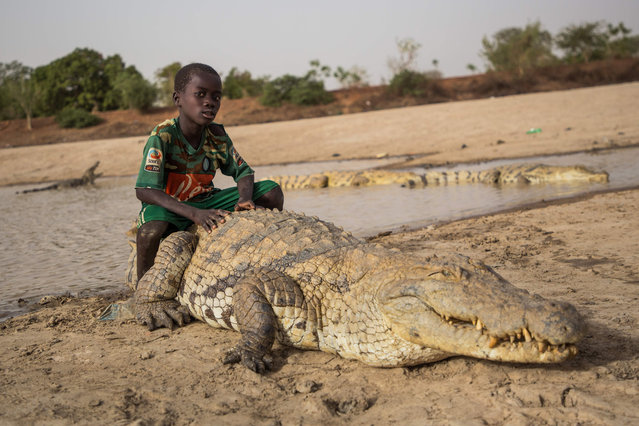
A boy sits on the back of a crocodile on May 19, 2018 at a pond in Bazoule in Burkina Faso, a village which happily shares its local pond with “sacred” crocodiles. Crocodiles may be one of the deadliest hunters in the animal kingdom, but in a small village in Burkina Faso it is not unusual to see someone sitting atop one of the fearsome reptiles. According to local legend, the startling relationship with the predators dates back to at least the 15 th century. The village was in the grip of an agonising drought until the crocodiles led women to a hidden pond where the population could slake their thirst. (Photo by Olympia de Maismont/AFP Photo)

A boy sits on the back of a crocodile on May 19, 2018 at a pond in Bazoule in Burkina Faso, a village which happily shares its local pond with “sacred” crocodiles. Crocodiles may be one of the deadliest hunters in the animal kingdom, but in a small village in Burkina Faso it is not unusual to see someone sitting atop one of the fearsome reptiles. According to local legend, the startling relationship with the predators dates back to at least the 15 th century. The village was in the grip of an agonising drought until the crocodiles led women to a hidden pond where the population could slake their thirst. (Photo by Olympia de Maismont/AFP Photo)
Details
17 Jul 2018 00:01:00
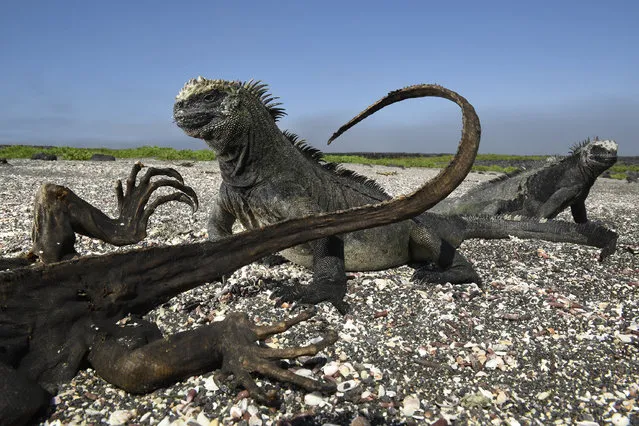
Galapagos – Rocking the Cradle: Four major ocean currents converge along the Galapagos archipelago, creating the conditions for an extraordinary diversity of animal life, April 25, 2016. The islands are home to at least 7,000 flora and fauna species, of which 97 percent of the reptiles, 80 percent of the land birds, 50 percent of the insects and 30 percent of the plants are endemic. The local ecosystem is highly sensitive to the changes in temperature, rainfall and ocean currents that characterize the climatic events known as El Niño and La Niña. These changes cause marked fluctuations in weather and food availability. Many scientists expect the frequency of El Niño and La Niña to increase as a result of climate change, making the Galapagos a possible early-warning location for its effects. (Photo by Thomas P. Peschak for National Geographic/World Press Photo)

Galapagos – Rocking the Cradle: Four major ocean currents converge along the Galapagos archipelago, creating the conditions for an extraordinary diversity of animal life, April 25, 2016. The islands are home to at least 7,000 flora and fauna species, of which 97 percent of the reptiles, 80 percent of the land birds, 50 percent of the insects and 30 percent of the plants are endemic. (Photo by Thomas P. Peschak for National Geographic/World Press Photo)
Details
16 Apr 2018 00:01:00
A nurse shows a syringe with a dose of the COVID-19 vaccine to a citizen who is about to receive it during a vaccination day as part of the campaign in Mexico City at Pepsi Center WTC on May 25, 2021 in Mexico City, Mexico. According to the head of Govermnment, Claudia Sheinbaum, seven municipalities will start their campaign today which plans to apply the first dose to over 500,000 citizens between 50 and 59 years old. (Photo by Hector Vivas/Getty Images)

A nurse shows a syringe with a dose of the COVID-19 vaccine to a citizen who is about to receive it during a vaccination day as part of the campaign in Mexico City at Pepsi Center WTC on May 25, 2021 in Mexico City, Mexico. According to the head of Govermnment, Claudia Sheinbaum, seven municipalities will start their campaign today which plans to apply the first dose to over 500,000 citizens between 50 and 59 years old. (Photo by Hector Vivas/Getty Images)
Details
26 May 2021 09:26:00