Loading...
Done
An aerial view shows the Amazon rainforest at the Bom Futuro National Forest near Rio Pardo in Porto Velho, Rondonia State, Brazil, September 3, 2015. The town of Rio Pardo, a settlement of about 4,000 people in the Amazon rainforest, rises where only jungle stood less than a quarter of a century ago. Loggers first cleared the forest followed by ranchers and farmers, then small merchants and prospectors. (Photo by Nacho Doce/Reuters)

An aerial view shows the Amazon rainforest at the Bom Futuro National Forest near Rio Pardo in Porto Velho, Rondonia State, Brazil, September 3, 2015. The town of Rio Pardo, a settlement of about 4,000 people in the Amazon rainforest, rises where only jungle stood less than a quarter of a century ago. Loggers first cleared the forest followed by ranchers and farmers, then small merchants and prospectors. Brazil's government has stated a goal of eliminating illegal deforestation, but enforcing the law in remote corners like Rio Pardo is far from easy. (Photo by Nacho Doce/Reuters)
Details
08 Nov 2015 08:00:00
Ilyas Wadood (right) of the Islamic Community Center talks with a demonstrator during the "Freedom of Speech Rally Round II" in Phoenix, Arizona May 29, 2015. More than 200 protesters, some armed, berated Islam and its Prophet Mohammed outside an Arizona mosque on Friday in a provocative protest that was denounced by counterprotesters shouting "Go home, Nazis," weeks after an anti-Muslim event in Texas came under attack by two gunmen. REUTERS/Nancy Wiechec

Ilyas Wadood (right) of the Islamic Community Center talks with a demonstrator during the "Freedom of Speech Rally Round II" in Phoenix, Arizona May 29, 2015. More than 200 protesters, some armed, berated Islam and its Prophet Mohammed outside an Arizona mosque on Friday in a provocative protest that was denounced by counterprotesters shouting "Go home, Nazis," weeks after an anti-Muslim event in Texas came under attack by two gunmen. REUTERS/Nancy Wiechec
Details
04 Jun 2015 10:53:00
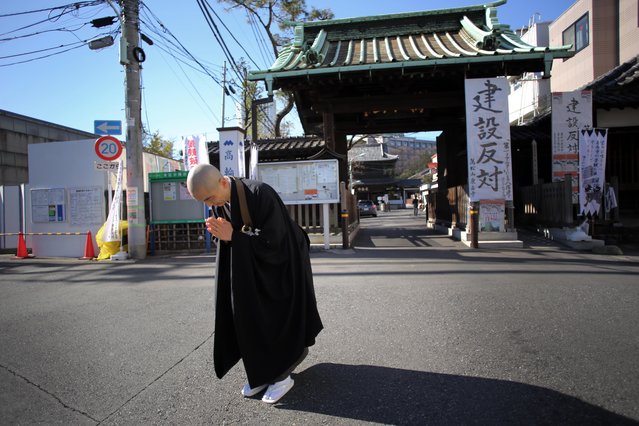
In this January 8, 2015 photo, a monk Kenmyo Muta bows at the condominium construction site and the gate of Sengakuji temple in Tokyo. (Photo by Eugene Hoshiko/AP Photo)

In this January 8, 2015 photo, a monk Kenmyo Muta bows at the condominium construction site and the gate of Sengakuji temple in Tokyo. The “47 ronin” samurai who inspired the long-loved saga of loyalty and honor eulogized in films, books and plays are fighting a new kind of battle in urban Japan. An apartment complex is going up next to the curved tile-roofed Sengakuji temple where the three-century-old graves of the ronin, or masterless samurai, lie. The banner reads: “We only hope to protect landscape of Sengakuji temple”. (Photo by Eugene Hoshiko/AP Photo)
Details
16 Jan 2015 13:01:00
A dog at the Zoozashchita-NN veterinary clinic in Nizhny Novgorod, Russia on February 19, 2021. On February 13, 13 stray dogs with bright blue fur were found and caught at the Dzerzhinskoye Steklo (Dzerzhinsk Glass) factory producing acrylic glass and prussic acid in the city of Dzerzhinsk. The dogs' fur tested positive for the Prussian blue pigment; now the dogs are under supervision at the Zoozashchita-NN vet clinic in Nizhny Novgorod. (Photo by Mikhail Solunin/TASS)

A dog at the Zoozashchita-NN veterinary clinic in Nizhny Novgorod, Russia on February 19, 2021. On February 13, 13 stray dogs with bright blue fur were found and caught at the Dzerzhinskoye Steklo (Dzerzhinsk Glass) factory producing acrylic glass and prussic acid in the city of Dzerzhinsk. The dogs' fur tested positive for the Prussian blue pigment; now the dogs are under supervision at the Zoozashchita-NN vet clinic in Nizhny Novgorod. (Photo by Mikhail Solunin/TASS)
Details
11 Jan 2022 07:20:00
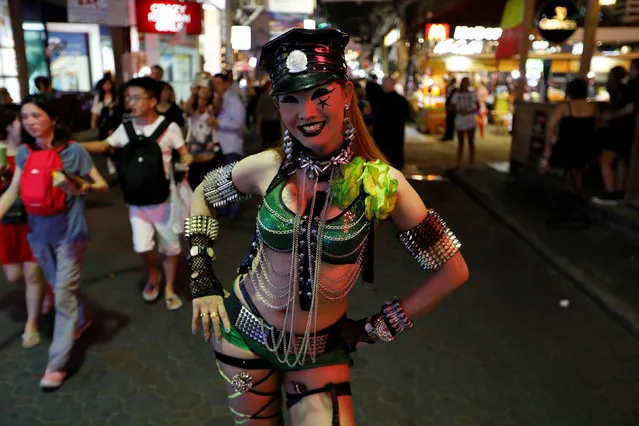
A woman promotes a go-go dance bar in Pattaya, Thailand March 25, 2017. With mascots dressed as smiling fish and a police rock band, Thai authorities launched a “Happy Zone” at the weekend to improve the image of a city notorious for sеx tourism. Stung by foreign headlines portraying the seaside resort of Pattaya as “Sin City” and “The World’s Sеx Capital”, Thailand’s junta has begun a new effort to re-brand it. Businesses in the Happy Zone are asked to make the area feel safer, there are increased security patrols, police launched a mobile phone app for visitors to summon them if an emergency occurs. (Photo by Jorge Silva/Reuters)

A woman promotes a go-go dance bar in Pattaya, Thailand March 25, 2017. With mascots dressed as smiling fish and a police rock band, Thai authorities launched a “Happy Zone” at the weekend to improve the image of a city notorious for sеx tourism. Stung by foreign headlines portraying the seaside resort of Pattaya as “Sin City” and “The World’s Sеx Capital”, Thailand’s junta has begun a new effort to re-brand it. Businesses in the Happy Zone are asked to make the area feel safer, there are increased security patrols, police launched a mobile phone app for visitors to summon them if an emergency occurs. (Photo by Jorge Silva/Reuters)
Details
28 Mar 2017 09:20:00
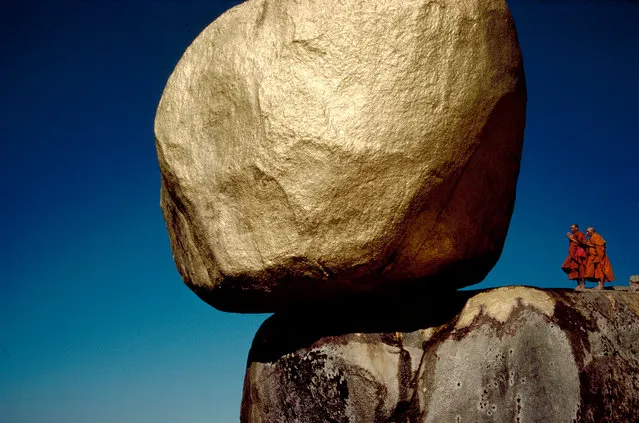
Kyaiktiyo, Burma, 1978. The Golden Rock at Shwe Pyi Daw (the Golden Country), the Buddhist holy place. Hiroji Kubota writes: “I was desperate to keep a distance from America for a while; luckily, I found Burma and its gentle and compassionate people. In the spring of 1978, on the top of the hill where I took this photo, I had two Leica bodies: the one with Tri-X and the other with Kodachrome 64. Soon after, I realised that the colour one looked very colourful and was more powerful. That was my decisive moment, to become a colour photographer”. (Photo by Hiroji Kubota/Magnum Photos)

Kyaiktiyo, Burma, 1978. The Golden Rock at Shwe Pyi Daw (the Golden Country), the Buddhist holy place. Hiroji Kubota writes: “I was desperate to keep a distance from America for a while; luckily, I found Burma and its gentle and compassionate people. In the spring of 1978, on the top of the hill where I took this photo, I had two Leica bodies: the one with Tri-X and the other with Kodachrome 64. Soon after, I realised that the colour one looked very colourful and was more powerful. That was my decisive moment, to become a colour photographer”. (Photo by Hiroji Kubota/Magnum Photos)
Details
10 Jun 2016 13:30:00
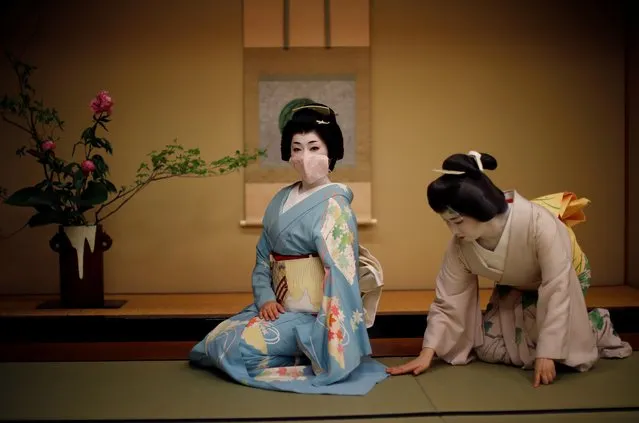
Mayu adjusts Koiku’s kimono, as Koiku wears a protective face mask while posing for a photograph, before they work at a party where they will entertain with other geisha at Japanese luxury restaurant Asada in Tokyo, Japan, June 23, 2020. The coronavirus pandemic has made Tokyo's geisha fear for their centuries-old profession as never before. Though the number of geisha - famed for their witty conversation, beauty and skill at traditional arts - has been falling for years, they were without work for months due to Japan's state of emergency and now operate under awkward social distancing rules. Engagements are down 95 percent, and come with new rules: no pouring drinks for customers or touching them even to shake hands, and sitting 2 meters apart. Masks are hard to wear with their elaborate wigs, so they mostly don't. “I was just full of anxiety”, said Mayu, 47. “I went through my photos, sorted my kimonos ... The thought of a second wave is terrifying”. (Photo by Kim Kyung-Hoon/Reuters)

Mayu adjusts Koiku’s kimono, as Koiku wears a protective face mask while posing for a photograph, before they work at a party where they will entertain with other geisha at Japanese luxury restaurant Asada in Tokyo, Japan, June 23, 2020. (Photo by Kim Kyung-Hoon/Reuters)
Details
23 Jul 2020 00:03:00
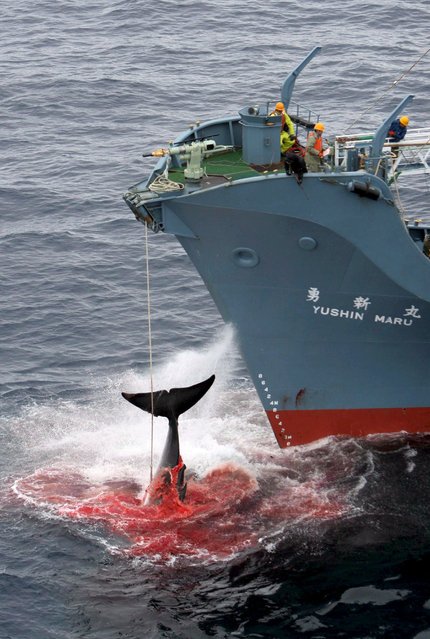
A file photograph dated 07 January 2006 and released by Greenpeace, showing the Yushin Maru, a factory ship in a Japanese whaling fleet, injuring a whale with it's first harpoon attempt. A UN court in The Hague on 31 March 2014 halted Japan's much-criticized whaling programme, ruling that it contravenes a 1986 moratorium on whale hunting. Japan must end its 'research whaling' programme, the International Court of Justice (ICJ) said. (Photo by Kate Davison/EPA)

A file photograph dated 07 January 2006 and released by Greenpeace, showing the Yushin Maru, a factory ship in a Japanese whaling fleet, injuring a whale with it's first harpoon attempt. A UN court in The Hague on 31 March 2014 halted Japan's much-criticized whaling programme, ruling that it contravenes a 1986 moratorium on whale hunting. Japan must end its 'research whaling' programme, the International Court of Justice (ICJ) said. Japan said the programme was for scientific research and permitted under international conventions. Australia had brought the case to the ICJ in 2010, charging that Japan was breaching international law by killing hundreds of whales every year for commercial purposes. Japan was “deeply disappointed” by the ruling, an unnamed government official was quoted by the Kyodo News agency as saying. But the official said Japan would stand by the ruling. (Photo by Kate Davison/EPA)
Details
01 Apr 2014 08:38:00