Loading...
Done
Pine trees are seen after a forest fire near Sao Pedro do Sul, Portugal August 14, 2016. (Photo by Rafael Marchante/Reuters)

Pine trees are seen after a forest fire near Sao Pedro do Sul, Portugal August 14, 2016. Deadly wildfires raging for two weeks in Portugal have destroyed a wooded area the size of 100,000 soccer fields, and the small Iberian nation alone accounts for half of all forests burned in the European Union this year. (Photo by Rafael Marchante/Reuters)
Details
17 Aug 2016 11:07:00
Tiyamike Phiri hopes to become a nurse because she wants to travel the country and help others. (Photo by David Levene/The Guardian)

Life as tenant farmers in Kasungu, northern Malawi, can be a struggle for families trapped in poverty, who feel forced to rely on their children’s help, impacting schooling. Here: A tobacco field at a farm in Kasungu region, Malawi. Tobacco is the country’s most important export crop, with tobacco leaf from Malawi filling cigarettes found all over the world. Here: Tiyamike Phiri hopes to become a nurse because she wants to travel the country and help others. (Photo by David Levene/The Guardian)
Details
27 Jun 2018 00:05:00
Humanoid robots of the children size league compete during the RoboCup 2006 football world championships

“RoboCup is an international robotics competition founded in 1997. The aim is to develop autonomous soccer robots with the intention of promoting research and education in the field of artificial intelligence. The name RoboCup is a contraction of the competition's full name, «Robot Soccer World Cup», but there are many other stages of the competition such as «Search and Rescue» and «Robot Dancing»”. – Wikipedia

Photo: Humanoid robots of the children size league compete during the RoboCup 2006 football world championships final at the Congress Centre on June 18, 2006 in Bremen, Germany. (Photo by Malte Christians/Bongarts/Getty Images)
Details
25 Oct 2011 13:22:00
Tim Laman - Wildlife Photojournalist

Tim Laman is a field biologist and wildlife photojournalist. His pioneering research in the rain forest canopy in Borneo led to a PhD from Harvard and his first National Geographic article in 1997. Since then, he has pursued his passion for exploring wild places and documenting little-known and endangered wildlife by becoming a regular contributor to National Geographic. He has eighteen articles to his credit to date, all of which have had a conservation message. Some have focused on endangered species such as Orangutans or Hornbills, while others, such as a series of articles on Conservation International’s Biodiversity Hotspots, have highlighted regions under intense pressure.
Details
14 Sep 2013 10:13:00


A Geminid meteor streaks diagonally across the sky against a field of star trails behind one of the peaks of the Seven Sisters rock formation in this long exposure early December 14, 2007 in the Valley of Fire State Park in Nevada. The meteor display, known as the Geminid meteor shower because it appears to radiate from near the star Castor in the constellation Gemini, is thought to be the result of debris cast off from an asteroid-like object called 3200 Phaethon. The shower is visible every December. (Photo by Ethan Miller/Getty Images)
Details
07 Jul 2011 10:34:00
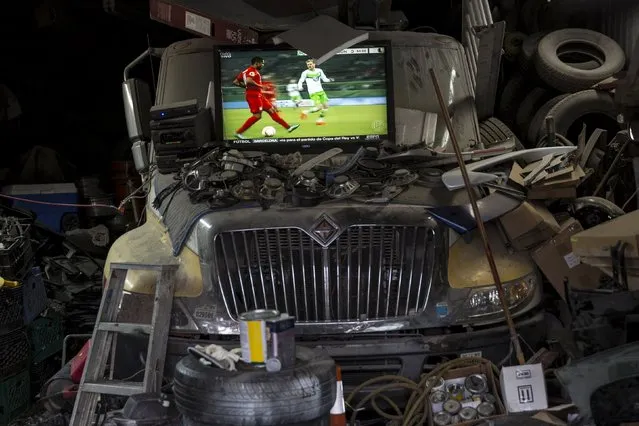
Soccer is played on a television mounted in a workshop in the Willets Point area of Queens in New York October 27, 2015. (Photo by Andrew Kelly/Reuters)

Soccer is played on a television mounted in a workshop in the Willets Point area of Queens in New York October 27, 2015. Willets Point, also known as the Iron Triangle, is an industrial precinct that sits in the shadow of Citi Field, home of the New York Mets baseball team. Many businesses within Willets Point employ a largely immigrant workforce. (Photo by Andrew Kelly/Reuters)
Details
04 Nov 2015 08:00:00
A student of the Sri Lankan ancient martial art “Angampora” performs during a practice session at the angam maduwa or fighting field, in Korathota, a suburb of Colombo, Sri Lanka, 07 September 2022. Sri Lanka's ancient martial art, Angampora, is thought to be thousands of years old. Anga translates to “body parts” and Angampora is a fighting art that uses body parts. Martial arts practitioners in Angampora were mostly in the king's service, and they were tasked with protecting the king and his kingdom. Angampora was practiced in secret for most centuries because the British, who colonized Sri Lanka, banned it in 1818 after seeing it as a threat. (Photo by Chamila Karunarathne/EPA/EFE)

A student of the Sri Lankan ancient martial art “Angampora” performs during a practice session at the angam maduwa or fighting field, in Korathota, a suburb of Colombo, Sri Lanka, 07 September 2022. Sri Lanka's ancient martial art, Angampora, is thought to be thousands of years old. Anga translates to “body parts” and Angampora is a fighting art that uses body parts. Martial arts practitioners in Angampora were mostly in the king's service, and they were tasked with protecting the king and his kingdom. Angampora was practiced in secret for most centuries because the British, who colonized Sri Lanka, banned it in 1818 after seeing it as a threat. (Photo by Chamila Karunarathne/EPA/EFE)
Details
14 Oct 2022 04:47:00
Cuban-American artist Jorge Rodriguez-Gerada's six-acre sand and soil “facescape” stretches across the JFK Hockey Field on the north side of the Reflecting Pool along the National Mall October 1, 2014 in Washington, DC. Titled “Out of Many, One” and composed of 2,500 tons of sand, 800 tons of top soil and eight miles of string, the piece is the artist's interpreative blending of 30 different men's faces. (Photo by Chip Somodevilla/Getty Images)

Cuban-American artist Jorge Rodriguez-Gerada's six-acre sand and soil “facescape” stretches across the JFK Hockey Field on the north side of the Reflecting Pool along the National Mall October 1, 2014 in Washington, DC. Titled “Out of Many, One” and composed of 2,500 tons of sand, 800 tons of top soil and eight miles of string, the piece is the artist's interpreative blending of 30 different men's faces. Rodriguez-Gereda used high-precision global positioning satellites to place 10,000 wood pegs as waypoints for the giant face. The piece will be open to the public beginning October 4 and will eventually be tilled back into the earth. (Photo by Chip Somodevilla/Getty Images)
Details
04 Oct 2014 11:39:00