Loading...
Done
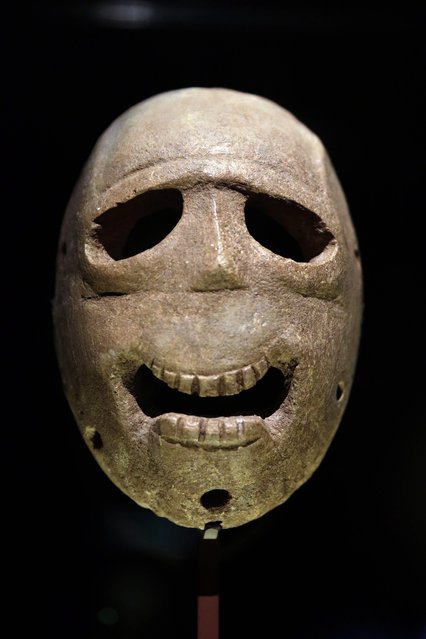
In this  Monday, March 10, 2014 photo, a 9,000 year-old mask is on display at the Israel Museum in Jerusalem.  (Photo by Tsafrir Abayov/AP Photo)

In this Monday, March 10, 2014 photo, a 9,000 year-old mask is on display at the Israel Museum in Jerusalem. The exhibition called “Face To Face” shows eleven stone masks, said to have been discovered in the Judean desert and hills near Jerusalem, which date back 9,000 years and offer a rare glimpse at some of civilization's first communal rituals. (Photo by Tsafrir Abayov/AP Photo)
Details
14 Mar 2014 08:25:00


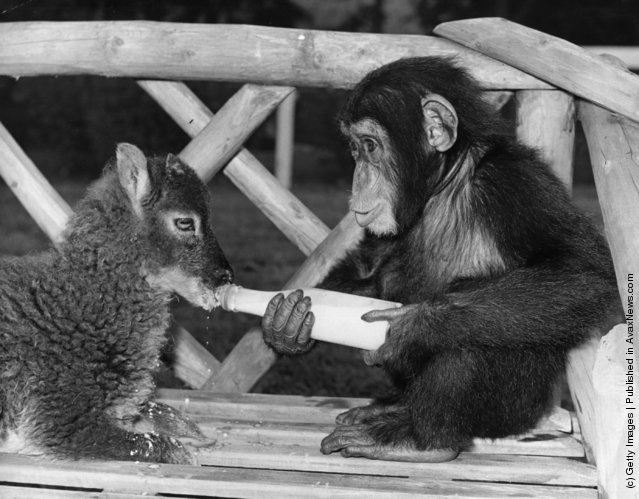
A chimpanzee bottle-feeds a lamb at Southam Zoo Farm in Warwickshire. The owners of the zoo, Mr and Mrs Clews, bring up many of the animals as their pets; the animals, are, as a result, of a friendly disposition. (Photo by Fox Photos/Getty Images). 23rd August 1968
Details
01 Apr 2011 07:47:00
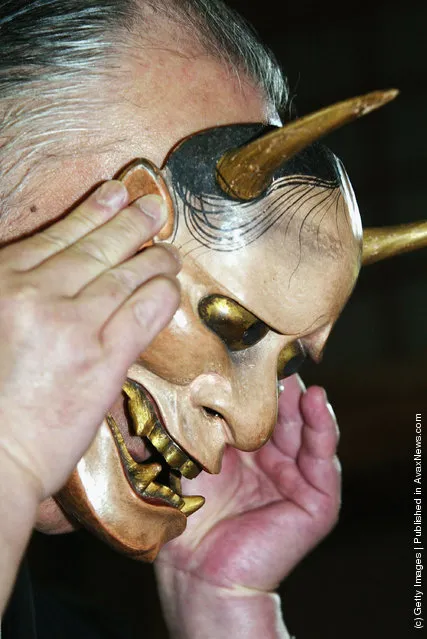
A renowned Noh actor, Otoshige Sakai, demostrates how to put on a Noh mask

“Noh, or Nogaku – derived from the Japanese word for “skill” or “talent” – is a major form of classical Japanese musical drama that has been performed since the 14th century. Many characters are masked, with men playing male and female roles. Traditionally, a Noh “performance day” lasts all day and consists of five Noh plays interspersed with shorter, humorous kyōgen pieces. However, present-day Noh performances often consist of two Noh plays with one Kyōgen play in between”. – Wikipedia

Photo: A renowned Noh actor, Otoshige Sakai, demostrates how to put on a Noh mask, on May 17, 2004 in Tokyo, Japan. (Photo by Koichi Kamoshida/Getty Images)
Details
02 Aug 2011 14:09:00
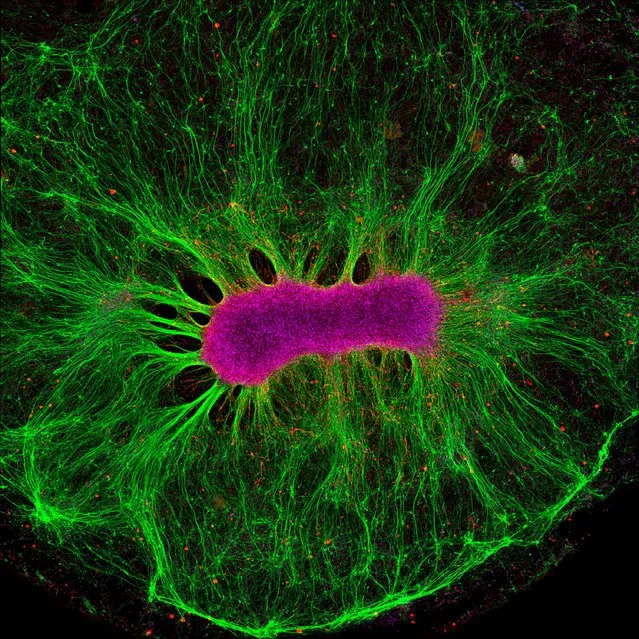
Brain-on-a-chip. Dazzling in green and magenta this image shows the nerve fibres (in green) produced by neural stem cells (in magenta) as they grow on a synthetic gel. Captured by a technique known as confocal microscopy, the image is part of research shedding light on how tinkering with the environment can affect the way in which nerve fibres grow. (Photo by Collin Edington and Iris Lee/Massachusetts Institute of Technology/Wellcome Images)

Brain-on-a-chip. Dazzling in green and magenta this image shows the nerve fibres (in green) produced by neural stem cells (in magenta) as they grow on a synthetic gel. Captured by a technique known as confocal microscopy, the image is part of research shedding light on how tinkering with the environment can affect the way in which nerve fibres grow. (Photo by Collin Edington and Iris Lee/Massachusetts Institute of Technology/Wellcome Images)
Details
17 Mar 2017 00:01:00
Pictured: Wally. (Photo by Dan Borris/Caters News)

This photo series shows curvy canines and flexible felines participating in a spot of yoga. The shots feature the animals in the likes of the lotus position, balancing on two legs, and stretching in ways that would make the greatest of yoga masters proud. Photographer Dan Borris came up with the idea for the series in 2000, when he was asked by a friend to photograph her in a yoga pose while her dog bothered her. Pictured: Wally. (Photo by Dan Borris/Caters News)
Details
13 Feb 2016 09:24:00
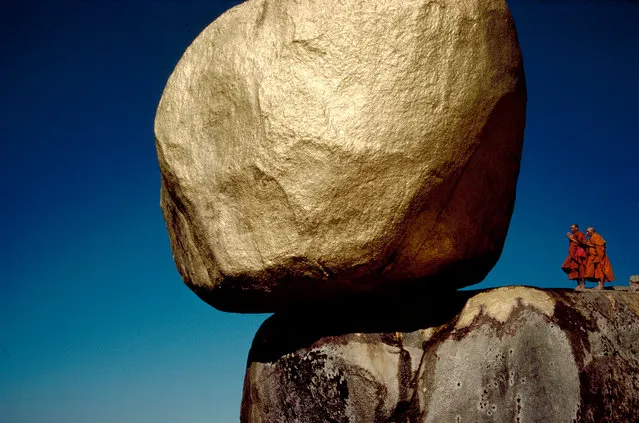
Kyaiktiyo, Burma, 1978. The Golden Rock at Shwe Pyi Daw (the Golden Country), the Buddhist holy place. Hiroji Kubota writes: “I was desperate to keep a distance from America for a while; luckily, I found Burma and its gentle and compassionate people. In the spring of 1978, on the top of the hill where I took this photo, I had two Leica bodies: the one with Tri-X and the other with Kodachrome 64. Soon after, I realised that the colour one looked very colourful and was more powerful. That was my decisive moment, to become a colour photographer”. (Photo by Hiroji Kubota/Magnum Photos)

Kyaiktiyo, Burma, 1978. The Golden Rock at Shwe Pyi Daw (the Golden Country), the Buddhist holy place. Hiroji Kubota writes: “I was desperate to keep a distance from America for a while; luckily, I found Burma and its gentle and compassionate people. In the spring of 1978, on the top of the hill where I took this photo, I had two Leica bodies: the one with Tri-X and the other with Kodachrome 64. Soon after, I realised that the colour one looked very colourful and was more powerful. That was my decisive moment, to become a colour photographer”. (Photo by Hiroji Kubota/Magnum Photos)
Details
10 Jun 2016 13:30:00


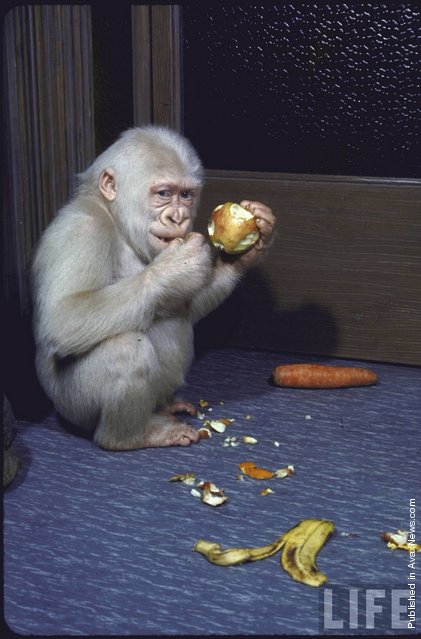
“Snowflake (c. 1964 – November 24, 2003) was an albino gorilla. He was the only known albino gorilla so far, and the most popular resident of the Barcelona Zoo in Catalonia, Spain. Originally named Nfumu Ngui in Fang language ("white gorilla") by his captor, he was then nicknamed Floquet de Neu (Catalan for little snowflake) by his keeper Jordi Sabater Pi. On his arrival to Barcelona where he was given an official reception by the then Mayor of Barcelona, Josep Maria de Porcioles, in November 1966, he was called Blancanieves (“Snow White”) in the newspaper Tele/Exprés. But he became famous with the name given to him by Sabater when National Geographic Magazine featured him on the main page in March 1967, with the English name Snowflake. This name spread among the press (Stern, Life, Paris-Match) and was later translated to Spanish as Copito de Nieve. Sabater himself called the gorilla Floquet or Copi, and in the later years Nfumu. The asteroid 95962 Copito, discovered by Catalan astronomer J. Manteca, is named in his honour”.

Details
07 Mar 2011 15:50:00
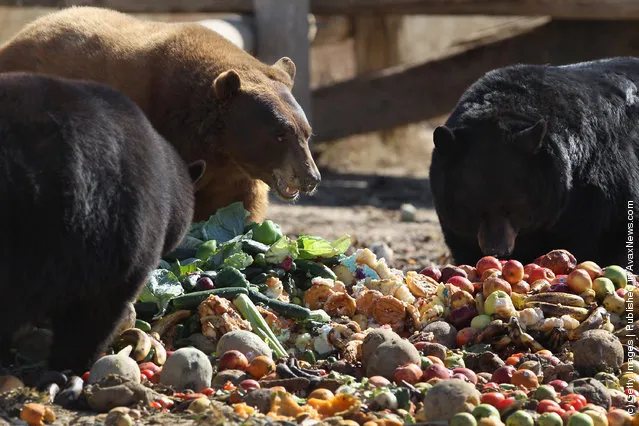
Rescued brown and black bears feed at The Wild Animal Sanctuary

“The Wild Animal Sanctuary is a U.S. organization that specializes in rescuing and caring for large predators which are being ill-treated, for which their owners can no longer care, or which might otherwise be euthanized. Created in 1980, The Wild Animal Sanctuary is situated on 720 acres (291 ha) of grassland near Keenesburg, Colorado North of Denver, and has helped over 1,000 animals since it first opened. As of 2010, it was home to over 290 animals”. – Wikipedia

Photo: Rescued brown and black bears feed at The Wild Animal Sanctuary on October 20, 2011 in Keenesburg, Colorado. (Photo by John Moore/Getty Images)
Details
27 Feb 2012 11:59:00