Loading...
Done
Cenote In Mexico

A cenote is a natural phenomenon, a sinkhole in the Earth’s surface. The Yucatan Peninsula in Mexico has an estimated 7,000 cenotes because it is primarily made up of porous limestone. For millions of years, rainfall slowly ate away at the limestone and a huge system of underground caves and caverns was formed. Many filled with water from rain or from the underground water table. When the roof of a water filled cave collapses, a cenote is born. The water found in a cenote may be fresh water, salt water, or both. Structurally it may be completely open, like a lake, almost completely closed with just a small opening at the top, or somewhere in between.
Details
06 Oct 2013 09:45:00
A graffiti, portraying a woman, is seen in Medellin, Colombia on November 19, 2017. (Photo by Juancho Torres/Anadolu Agency/Getty Images)

A graffiti, portraying a woman, is seen in Medellin, Colombia on November 19, 2017. Mural graffitis from different artists, street art can be seen in almost every city on Earth, but street arts raw power and potential for change was felt by me most intensively in Medellins Comuna 13, previously one of Colombias most dangerous neighbourhoods, in fact Communa 13 was constant battleground between gangs, narcos, paramilitaries and the government, but today you would hardly recognise it. (Photo by Juancho Torres/Anadolu Agency/Getty Images)
Details
22 Nov 2017 05:59:00
Farmer holding a freshly cut cocoa bean pod, revealing the pulp and seed inside on a rainforest farm. (Photo by Doug McKinlay/Getty Images)

Chocolate is the greatest gift the Earth has given us. The dessert table would be a sad sight without it. It’s so beloved, so appreciated, that the Swedish scientist who named the cocoa plant that gives us chocolate called it Theobroma cacao, which means “food of the gods”. Here: Farmer holding a freshly cut cocoa bean pod, revealing the pulp and seed inside on a rainforest farm. (Photo by Doug McKinlay/Getty Images)
Details
10 Aug 2016 10:20:00
Miners search for jade stones at a mine dump at a Hpakant jade mine in Kachin state, Myanmar November 25, 2015. (Photo by Soe Zeya Tun/Reuters)

Miners search for jade stones at a mine dump at a Hpakant jade mine in Kachin state, Myanmar November 25, 2015. Using heavy earth-excavators and explosives, miners have been tearing into Myanmar's northern hills in recent months, in a rush to excavate more jade from the world's richest deposits of the gemstone before a new government takes office next year. (Photo by Soe Zeya Tun/Reuters)
Details
18 Dec 2015 08:03:00
Perfectly situated in the middle of the passage this giant calcite stal boss makes a huge statement. Dwarfed by it's sheer size, Hong Meigui team member; Matt Ryan can only look up in amazement. This is one of many gigantic formations in San Wang Dong. (Photo by Robbie Shone/Caters News/ImagineChina)

“A team of expert cavers and photographers had been exploring caves in the Chongquing province of China – when they were amazed to discover the entrance to a hidden cave that was previously undiscovered. And they were stunned when they managed to enter the ginormous cave – and found that it was so large there was even a cloud inside it – a cave so large it has its own weather system. Photographer and caver Robbie Shone, from Manchester, was part of a team of 15 explorers on a month-long expedition who stumbled across the natural wonder”. – Caters News
Details
23 Mar 2014 00:03:00
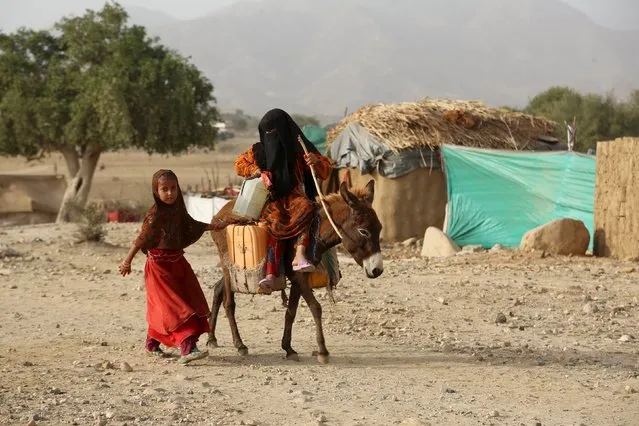
A girl rides a donkey as another walks by at the Shawqaba camp for internally displaced people who were forced to leave their villages by the war in Yemen's northwestern province of Hajjah March 12, 2016. In northwest Yemen, one of the poorest countries in the Middle East, about 400 families uprooted by the war have been stuck in the Shawqaba camp in Hajjah province for the past year. Residents live in poorly built huts that protect them neither from summer heat nor winter cold in a camp that lacks the most basic services. (Photo by Abduljabbar Zeyad/Reuters)

A girl rides a donkey as another walks by at the Shawqaba camp for internally displaced people who were forced to leave their villages by the war in Yemen's northwestern province of Hajjah March 12, 2016. In northwest Yemen, one of the poorest countries in the Middle East, about 400 families uprooted by the war have been stuck in the Shawqaba camp in Hajjah province for the past year. Residents live in poorly built huts that protect them neither from summer heat nor winter cold in a camp that lacks the most basic services. (Photo by Abduljabbar Zeyad/Reuters)
Details
09 Apr 2016 13:16:00
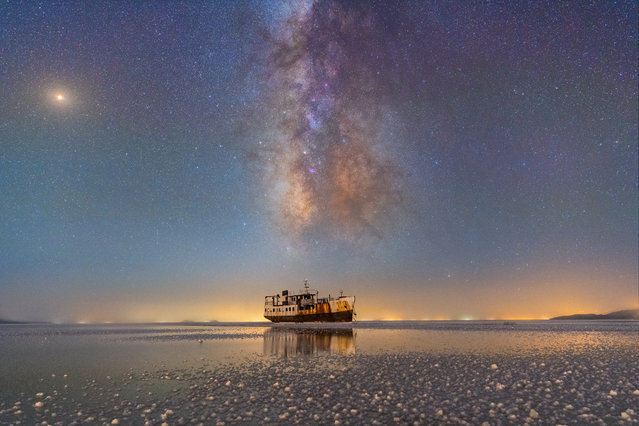
Sharafkhaneh port and lake Urmia. Masoud Ghadiri (Iran). The summer Milky Way is very prominent in this photo. On the galaxy zone, Saturn is located besides the Lagoon nebula. On the right of the horizon, you can see the extreme light pollution of Urmia, which is caused by ever-increasing city development. (Photo by Masoud Ghadiri/National Maritime Museum)

Sharafkhaneh port and lake Urmia. Masoud Ghadiri (Iran). The summer Milky Way is very prominent in this photo. On the galaxy zone, Saturn is located besides the Lagoon nebula. On the right of the horizon, you can see the extreme light pollution of Urmia, which is caused by ever-increasing city development. (Photo by Masoud Ghadiri/National Maritime Museum)
Details
20 Jun 2019 00:01:00
Nuclear power station Temelin, Czech Republic. (Photo by Radek Kalhous/Caters News)

“You wouldn’t normally associate power stations with beautiful scenic shots but one photographer has traveled nearly 2000 to track down the ugliest energy plants and show them in a whole new light. Czech snapper, Radek Kalhous, uses Google Earth to find the perfect locations for his unique pictures and arrives at each site after sunset to create the atmospheric shots”. – Caters News. Photo: Nuclear power station Temelin, Czech Republic. (Photo by Radek Kalhous/Caters News)
Details
27 Jul 2014 11:30:00