Moana Mason, 8, participates in the People's Summit event on Guajara Bay during the COP30 U.N. Climate Summit, Wednesday, November 12, 2025, in Belem, Brazil. (Photo by Joshua A. Bickel/AP Photo)
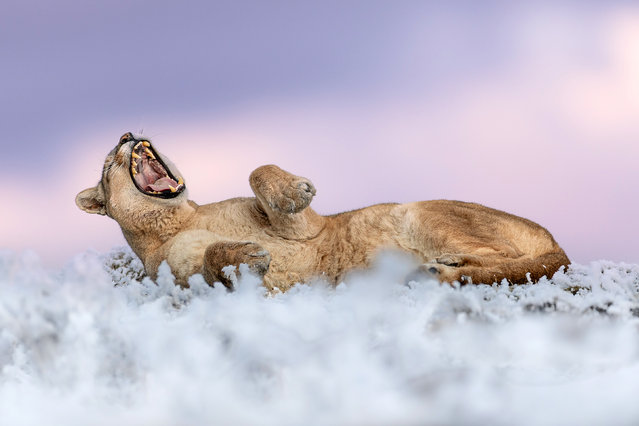
A puma rolls and yawns on frost-covered ground in Laguna Amarga, Torres del Paine, Chile in the first decade of December 2025, pausing briefly after several hours of rest before continuing on her way. (Photo by Sara Jenner/Solent News & Photo Agency)
A lone protester sings outside the offices of Republican president-elect Donald Trump at Trump Tower in New York, New York, U.S. November 14, 2016. (Photo by Carlo Allegri/Reuters)
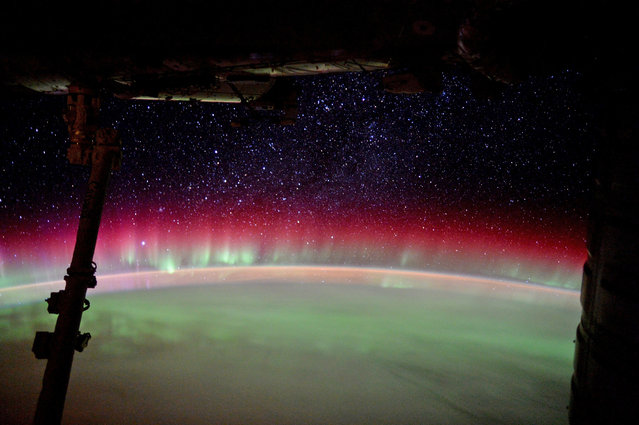
ESA astronaut Tim Peake posted this stunning image on his social media channels, commenting: “Station passed through magnificent aurora Australis last night”. Tim is set to return to Earth on 18 June 2016, bringing his six-month Principia mission to the ISS to an end. During his stay he performed more than 30 scientific experiments for ESA and taking part in numerous others from ESA's international partners. ESA and the UK Space Agency have partnered to develop many exciting educational activities around the Principia mission, aimed at sparking the interest of young children in science and space. (Photo by Tim Peake/ESA/NASA)
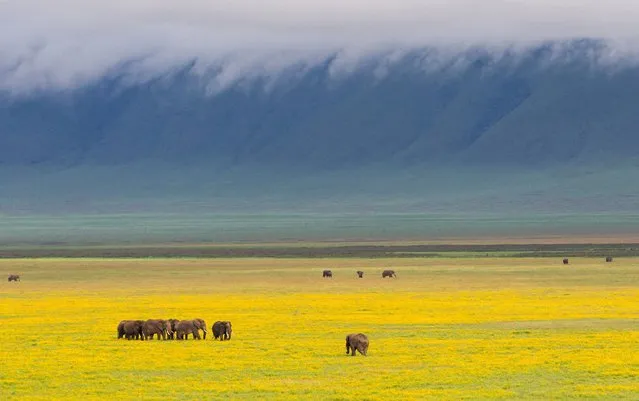
Ngorongoro Crater (Tanzania). At 610m deep and 260 sq km, this is the largest unflooded caldera in the world. A blue-green vision from above it's a haven for engangered wildlife and Maasai livestock. The crater was formed three million years ago when a giant volcano, which could have been as high as Kilimanjaro, exploded and collapsed. The caldera formed the concentric fractures in the crust cracked down to a magma reservoir deep underground. (Photo by John Bryant/Getty Images)
Pakistan girls make selfies holding a Pakistan-made weapon displayed at the four-day International Defence Exhibition and Seminar (IDEAS) 2016 in Karachi, Pakistan, Wednesday, November 23, 2016. (Photo by Shakil Adil/AP Photo)
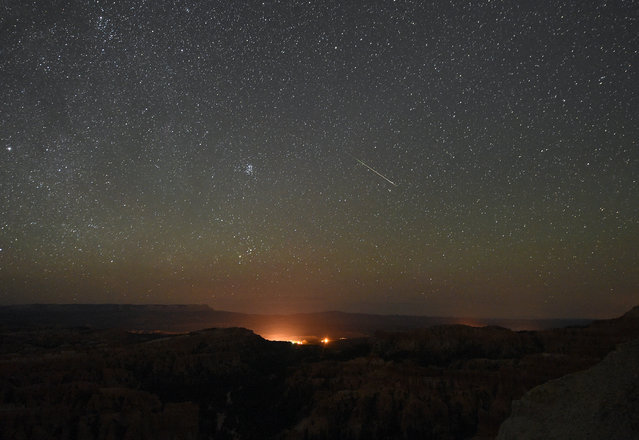
A Perseid meteor streaks across the sky above Inspiration Point early on August 12, 2016 in Bryce Canyon National Park, Utah. The annual display, known as the Perseid shower because the meteors appear to radiate from the constellation Perseus in the northeastern sky, is a result of Earth's orbit passing through debris from the comet Swift-Tuttle. (Photo by Ethan Miller/Getty Images)