Loading...
Done


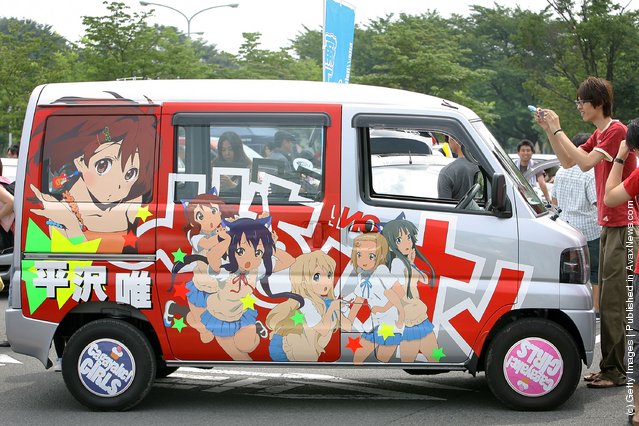
“Itasha (痛車), literally “painmobile”, is a Japanese term for an otaku fad of individuals decorating the bodies of their cars with fictional characters of anime, manga, or video games (especially bishōjo game or eroge). These characters are predominately “cute” female. The decorations usually involve paint schemes and stickers. Automobiles are called Itasha, while similar motorcycles and bicycles are called itansha (痛単車) and itachari (痛チャリ), respectively”. – Wikipedia


Photo: A visitor takes pictures of an anime-decorated «Itasha» car displayed during the “Moe Fes in Washimiya” at Washimiya Town Hall on July 18, 2009 in Washimiya, Saitama, Japan. Itasha, a word derived from “itai” (painful) and “sha” (car), are vehicles decorated with mostly female characters from Japanese manga, anime and video games. (Photo by Kiyoshi Ota/Getty Images)
Details
02 May 2011 08:38:00
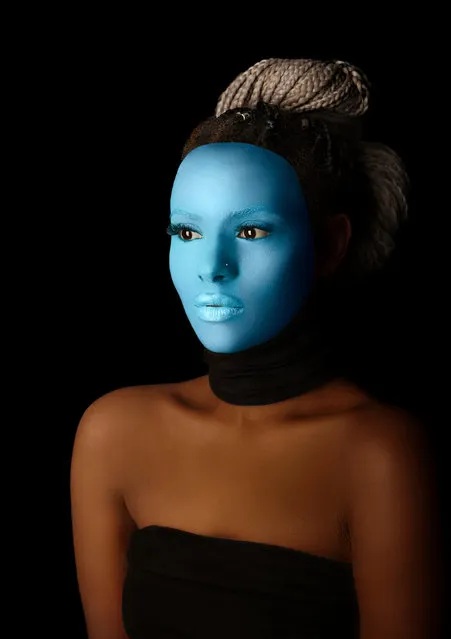
Brtukan. “Being a girl of colour in a society where the majority of the people are white, I have had to get used to all the different ways people approach me. From being asked what kind of rap music you listen to and how you wash your hair, to getting told, “you don’t sound black”, “you’re pretty for a black girl” or “you’re not that black so it’s OK”, as if being black is such a bad thing”. (Photo by Lisa Minogue/The Guardian)

As part of FLAIR Melbourne – a Flinders Lane art festival – Melbourne’s Lisa Minogue presents stylised photographic portraits of Australian women of colour, their faces painted vibrantly to accentuate their individuality and encourage the viewer to study each face more closely. Minogue asked each woman the same question: “What do the words “coloured girl” mean to you?”. (Photo by Lisa Minogue/The Guardian)
Details
17 Aug 2016 11:16:00
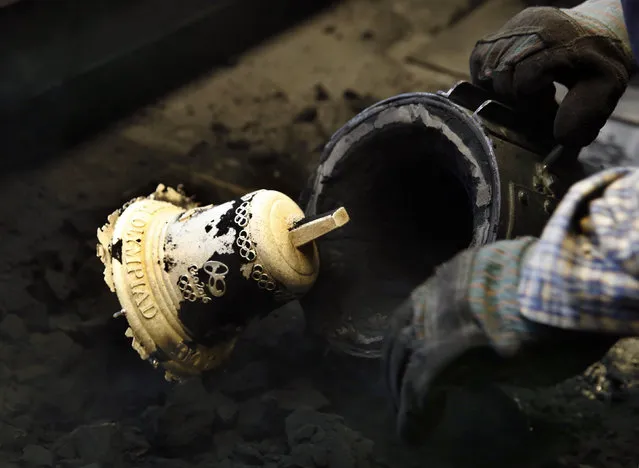
Serge Huguenin of the Blondeau foundry takes the newly melted bell out of the mould in La Chaux-de-Fonds, Switzerland January 21, 2016. At this year's Summer Olympics in Rio de Janeiro, no matter how elaborate the opening ceremony or how sophisticated the live broadcasts, the final lap of athletics races will be announced the traditional way by ringing an old-fashioned bell. (Photo by Denis Balibouse/Reuters)

Serge Huguenin of the Blondeau foundry takes the newly melted bell out of the mould in La Chaux-de-Fonds, Switzerland January 21, 2016. At this year's Summer Olympics in Rio de Janeiro, no matter how elaborate the opening ceremony or how sophisticated the live broadcasts, the final lap of athletics races will be announced the traditional way by ringing an old-fashioned bell. Omega, the official timekeeper of the event, has ordered 21 bells, forged almost entirely by hand by Blondeau's Bell Foundry in the Jura Mountains in Switzerland. Each last-lap bell is branded with the RIO 2016 logo and circled with the words “2016 GAMES OF THE XXXI OLYMPIAD”. (Photo by Denis Balibouse/Reuters)
Details
02 Feb 2016 13:51:00
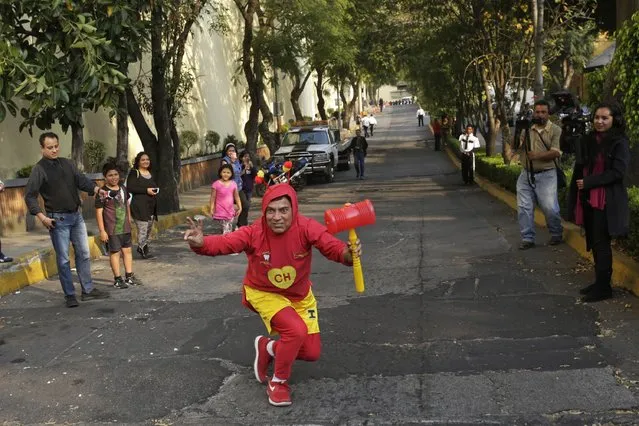
A man dressed as “El Chapulin Colorado”, a character by screenwriter Roberto Gomez Bolanos, performs for fans and media as they wait for the arrival of the funeral van carrying the body of Bolanos, at Mexican media company Televisa in Mexico City November 29, 2014. (Photo by Carlos Jasso/Reuters)

A man dressed as “El Chapulin Colorado”, a character by screenwriter Roberto Gomez Bolanos, performs for fans and media as they wait for the arrival of the funeral van carrying the body of Bolanos, at Mexican media company Televisa in Mexico City November 29, 2014. Mexican actor and screenwriter Roberto Gomez Bolanos, one of Latin America's most beloved comedians, whose slapstick acts charmed fans from Spain to Argentina for over four decades, died on Friday at the age 85. Known as “Chespirito”, a word play on “Little Shakespeare” for his diminutive stature and his prolific scripts, Gomez Bolanos created some of the region's most enduring comic characters. (Photo by Carlos Jasso/Reuters)
Details
01 Dec 2014 13:50:00
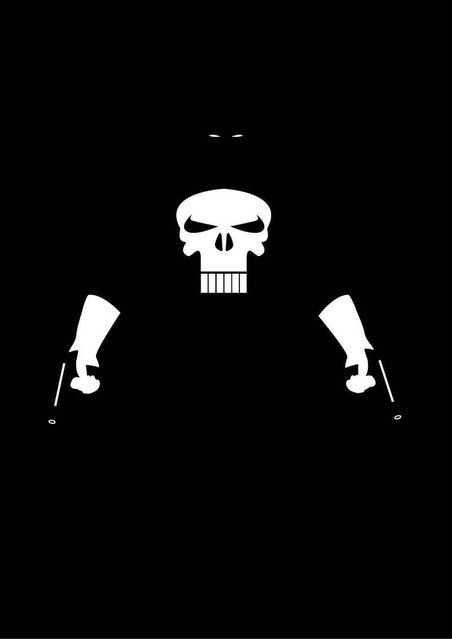
Super Hero Minimalist Posters By Michael Turner Part 1

Have you ever heard of a psychological phenomenon which lets us easily understand words, even if the order of letters is mixed up, as long as the first and last letters remain in their rightful place? Similarly, the art works of Michael Turner use only two colors to highlight the main futures of well-recognized superheroes, allowing our imagination to create the rest of the picture. The colors used in the pictures weren’t chosen at random. They perfectly reflect the key characteristics of the superheroes that they depict. For example, the picture of Flash uses red and yellow colors, which are exactly the colors of his costume. While the picture of Green Lantern is, you’ve guessed it, green and black. (Photo by Michael Turner)
Details
10 Dec 2014 11:38:00
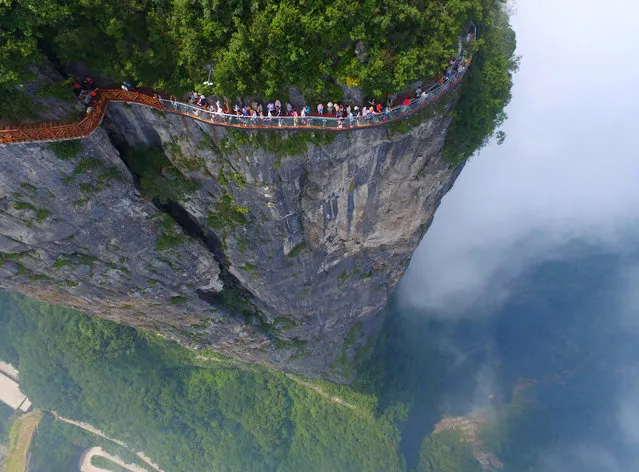
People walk on a sightseeing platform in Zhangjiajie, Hunan Province, China, August 1, 2016. (Photo by Reuters/Stringer)

People walk on a sightseeing platform in Zhangjiajie, Hunan Province, China, August 1, 2016. China has opened a 100-metre-long glass skywalk stretching around a cliff on the side of the Tianmen Mountain. The skywalk provides a view of a 300-metre drop and overlooks Tongtian Avenue, a mountain road with 99 turns that snakes up the mountain. When translated in English, it means “Avenue to the Sky”. (Photo by Reuters/Stringer)
Details
04 Aug 2016 10:39:00
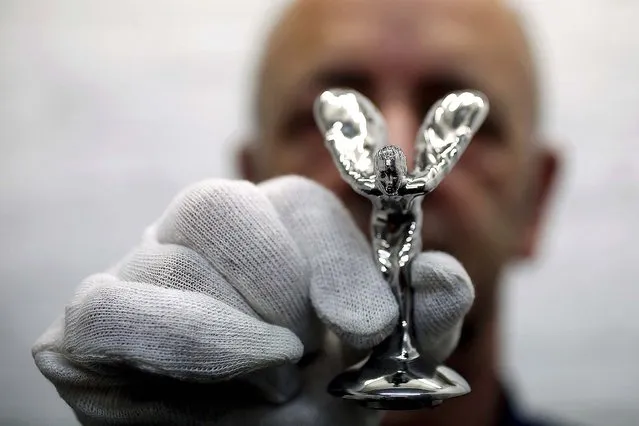
Worker Ronald Little displays a finished “Spirit of Ecstasy”. (Photo by Stefan Wermuth/Reuters)

The Spirit of Ecstasy, also called “Emily”, “Silver Lady” or “Flying Lady,” was designed by English sculptor Charles Robinson Sykes and carries with her a story about a secret passion between John Walter Edward Douglas-Scott-Montagu (second Lord Montagu of Beaulieu after 1905, a pioneer of the automobile movement, and editor of The Car Illustrated magazine) and his love and the model for the emblem, his secretary Eleanor Velasco Thornton. Photo: Worker Ronald Little displays a finished “Spirit of Ecstasy”. (Photo by Stefan Wermuth/Reuters)
Details
21 Oct 2013 11:30:00
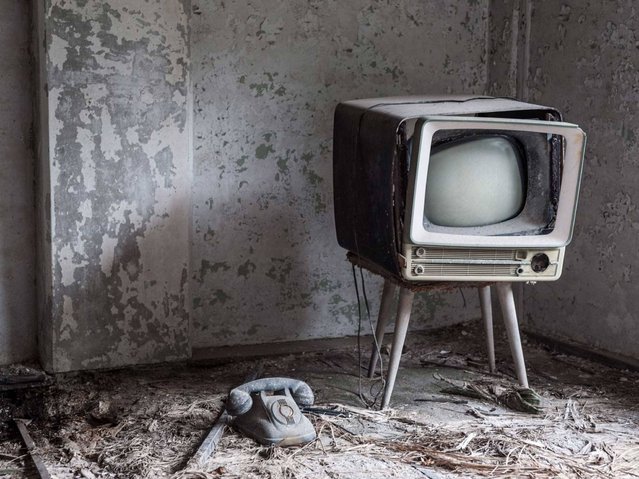
A decades-old television. (Photo by Mark C. O'Flaherty)

The official name for this tiny speck of land – the size of 12 football pitches – is Hashima, but few call it that. In English, its most commonly used name means “Battleship Island” and, viewed from a certain angle offshore, its silhouette is uncannily dreadnought in nature. It was a mining facility until 1974, when it was abandoned to the elements, before partially reopening as a tourist attraction in 2009. Photo: A decades-old television. (Photo by Mark C. O'Flaherty)
Details
15 Jun 2014 11:24:00