Loading...
Done
Stuttgart City Library

The city of Stuttgart, Germany has officially opened a marvelous new media center, the Stuttgart City Library. This cavernous white wonder is unobtrusive in design, where the books and visitors provide the color to an otherwise neutral environment. The visual center of the Stuttgart City Library is its grand atrium, a five-story open chamber that feels like the work of a modernist MC Esher. The interior is bright without direct lighting, it is warm without paint color and intimate yet open. This work by Yi Architects is a success in design, instantly one of the world’s most beautiful libraries
Details
30 Jan 2013 14:39:00
Chess boxing

Chess boxing is a hybrid sport that combines chess with boxing in alternating rounds. The sport was invented by Dutch artist Iepe Rubingh, who was inspired by a French comic book Le Froid Equateur by artist and filmmaker Enki Bilal. Chess boxing is a fast growing sport, with large followings in Berlin and London, where most events take place. Several other chessboxing events have taken place around the world, including in Los Angeles, Tokyo, Nantes (France), Reykjavík (Iceland), Amsterdam, Calcutta (India) and Krasnoyarsk (Russia). Participants must be skilled as both boxers and chess players, as a match may be won either way.
Details
17 Oct 2012 11:17:00
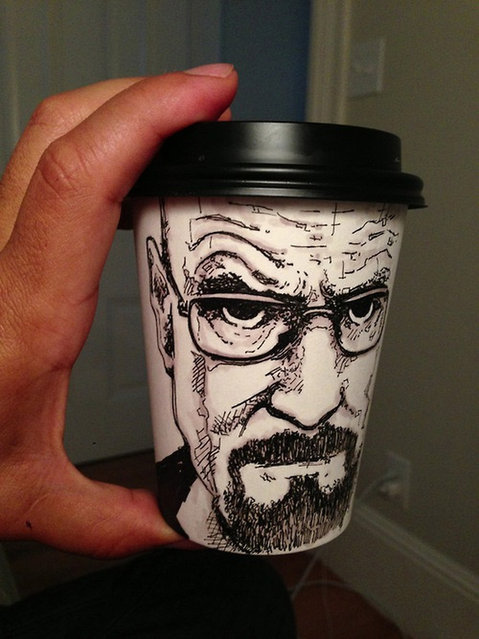
Paper Coffee Cup Art By Miguel Cardona

San Francisco-based design professor Miguel Cardona is selling his custom-drawn “Sketchcups” at Café Sophie for US$20 a piece to benefit Project Night Night, a charity that donates baby blankets, books, and toys to children in homeless shelters. Cardona discusses the project in an interview with Coolhunting. If you'd like to purchase or commission one of Cadona's pieces for yourself, you can do so for US$30 at his Sketchcups Store.
Details
31 Mar 2014 11:55:00
Women wearing prosthetic legs participate in a public photo session at the Hasselblad and Profoto booth, during the CP+ camera and imaging equipment trade fair in Yokohama south of Tokyo, February 14, 2015. (Photo by Thomas Peter/Reuters)

Women wearing prosthetic legs participate in a public photo session at the Hasselblad and Profoto booth, during the CP+ camera and imaging equipment trade fair in Yokohama south of Tokyo, February 14, 2015. Japanese prosthetist Fumio Usui inspired the event after collaborating with photographer Takao Ochi in the book project “Amputee Venus” that portrays 11 Japanese women with artificial legs, local media reported. (Photo by Thomas Peter/Reuters)
Details
21 Feb 2015 11:12:00
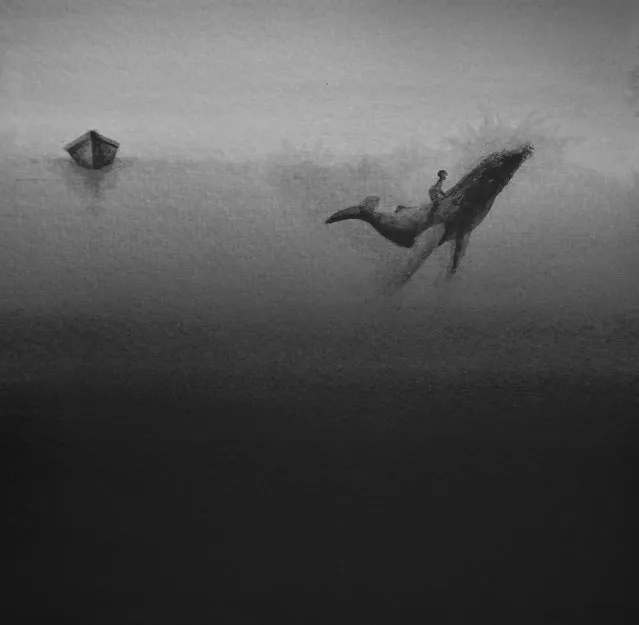
Black And White Watercolors By Artist Elicia Edijanto

There’s an innate relationship between children and the animal kingdom. Our children sing songs about animals, the have toy animals, they have books about animals and they dream about animals. Capturing this unique connection is Indonesian artist Elicia Edijanto, who depicts small, vulnerable children alongside creatures of the wild like elephants, wolves and bears. Created in stark black and white imagery, and using only watercolors, Edijanto creates dreamlike-scenes that are both tranquil and contemplative.
Details
17 Feb 2016 08:01:00
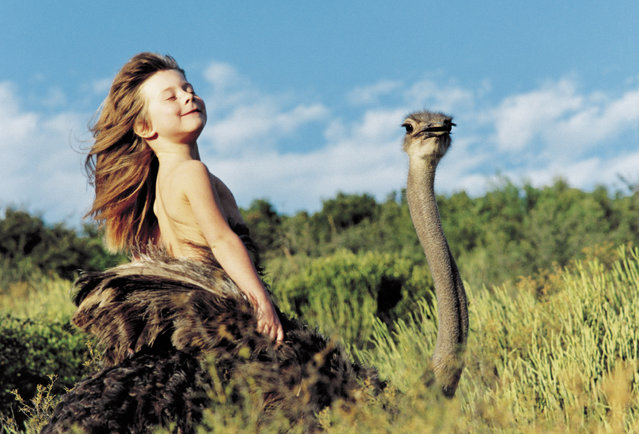
Tippi aged 6 sitting on the back of Linda, a tamed ostrich in South Africa, 1996. (Photo by Sylvie Robert/Barcroft Media)

Tippi aged 6 sitting on the back of Linda, a tamed ostrich in South Africa, 1996. Incredible pictures of the real life Mowgli, a girl who spent the first ten years of her life growing up in the African bush, have been released for the first time. The magical images chronicle the life of Tippi Benjamine Okanti Degré, who was brought up with wild animals, just like Rudyard Kipling's hero did in The Jungle Book. (Photo by Sylvie Robert/Barcroft Media)
Details
10 Dec 2016 08:48:00
These black-and-white photos are taken from the new book “Armoured Warfare in the First World War 1916 – 1918” by Anthony Tucker-Jones and published by Pen & Sword Military. “Interestingly the British, French and Germans took completely different approaches with varying results”. The British military produced “Little Willie” in Autumn 1915 weighing 18 tonnes, which had a crew of two plus four gunners. “Inspired by a tracked artillery tractor “Little Willie” was referred to as a water tank – hence the name tank – to ensure secrecy”, said Anthony. “This led to the strange looking Mark I with its peculiar rhomboid shape, designed to cross trenches with guns in sponsons on either side. The Germans saw the tank as unchivalrous and were slow to grasp its utility. They favoured the Stormtrooper (specialist soldiers used to infiltrate enemy trenches) and artillery, not the tank”, said Anthony. “However, they didn’t hesitate to make use of captured British tanks. Although the tank helped secure victory and German soldiers dubbed it “Germany’s Downfall” the country was ultimately brought to its knees by the Allies blockade”. Here: British troops hitch a ride on a Mark IV after the massed tank fleet spearheading attack at Cambrai on November 20, 1917. (Photo by Anthony Tucker-Jones/Mediadrumworld.com)

These black-and-white photos are taken from the new book “Armoured Warfare in the First World War 1916 – 1918” by Anthony Tucker-Jones and published by Pen & Sword Military. Here: British troops hitch a ride on a Mark IV after the massed tank fleet spearheading attack at Cambrai on November 20, 1917. (Photo by Anthony Tucker-Jones/Mediadrumworld.com)
Details
23 Feb 2017 00:02:00
American science fiction writer L. Ron Hubbard, founder of the Church of Scientology, uses his Hubbard Electrometer

“Lafayette Ronald Hubbard (March 13, 1911 – January 24, 1986), better known as L. Ron Hubbard (and often referred to by his initials, LRH), was an American pulp fiction author and religious leader who founded the Church of Scientology. After establishing a career as a writer, becoming best known for his science fiction and fantasy stories, he developed a self-help system called Dianetics which was first published in May 1950. He subsequently developed his ideas into a wide-ranging set of doctrines and rituals as part of a new religious movement that he called Scientology. His writings became the guiding texts for the Church of Scientology and a number of affiliated organizations that address such diverse topics as business administration, literacy and drug rehabilitation”. – Wikipedia

Photo: American science fiction writer L. Ron Hubbard, founder of the Church of Scientology, uses his Hubbard Electrometer (patent pending) to determine whether tomatoes experience pain, 1959. His work led him to the conclusion that tomatoes “scream when sliced”. (Photo by Scott Lauder/Evening Standard/Hulton Archive/Getty Images)
Details
09 Sep 2011 09:34:00