Loading...
Done
Marutaro The Hedgehog Part 1

With more than 40,000 followers on Twitter and 26,400 fans on Vine, it looks like Marutaro the hedgehog from Japan is one of the most popular hedgehogs on the Internet. And as his owner keeps on posting Marutaro’s pictures online daily, Marutaro’s popularity continues to grow. There are hundreds of cute photographs and videos of this little fellow, but the ones with little paper cut-out faces are probably the cutest. As Marutaro lies on his back, his owner gives him a variety of silly expressions and smiles. The 20 best of them will definitely boost your mood!
Details
09 Apr 2014 10:18:00


Are online casino games all fixed

Short answer: no.

I know, this answer was a little too short, so let me explain in a little more detail.

Imagine tossing a coin. Normally, any normal coin toss has two possible outcomes - heads or tails - with each one having a 50% chance of happening. Ideally, that is, because factors like the force of your finger tossing the coin, gravity, the wind, the moon phase and a passing TARDIS can all influence the outcome of the toss - but I have deviated from the subject.
Details
14 May 2014 07:28:00
Rubber Legs By Rauf Yasit

There are many types of hobbies. Some of them are strange, such as piercing your skin with huge metal hooks with ropes attached to them, and dangling yourself from the ceiling. Others might enjoy riding down huge mountain hills on skis, snowboards, mountain boards, bikes, etc. However, some enjoy pastimes that are more tranquil and meditative. For example, the art of contortionism is a very peculiar hobby that is usually practiced by women and children, due to the natural stretchiness of their tendons. Despite the fact that tendons of grown men are usually too stiff, a Berlin-based dancer is able to do amazing things with his body and is not afraid to show it to the world.
Details
27 Feb 2015 14:35:00
We Build Tomorrow – Sagrada Familia 2026 ( VIDEO )

For more than a century, the Barcelona skyline has been graced (or marred, depending on who’s talking) by the spectacle of the Basilica designed by Anton Gaudi, first started in 1882. If you want to know what it’ll look like when finished, don’t fret — 2026 is right around the corner. Or you can watch this video, released last week on YouTube by Basílica de la Sagrada Família and titled simply “2026 We Build Tomorrow,” a 3-D artists’ rendering of the building stages through completion.
(If 144 years sounds like a long time to finish a cathedral, keep in mind that there were decades that they didn’t work on it — and that Notre Dame de Paris took 182 years, although the 13th century Parisians didn’t have diesel-powered industrial cranes.) Now, if only the video could show us what the admission and hours will be in 2026 (and how to avoid the inevitable long lines).
Details
11 Jan 2014 10:59:00
Norwegian Trolls By Ivar Rodningen Part 1

Ivar Rodningem is a professional illustrator, whose imaginative mind transports us into a parallel world where trolls roam the lands. These creatures might seem scary at first sight, but in reality they are very docile and friendly, help each other and humans that they happen to meet. One of their characteristic features is of course their large noses and long tails. They are one with the nature, which is why it is almost impossible to see a troll if he doesn’t want to be found. Just like you and I they love having fun, though it is hard thing to do, considering their size.


See also:Part 2
Details
26 Feb 2015 20:03:00
Two keepers at the Australian Reptile Park in New South Wales struggle with Leonardo, an alligator snapping turtle weighing 45 kilos at the park in Gosford, NSW 2 July 2015. The 50cm long Leonardo – who was smuggled illegally into Australia and found in a Sydney sewer in November 200 – was removed from his tank for an annual health check. And as a gesture to onlooking press photographers demonstrated his strength by snapping a piece of bamboo in half. (Photo by EPA/HO)

Two keepers at the Australian Reptile Park in New South Wales struggle with Leonardo, an alligator snapping turtle weighing 45 kilos at the park in Gosford, NSW 2 July 2015. The 50cm long Leonardo – who was smuggled illegally into Australia and found in a Sydney sewer in November 2000 – was removed from his tank for an annual health check. And as a gesture to onlooking press photographers demonstrated his strength by snapping a piece of bamboo in half. (Photo by EPA/HO)
Details
03 Jul 2015 12:53:00
Rescue workers try to pull out a piece of an exploded Grad missile outside an apartment building in Vostochniy district of Mariupol, Eastern Ukraine, Sunday, January 25, 2015. Indiscriminate rocket fire slammed into a market, schools, homes and shops Saturday in Ukraine's southeastern city of Mariupol. (Photo by Evgeniy Maloletka/AP Photo)

Rescue workers try to pull out a piece of an exploded Grad missile outside an apartment building in Vostochniy district of Mariupol, Eastern Ukraine, Sunday, January 25, 2015. Indiscriminate rocket fire slammed into a market, schools, homes and shops Saturday in Ukraine's southeastern city of Mariupol, killing at least 30 people, authorities said. The Ukrainian president called the blitz a terrorist attack and NATO and the U.S. demanded that Russia stop supporting the rebels. (Photo by Evgeniy Maloletka/AP Photo)
Details
26 Jan 2015 11:25:00
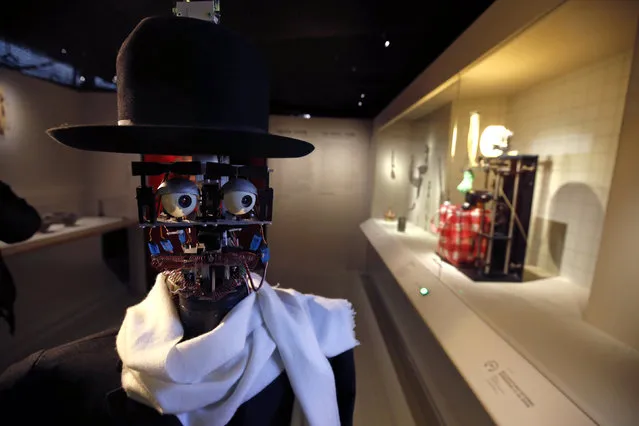
The Berenson robot strolls among visitors during the exhibition “Persona : Oddly Human” at the Quai Branly museum in Paris, France, February 23, 2016. The Berenson robot, developed in France in 2011, is the brainchild of anthropologist Denis Vidal and robotics engineer Philippe Gaussier. Its programming allows it to record reactions of museum visitors to certain pieces of art and then use the data to develop its own unique taste, which allows “Berenson” to judge whether or not it likes a certain work of art within an exhibition. (Photo by Philippe Wojazer/Reuters)

The Berenson robot strolls among visitors during the exhibition “Persona : Oddly Human” at the Quai Branly museum in Paris, France, February 23, 2016. The Berenson robot, developed in France in 2011, is the brainchild of anthropologist Denis Vidal and robotics engineer Philippe Gaussier. Its programming allows it to record reactions of museum visitors to certain pieces of art and then use the data to develop its own unique taste, which allows “Berenson” to judge whether or not it likes a certain work of art within an exhibition. (Photo by Philippe Wojazer/Reuters)
Details
25 Feb 2016 12:26:00