Loading...
Done
Asus Zenbook

Computer Inc. (Asus) unveiled the Zenbook, the new super-thin laptops. Encased in brushed steel, the Zenbook feels solid, yet light. “The super-thin laptop’s $999 configuration, which includes 4 GB of 133MHz DDR 3 RAM, a 128 GB SATA Solid State Drive (SSD) and two USB 3.0 ports, is $200 cheaper than a similarly configured “competitor” (read: MacBook Air). You can by a MacBook Air for $999 with the same Intel Core i5 CPU — but with only half the memory and storage space. Zenbook would get 7 hours of battery life (roughly 3.4 hours of streaming video and 3.25 hours of gameplay) and could remain in standby for up to two weeks”.
Details
13 Oct 2011 10:57:00
Turkish guard police take special training, lasting 316 hours, for carrying out their job at best at Police Training Center Directorate of Guarding Training Academy of Turkiye on June 1, 2022. in Ankara, Turkiye. A training covers forty nine different subjects such as “behavior analysis“, “security systems and devices”, “risk analysis and security configuration”, “advanced and safe driving techniques”, “first aid, protocol and etiquette”, “foreign language”, “pedestrian and vehicle protection applications”, “fx pistol scenario training”, “shooting simulation training”, “shooting training”. (Photo by Evrim Aydin/Anadolu Agency via Getty Images)

Turkish guard police take special training, lasting 316 hours, for carrying out their job at best at Police Training Center Directorate of Guarding Training Academy of Turkiye on June 1, 2022. in Ankara, Turkiye. (Photo by Evrim Aydin/Anadolu Agency via Getty Images)
Details
30 Jun 2022 04:54:00
Tin and Naing win live on a small boat which they sail throughout the Delta region in Myanmar. The former gardeners once had a home on land but it was destroyed when a powerful cyclone ravaged the area in 2008. Since then, the couple have not been able to afford to rebuild their home, so they live on the boat from which they sell fish paste to make a living. (Photo by Muse Mohammed/IOM)

The ferocity of crises worldwide is forcing a record number of people to flee their homes, seeking some form of safety within their own country or across international borders. There are 65.3 million displaced people worldwide, including 21.3 million refugees. Most have lost their homes to armed conflict or natural disasters but other factors, such as extreme poverty and climate change, also drive displacement. The International Organisation for Migration commissioned photojournalist Muse Mohammed to document the plight of the displaced. (Photo by Muse Mohammed/IOM)
Details
02 Jan 2017 12:04:00
American science fiction writer L. Ron Hubbard, founder of the Church of Scientology, uses his Hubbard Electrometer

“Lafayette Ronald Hubbard (March 13, 1911 – January 24, 1986), better known as L. Ron Hubbard (and often referred to by his initials, LRH), was an American pulp fiction author and religious leader who founded the Church of Scientology. After establishing a career as a writer, becoming best known for his science fiction and fantasy stories, he developed a self-help system called Dianetics which was first published in May 1950. He subsequently developed his ideas into a wide-ranging set of doctrines and rituals as part of a new religious movement that he called Scientology. His writings became the guiding texts for the Church of Scientology and a number of affiliated organizations that address such diverse topics as business administration, literacy and drug rehabilitation”. – Wikipedia

Photo: American science fiction writer L. Ron Hubbard, founder of the Church of Scientology, uses his Hubbard Electrometer (patent pending) to determine whether tomatoes experience pain, 1959. His work led him to the conclusion that tomatoes “scream when sliced”. (Photo by Scott Lauder/Evening Standard/Hulton Archive/Getty Images)
Details
09 Sep 2011 09:34:00
These black-and-white photos are taken from the new book “Armoured Warfare in the First World War 1916 – 1918” by Anthony Tucker-Jones and published by Pen & Sword Military. “Interestingly the British, French and Germans took completely different approaches with varying results”. The British military produced “Little Willie” in Autumn 1915 weighing 18 tonnes, which had a crew of two plus four gunners. “Inspired by a tracked artillery tractor “Little Willie” was referred to as a water tank – hence the name tank – to ensure secrecy”, said Anthony. “This led to the strange looking Mark I with its peculiar rhomboid shape, designed to cross trenches with guns in sponsons on either side. The Germans saw the tank as unchivalrous and were slow to grasp its utility. They favoured the Stormtrooper (specialist soldiers used to infiltrate enemy trenches) and artillery, not the tank”, said Anthony. “However, they didn’t hesitate to make use of captured British tanks. Although the tank helped secure victory and German soldiers dubbed it “Germany’s Downfall” the country was ultimately brought to its knees by the Allies blockade”. Here: British troops hitch a ride on a Mark IV after the massed tank fleet spearheading attack at Cambrai on November 20, 1917. (Photo by Anthony Tucker-Jones/Mediadrumworld.com)

These black-and-white photos are taken from the new book “Armoured Warfare in the First World War 1916 – 1918” by Anthony Tucker-Jones and published by Pen & Sword Military. Here: British troops hitch a ride on a Mark IV after the massed tank fleet spearheading attack at Cambrai on November 20, 1917. (Photo by Anthony Tucker-Jones/Mediadrumworld.com)
Details
23 Feb 2017 00:02:00
Aerial view of the “Viracocha III”, a boat made only from the totora reed, as it is being prepared to cross the Pacific from Chile to Australia on an expected six-month journey, La Paz, Bolivia, October 19, 2016. An expedition in a boat made only of reeds crafted by indigenous Bolivians is getting ready to cross the Pacific from South America to Australia, in a fresh attempt to prove that ancient mariners were capable of making the journey. Phil Buck, a 51-year-old explorer from the United States, already has led two similar expeditions and will captain the “Viracocha III” set to depart from northern Chile in February on an expected six-month journey. (Photo by David Mercado/Reuters)

Aerial view of the “Viracocha III”, a boat made only from the totora reed, as it is being prepared to cross the Pacific from Chile to Australia on an expected six-month journey, La Paz, Bolivia, October 19, 2016. An expedition in a boat made only of reeds crafted by indigenous Bolivians is getting ready to cross the Pacific from South America to Australia, in a fresh attempt to prove that ancient mariners were capable of making the journey. (Photo by David Mercado/Reuters)
Details
20 Oct 2016 10:53:00
Japan To Commemorate 6 Months Anniversary Of Earthquake And Tsunami

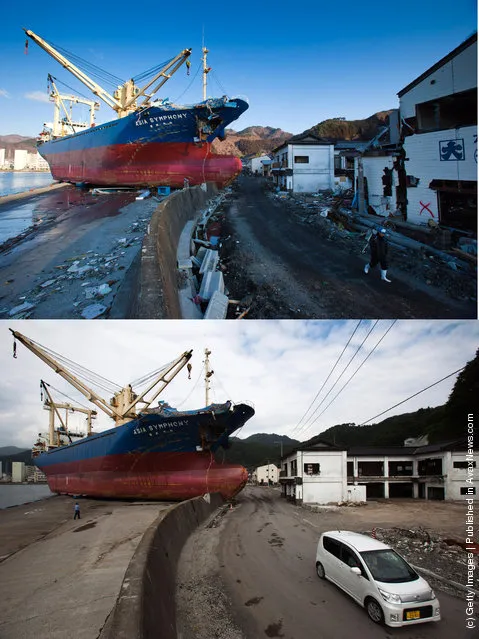
In this composite image, (Bottom Photo) a car drives past a ship called Asia Symphony that was left stranded prior to the sixth month anniversary of the March 11 earthquake and massive tsunami on September 10, 2011 in Kamaishi, Iwate Prefecture, Japan. (Top Photo) Local residents walk past the Asia Symphony, which has been left stranded after being lifted up onto the promenade of the docks March 24, 2011 in Kamaishi, Iwate Prefecture, Japan. A 9.0 magnitude strong earthquake struck Japan offshore on March 11 at 2:46pm local time, triggering a tsunami wave of up to ten metres which engulfed large parts of north-eastern Japan and also damaging the Fukushima nuclear plant, causing the worst nuclear crisis in decades. The current number of dead and missing is reportedly estimated to be 22,900. (Photo by Athit Perawongmetha/Getty Images)
Details
11 Sep 2011 10:06:00
Plagued by Doubt By Thomas Wightman

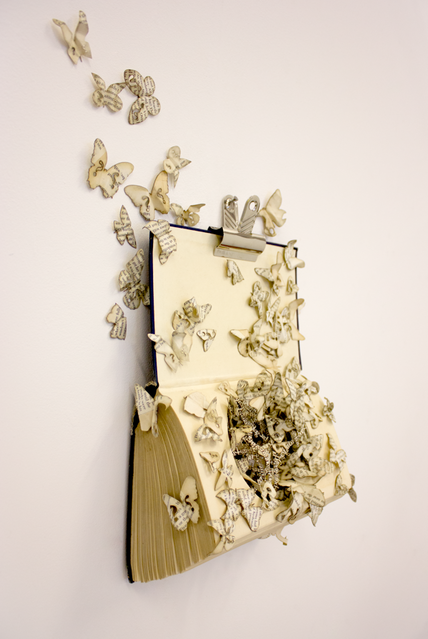
Thoughts. They fly through the broad expenses of our mind, floating gracefully in midair, going into the clouds, and then reemerging once again. Some are quick and furtive, others are grand and majestic. We reflect upon them as they enter our minds, and once they leave, they are usually gone for good. However, some thoughts are different. These thoughts resemble a flock of angry birds or a swarm of hungry moths that invade your mind, slowly eating away at your sanity, strength, and desire to live. Such thoughts often plague that minds of people with Obsessive Compulsive disorder. They completely occupy their time; constantly there; ever-present. With his book sculpture, Thomas Wightman was able to accurately convey the way these thoughts consume the mind, slowly building a nest within it, resisting all attempts to drive them away.

Thomas Wightman


See Also: Derailing My Train of Thought
Details
19 Mar 2015 09:11:00