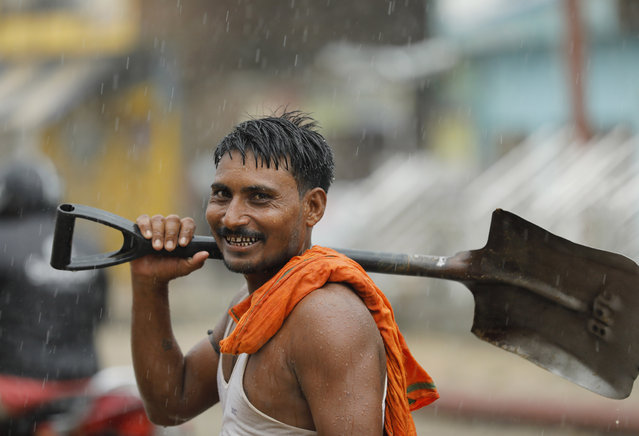
An Indian worker crosses a street holding a shovel during monsoon rains in Prayagraj, in the northern Indian state of Uttar Pradesh, Wednesday, July 29, 2020. (Photo by Rajesh Kumar Singh/AP Photo)
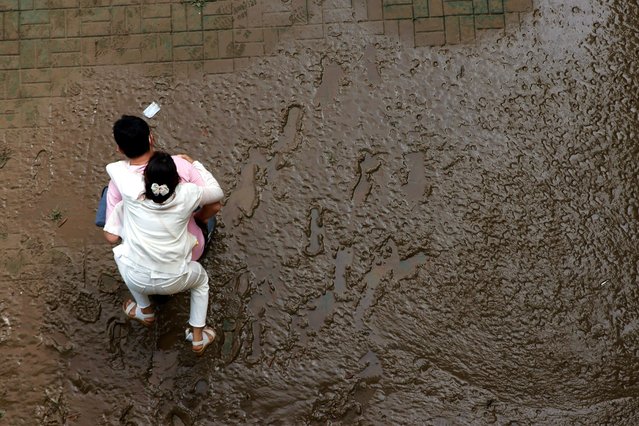
A man crosses a mud-covered trail carrying his wife on his back at a flooded Han River park in Seoul, South Korea, August 4, 2020. (Photo by Kim Hong-Ji/Reuters)
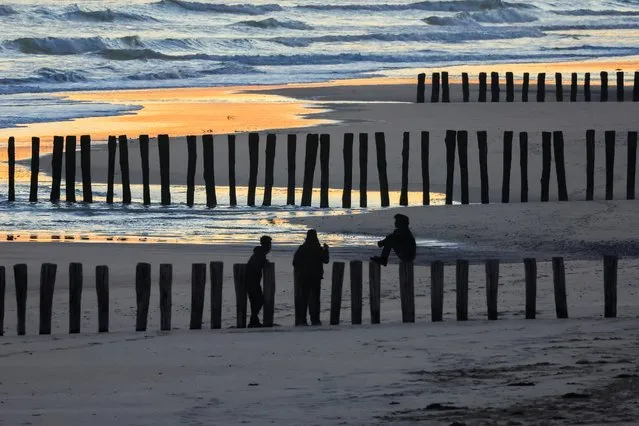
A view of migrants on the beach at sunrise after a fail attempt to cross the Channel to the UK on a small boat, in Sangatte, near Calais, France on August 10, 2023. (Photo by Pascal Rossignol/Reuters)
1st Place in Wildlife: A male orangutan peers from behind a tree while crossing a river in Borneo, Indonesia. (Photo by Jayaprakash Joghee Bojan/National Geographic Nature Photographer of the Year contest 2017)
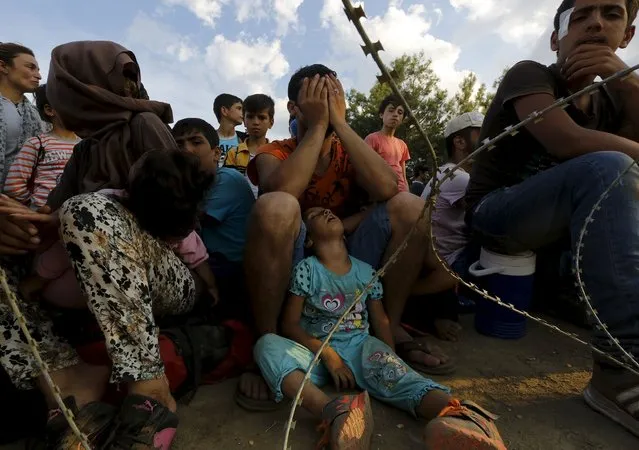
Syrian refugees sit behind barbed wire as they wait to cross into Macedonia at the Greek-Macedonian border, near the village of Idomeni, August 21, 2015. (Photo by Yannis Behrakis/Reuters)
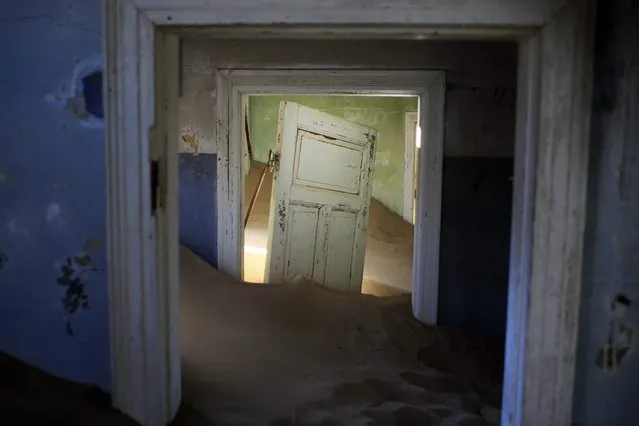
In this July 23, 2013 photo, sand fills an abandoned house in Kolmanskop, Namibia. Kolmanskop, was a diamond mining town south of Namibia, build in 1908 and deserted in 1956. SInce then, the desert slowly reclaims its territory, with sand invading the buildings where 350 German colonists and more than 800 local workers lived during its hay-days of the 1920s. (Photo by Jerome Delay/AP Photo)
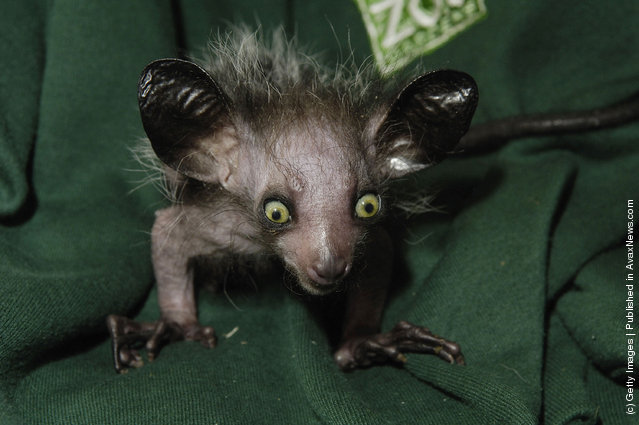
“The aye-aye (Daubentonia madagascariensis) is a lemur, a strepsirrhine primate native to Madagascar that combines rodent-like teeth and a special thin middle finger to fill the same ecological niche as a woodpecker. It is the world's largest nocturnal primate, and is characterized by its unusual method of finding food; it taps on trees to find grubs, then gnaws holes in the wood and inserts its narrow middle finger to pull the grubs out. The only other animal species known to find food in this way is the striped possum. From an ecological point of view the aye-aye fills the niche of a woodpecker as it is capable of penetrating wood to extract the invertebrates within”. – Wikipedia
Photo: In this handout image from Bristol Zoo is seen the first captive bred aye-aye in the UK named “Kintana” (meaning star in Malagasy) April 15, 2005 at Bristol Zoo Gardens, England. The zoo announced today only the second baby aye-aye to be hand-reared in the world (the first was in Jersey Zoo) and has now made his first public appearance since his birth on 11 February 2005. (Photo by Rob Cousins/Bristol Zoo via Getty Images)
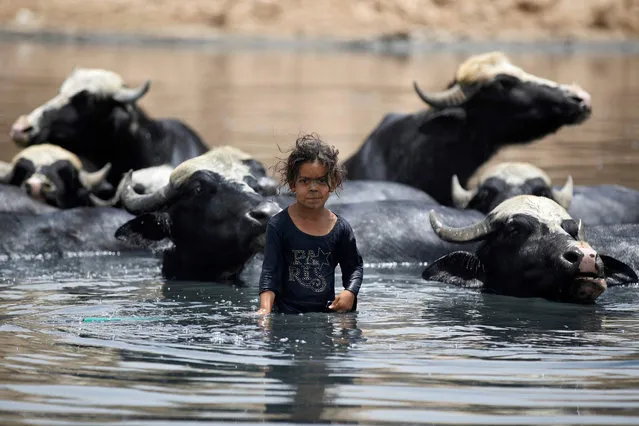
A young Iraqi shepherdess cools down buffaloes in wastewater filling the dried-up Diyala river which was a tributary of the Tigris, in the Al-Fadiliyah district east of Baghdad, on June 26, 2022. Iraq's drought reflects a decline in the level of waterways due to the lack of rain and lower flows from upstream neighboring countries Iran and Turkey. (Photo by Ahmad Al-Rubaye/AFP Photo)