Loading...
Done
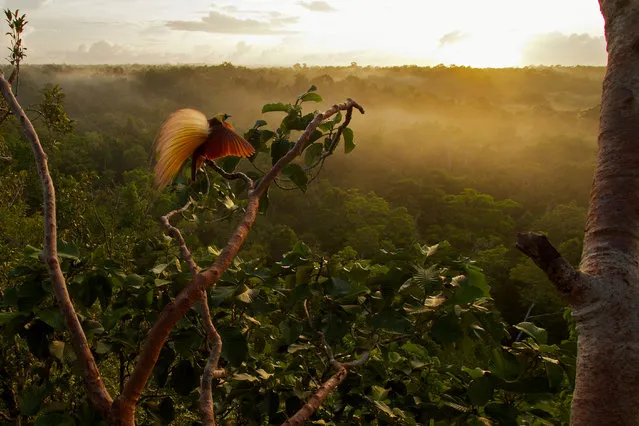
A greater bird of paradise (Paradisaea apoda) displaying in Badigaki Forest, Wokam Island (Aru Islands, Indonesia). Found here in Aru and on adjacent New Guinea, the greater bird of paradise represents about 40 different species of birds of paradise that depend on intact rainforest across the New Guinea region spanning eastern Indonesia and Papua New Guinea. With more than 80% of forest cover still intact, this region represents the largest remaining block of rainforest in the entire Asia-Pacific. (Photo by Tim Laman/naturepl.com/LDY Agency)

A greater bird of paradise (Paradisaea apoda) displaying in Badigaki Forest, Wokam Island (Aru Islands, Indonesia). Found here in Aru and on adjacent New Guinea, the greater bird of paradise represents about 40 different species of birds of paradise that depend on intact rainforest across the New Guinea region spanning eastern Indonesia and Papua New Guinea. With more than 80% of forest cover still intact, this region represents the largest remaining block of rainforest in the entire Asia-Pacific. (Photo by Tim Laman/naturepl.com/LDY Agency)
Details
14 Nov 2021 05:57:00
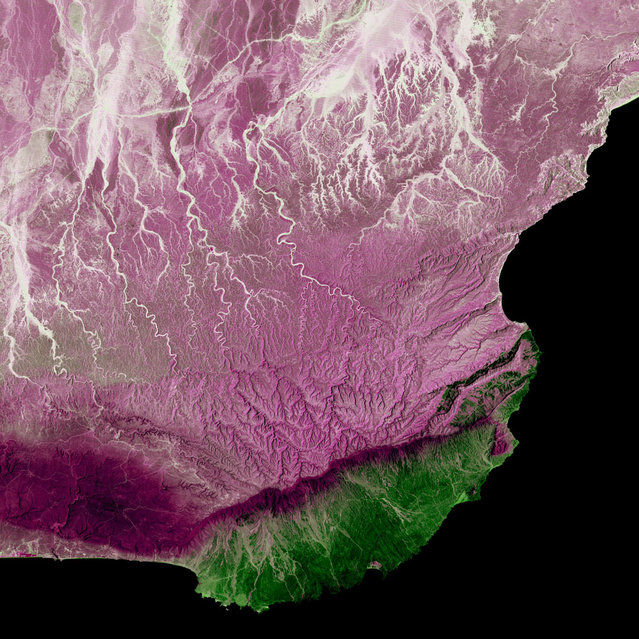
Dhofar Region, Oman. Much of Oman is desert, but the Arabian Sea coast in the Dhofar region represents a startling difference in climate. This coastal region catches the monsoon rains, or khareef, during the summer months. Drenching rains fall primarily on the mountainous ridge that separates the lush, fertile areas along the coast from the arid interior, recharging streams, waterfalls and springs that provide plentiful water supplies in the fertile lowlands for the remainder of the year. Image taken by Landsat 5 on April 2, 2005. (Photo by USGS/NASA)

Dhofar Region, Oman. Much of Oman is desert, but the Arabian Sea coast in the Dhofar region represents a startling difference in climate. This coastal region catches the monsoon rains, or khareef, during the summer months. Drenching rains fall primarily on the mountainous ridge that separates the lush, fertile areas along the coast from the arid interior, recharging streams, waterfalls and springs that provide plentiful water supplies in the fertile lowlands for the remainder of the year. Image taken by Landsat 5 on April 2, 2005. (Photo by USGS/NASA)
Details
25 Dec 2012 11:13:00
At the 50th anniversary of the Hartford Automobile Club a 1914 Mercer with an economical wind screen, looking like a large magnifying glass, designed to offer minimum wind resistance. Brass is used instead of chrome for the “shiny” parts, circa 1955. (Photo by Three Lions)

At the 50th anniversary of the Hartford Automobile Club a 1914 Mercer with an economical wind screen, looking like a large magnifying glass, designed to offer minimum wind resistance. Brass is used instead of chrome for the “shiny” parts, circa 1955. (Photo by Three Lions)
Details
28 Sep 2012 10:56:00
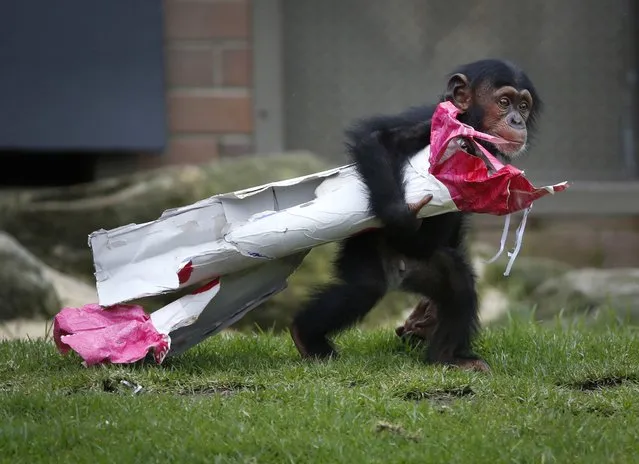
A 13-month-old chimp named Fumo carries a “Christmas present” of food treats in wrapping paper under his arm during a Christmas-themed feeding time at Sydney's Taronga Park Zoo, December 9, 2014. Fumo, meaning “chief” or “spear” in Swahili, is one of the latest additions to the zoo's successful primate breeding program. (Photo by Jason Reed/Reuters)

A 13-month-old chimp named Fumo carries a “Christmas present” of food treats in wrapping paper under his arm during a Christmas-themed feeding time at Sydney's Taronga Park Zoo, December 9, 2014. Fumo, meaning “chief” or “spear” in Swahili, is one of the latest additions to the zoo's successful primate breeding program. (Photo by Jason Reed/Reuters)
Details
09 Dec 2014 09:32:00
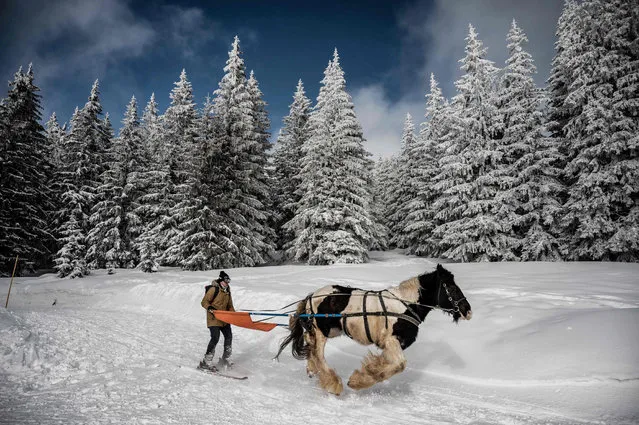
A person practices ski-joering at the Avoriaz resort in the French Alps on February 11, 2021. (Photo by Jeff Pachoud/AFP Photo)

A person practices ski-joering at the Avoriaz resort in the French Alps on February 11, 2021. (Photo by Jeff Pachoud/AFP Photo)
Details
08 Apr 2021 10:41:00
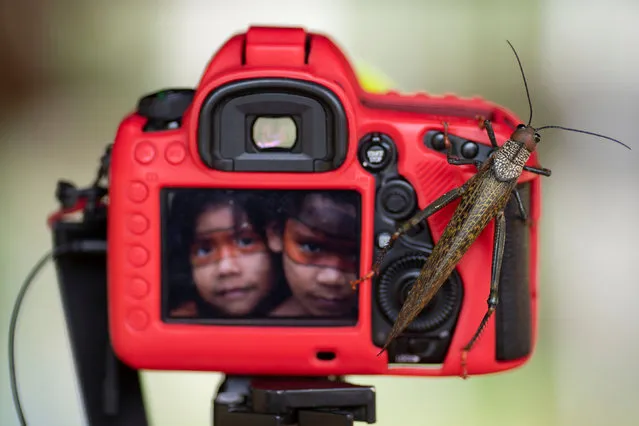
A grasshopper rests on a photographic camera during a meeting in the village of Alto Jamari called to face the threat of armed land grabbers invading the Uru-eu-wau-wau Indigenous Reservation near Campo Novo de Rondonia, Brazil on January 30, 2019. (Photo by Ueslei Marcelino/Reuters)

A grasshopper rests on a photographic camera during a meeting in the village of Alto Jamari called to face the threat of armed land grabbers invading the Uru-eu-wau-wau Indigenous Reservation near Campo Novo de Rondonia, Brazil on January 30, 2019. (Photo by Ueslei Marcelino/Reuters)
Details
16 Mar 2019 00:03:00
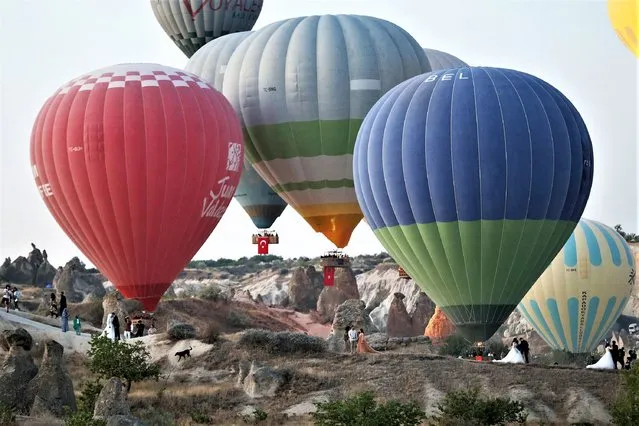
Hot-air balloons glide over the historical Cappadocia region with Turkish flags to mark August 30 Turkiye's Victory Day in Nevsehir, Turkiye on August 30, 2023. (Photo by Behcet Alkan/Anadolu Agency via Getty Images)

Hot-air balloons glide over the historical Cappadocia region with Turkish flags to mark August 30 Turkiye's Victory Day in Nevsehir, Turkiye on August 30, 2023. (Photo by Behcet Alkan/Anadolu Agency via Getty Images)
Details
23 Jan 2024 09:51:00


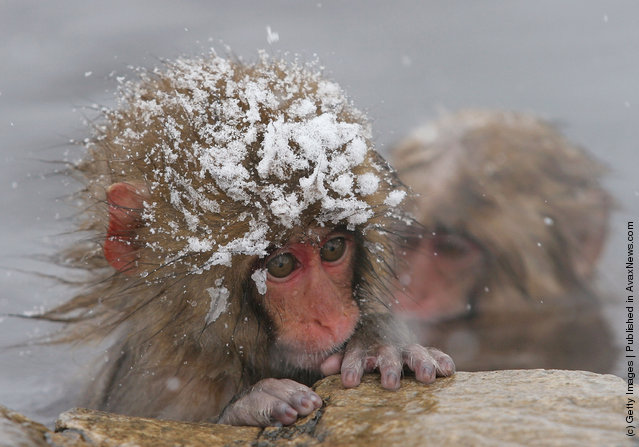
Japanese macaque monkeys enjoy sitting in the hot springs at Jigokudani-Onsen (Hell Valley) on January 23, 2005 in Jigokudani, Nagano-Prefecture, Japan. Japanese Macaques, also known as snow monkeys are the most northerly nonhuman primate in the world. In 1963 a female Macaque ventured into the hot springs to retrieve some soybeans. This behaviour was adopted by other monkeys, and eventually by the entire troop. This Macaque troop regularly visits the Jigokudani-Onsen springs to escape the cold. The hot springs are said to help relieve nerve pain and fatigue. (Photo by Koichi Kamoshida/Getty Images)
Details
20 May 2011 08:04:00