Loading...
Done
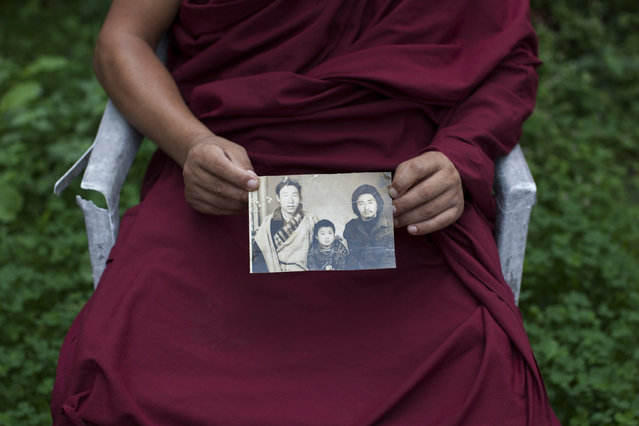
In this Saturday, September 27, 2014 photo, Tibetan monk Dorjee, 38, displays a photograph of his father, left, and himself, center, taken in Tibet, in Dharamsala, India. Dorjee said he held back his tears when he spoke with his parents on the phone after a separation period of 27 years. He exchanged a few words with his father but said his mother fainted on hearing his voice. (Photo by Tsering Topgyal/AP Photo)

“When I was 8 years old, my parents paid a smuggler to take me across the Himalayas, a weekslong walk over the mountains from Tibet to India. It was a trek that tens of thousands of other Tibetans have taken since the Dalai Lama fled a failed 1959 uprising against Chinese rule. My parents must have had their reasons to send me here; they must have had the best of intentions. But 18 years later, I still don't know why they did it. They are not political people. They are small farmers who raise barley and a few yak in a rural area not far from Lhasa, the Tibetan capital. I have not seen them since I left...”. – Tsering Topgyal via The Associated Press. (Photo by Tsering Topgyal/AP Photo)
Details
05 Nov 2014 12:27:00
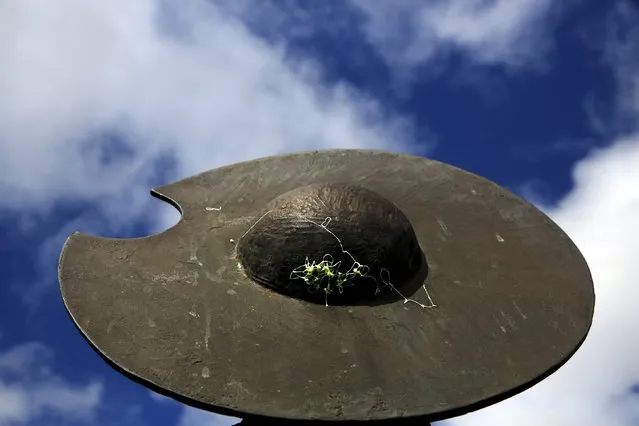
A sculpture of Don Quixote shows him wearing the basin he mistook for the enchanted helmet of the fictional Moorish king Mambrino in Alcazar de San Juan, Spain, April 5, 2016. (Photo by Susana Vera/Reuters)

A sculpture of Don Quixote shows him wearing the basin he mistook for the enchanted helmet of the fictional Moorish king Mambrino in Alcazar de San Juan, Spain, April 5, 2016. The arid central Spanish region of La Mancha is the setting for “Don Quixote”, the seventeenth-century novel by Miguel de Cervantes. Four hundred years after his death, references to the characters of Don Quixote, his loyal squire Sancho Panza and his beautiful lady Dulcinea abound in the surrounding villages from sweet treats to theatre productions involving livestock. Cervantes did not give away the name of the birthplace of Don Quixote, a middle-aged gentleman who becomes obsessed with chivalrous ideals. But many identify the village of Argamasilla de Alba as his hometown. The anniversary of Cervantes’ death is marked on the 23 April. (Photo by Susana Vera/Reuters)
Details
21 Apr 2016 12:32:00
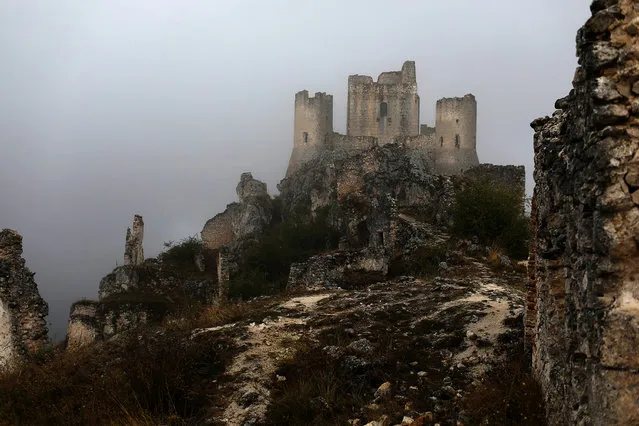
The ruins of a castle stand above the town of Rocca Calascio, close to Santo Stefano di Sessanio in the province of L'Aquila in Abruzzo, inside the national park of the Gran Sasso e Monti della Laga, Italy, September 7, 2016. (Photo by Siegfried Modola/Reuters)

The ruins of a castle stand above the town of Rocca Calascio, close to Santo Stefano di Sessanio in the province of L'Aquila in Abruzzo, inside the national park of the Gran Sasso e Monti della Laga, Italy, September 7, 2016. (Photo by Siegfried Modola/Reuters)
Details
06 Nov 2016 10:56:00
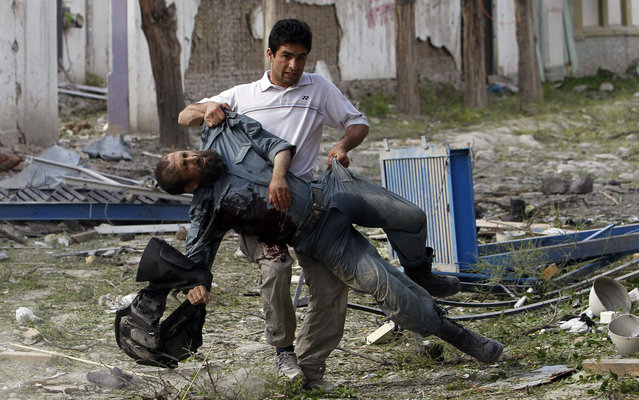
A wounded Afghan policeman is carried away from the site of an explosion in Kabul May 24, 2013. Several large explosions rocked a busy area in the centre of the Afghan capital, Kabul, on Friday with Reuters witnesses describing shooting in the area. (Photo by Omar Sobhani/Reuters)

A wounded Afghan policeman is carried away from the site of an explosion in Kabul May 24, 2013. Several large explosions rocked a busy area in the centre of the Afghan capital, Kabul, on Friday with Reuters witnesses describing shooting in the area. (Photo by Omar Sobhani/Reuters)

P.S. All pictures are presented in high resolution. To see Hi-Res images – just TWICE click on any picture. In other words, click small picture – opens the BIG picture. Click BIG picture – opens VERY BIG picture (if available; this principle works anywhere on the site AvaxNews)
Details
26 May 2013 12:36:00
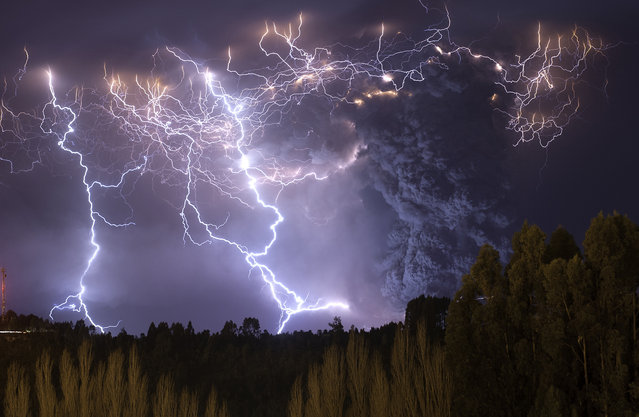
The eruption of Cordon Caulle began on June 4, 2011, located in the Region of Los Rios in Chile. For about 12 months, people and animals became accustomed to living with the daily fall of ash, which also caused problems in the air traffic in South America. The explosions and lightning during first days of the eruption could be seen from hundreds of miles around. This photograph was taken on the second night of eruption from the town of Lago Ranco. (Photo and caption by Francisco Negroni/National Geographic Traveler Photo Contest)

The eruption of Cordon Caulle began on June 4, 2011, located in the Region of Los Rios in Chile. For about 12 months, people and animals became accustomed to living with the daily fall of ash, which also caused problems in the air traffic in South America. The explosions and lightning during first days of the eruption could be seen from hundreds of miles around. This photograph was taken on the second night of eruption from the town of Lago Ranco. (Photo and caption by Francisco Negroni/National Geographic Traveler Photo Contest)

ATTENTION! All pictures are presented in high resolution. To see Hi-Res images – just TWICE click on any picture. In other words, click small picture – opens the BIG picture. Click BIG picture – opens VERY BIG picture.
Details
23 Jun 2013 11:24:00
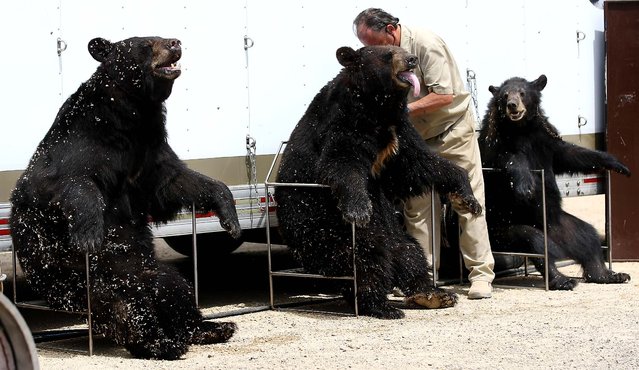
Bob Steele, of Jefferson, Texas, positions his bears during The Great Bear Show at the Dubuque (Iowa) County Fair on July 25, 2012. (Photo by Jessica Reilly/Telegraph Herald)

Bob Steele, of Jefferson, Texas, positions his bears during The Great Bear Show at the Dubuque (Iowa) County Fair on July 25, 2012. (Photo by Jessica Reilly/Telegraph Herald)
Details
28 Jul 2012 08:43:00
A Swiss police officer accompanies a migrant from Syria carrying her baby, upon her arrival at the railway station in the north-eastern Swiss town of Buchs September 1, 2015. (Photo by Arnd Wiegmann/Reuters)

A Swiss police officer accompanies a migrant from Syria carrying her baby, upon her arrival at the railway station in the north-eastern Swiss town of Buchs September 1, 2015. (Photo by Arnd Wiegmann/Reuters)
Details
03 Sep 2015 11:58:00
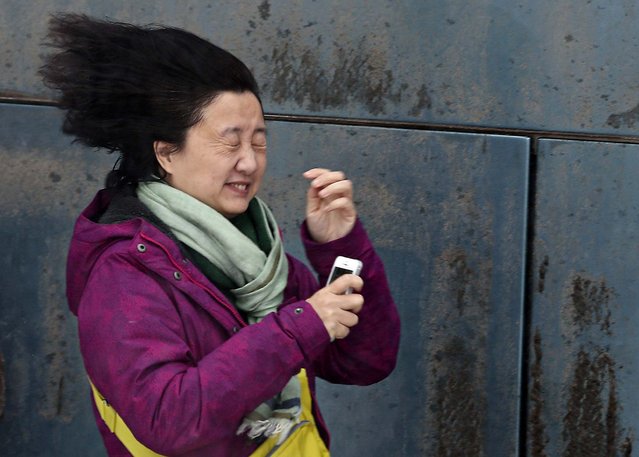
A woman has her hair blown by the wind during a snowstorm in Quebec City, on December 22, 2013. (Photo by Mathieu Belanger/Reuters)

A woman has her hair blown by the wind during a snowstorm in Quebec City, on December 22, 2013. (Photo by Mathieu Belanger/Reuters)
Details
28 Dec 2013 12:50:00