Loading...
Done
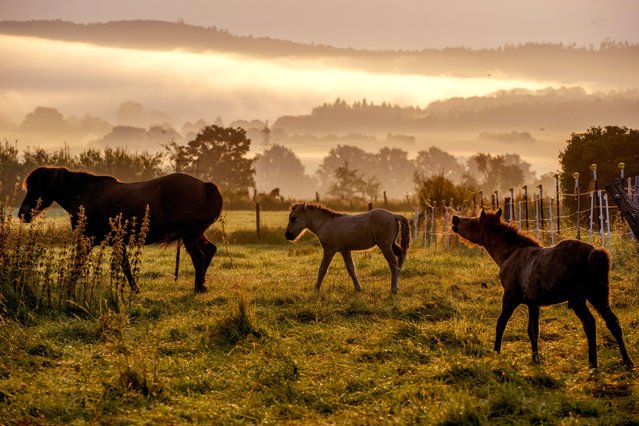
Icelandic horses play in their paddock at a stud farm in Wehrheim near Frankfurt, Germany, as  a mist rolls in on Thursday, August 5, 2021. (Photo by Michael Probst/AP Photo)

Icelandic horses play in their paddock at a stud farm in Wehrheim near Frankfurt, Germany, as a mist rolls in on Thursday, August 5, 2021. (Photo by Michael Probst/AP Photo)
Details
07 Oct 2021 08:10:00
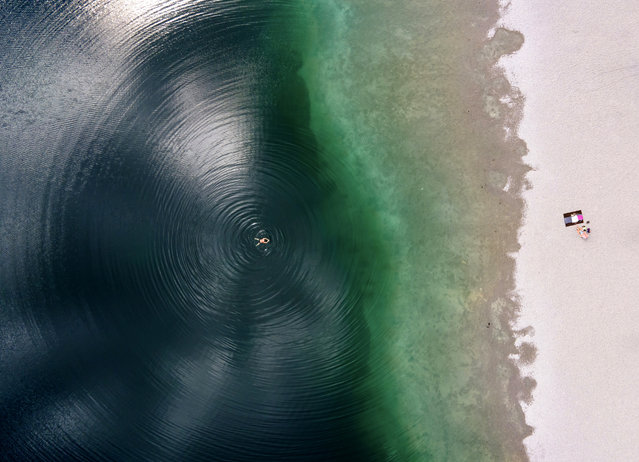
In this picture taken with a drone a man and a woman enjoy the beautiful weather at the Langwieder See (Lake Langwieder) in Munich, Germany, Thursday, June 18, 2020. (Photo by Sven Hoppe/dpa via AP Photo)

In this picture taken with a drone a man and a woman enjoy the beautiful weather at the Langwieder See (Lake Langwieder) in Munich, Germany, Thursday, June 18, 2020. (Photo by Sven Hoppe/dpa via AP Photo)
Details
17 Jul 2020 00:03:00
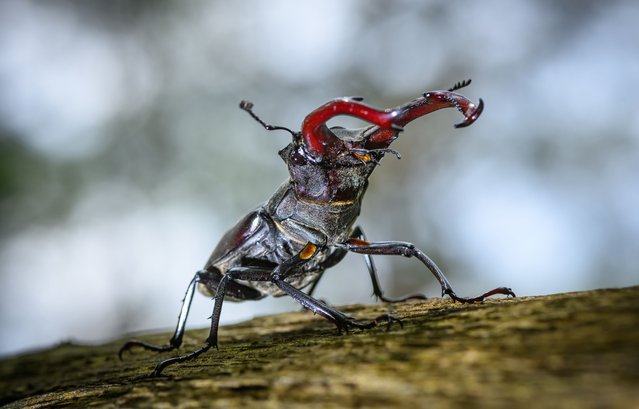
A male stag beetle walks on a branch in an oak forest near the Spree River in Kersdorf, Brandenburg, Germany, on June 8, 2025. (Photo by Patrick Pleul/picture alliance via Getty Images)

A male stag beetle walks on a branch in an oak forest near the Spree River in Kersdorf, Brandenburg, Germany, on June 8, 2025. (Photo by Patrick Pleul/picture alliance via Getty Images)
Details
29 Jun 2025 03:45:00


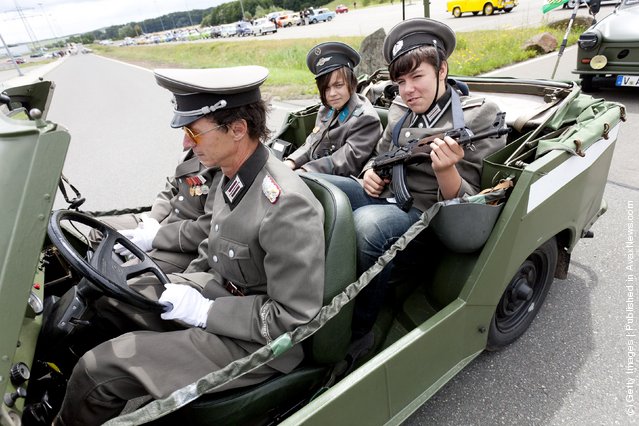
“The Trabant is a car that was produced by former East German auto maker VEB Sachsenring Automobilwerke Zwickau in Zwickau, Sachsen. It was the most common vehicle in East Germany, and was also exported to countries both inside and outside the communist bloc. The main selling points was that it had room for four adults and luggage in a compact, light and durable shell and that it was fast (when introduced) and durable. With its mediocre performance, smoky two-stroke engine, and production shortages, the Trabant is often cited as an example of the disadvantages of centralized planning; on the other hand, it is regarded with derisive affection as a symbol of the failed former East Germany and of the fall of communism (in former West Germany, as many East Germans streamed into West Berlin and West Germany in their Trabants after the opening of the Berlin Wall in 1989). It was in production without any significant changes for nearly 30 years with 3,096,099 Trabants produced in total”. – Wikipedia

Photo: Enthusiasts weared in uniforms of the former eastern german army trive in a military Trabant car as fans and owners of East German-era Trabant cars gather at the 2011 International Trabantfahrer Treffen (International Trabant Drivers Meeting) on June 26, 2011 in Zwickau, Germany. The Trabant, also known as the Trabi, was among the main cars produced in communist East Germany and built by VEB Sachsenring Automobilwerke in Zwickau for 30 years until 1989. Today the car has cult status for many followers and one company, IndiKar, is even seeking to revive the brand in a modern, electric version. (Photo by Carsten Koall/Getty Images)
Details
27 Jun 2011 12:21:00


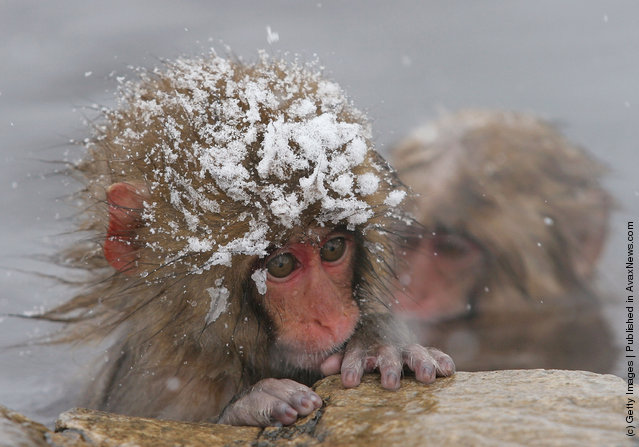
Japanese macaque monkeys enjoy sitting in the hot springs at Jigokudani-Onsen (Hell Valley) on January 23, 2005 in Jigokudani, Nagano-Prefecture, Japan. Japanese Macaques, also known as snow monkeys are the most northerly nonhuman primate in the world. In 1963 a female Macaque ventured into the hot springs to retrieve some soybeans. This behaviour was adopted by other monkeys, and eventually by the entire troop. This Macaque troop regularly visits the Jigokudani-Onsen springs to escape the cold. The hot springs are said to help relieve nerve pain and fatigue. (Photo by Koichi Kamoshida/Getty Images)
Details
20 May 2011 08:04:00
A frog appears to have a big smile for the camera, Russia. (Photo by Artyom Krivosheev/Barcroft Images/Comedy Wildlife Photography Awards 2016)

A frog appears to have a big smile for the camera, Russia. Things are heating up at the Comedy Wildlife Photography Awards as the shortlisted final 40 entries are revealed. This year's competition has featured over 2200 hilarious entries from around the world with photos including a fox face planting in the snow, a dancing brown bear and a pair of seemingly headless penguins – all beautifully photographed with perfect comedy timing and a strong conservation message. (Photo by Artyom Krivosheev/Barcroft Images/Comedy Wildlife Photography Awards 2016)
Details
08 Oct 2016 11:57:00
Kira Walkenhorst of Germany (L) signals as Doaa Elghobashy of Egypt (R) watches during the women's Beach Volleyball preliminary pool D game between Ludwig/Walkenhors of Germany and Elghobashy/Nada of Egypt the Rio 2016 Olympic Games at the Beach Volleyball Arena on Copacabana Beach in Rio de Janeiro, Brazil, 07 August 2016. (Photo by Antonio Lacerda/ANSA)

Kira Walkenhorst of Germany (L) signals as Doaa Elghobashy of Egypt (R) watches during the women's Beach Volleyball preliminary pool D game between Ludwig/Walkenhors of Germany and Elghobashy/Nada of Egypt the Rio 2016 Olympic Games at the Beach Volleyball Arena on Copacabana Beach in Rio de Janeiro, Brazil, 07 August 2016. (Photo by Antonio Lacerda/ANSA)
Details
09 Aug 2016 12:54:00


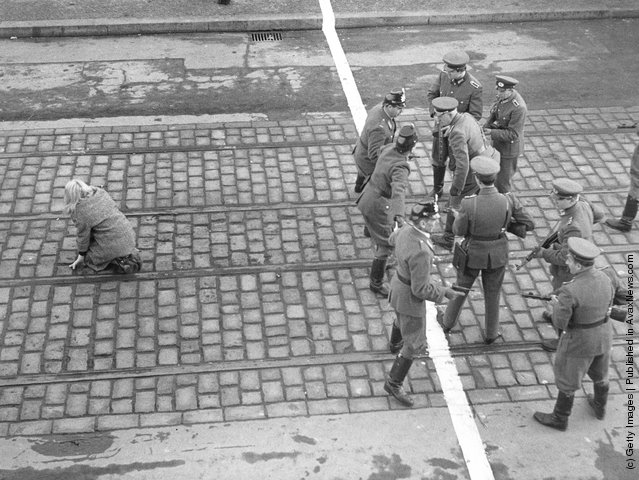
“The Berlin Wall (German: Berliner Mauer) was a barrier constructed by the German Democratic Republic (GDR, East Germany) starting on 13 August 1961, that completely cut off West Berlin from surrounding East Germany and from East Berlin. The barrier included guard towers placed along large concrete walls, which circumscribed a wide area (later known as the “death strip”) that contained anti-vehicle trenches, “fakir beds” and other defenses. The Soviet-dominated Eastern Bloc officially claimed that the wall was erected to protect its population from fascist elements conspiring to prevent the “will of the people” in building a socialist state in East Germany. However, in practice, the Wall served to prevent the massive emigration and defection that marked Germany and the communist Eastern Bloc during the post-World War II period”. – Wikipedia

Photo: West Berlin policemen and East German Volkspolizei face each other across the border in Berlin, circa 1955. (Photo by Three Lions/Hulton Archive/Getty Images)
Details
22 May 2011 10:49:00