Loading...
Done
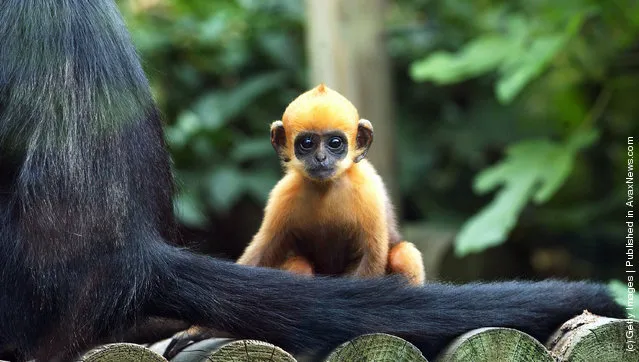
Baby Francois' Langur

“Francois' langur is one of several species of leaf monkeys. Over 50% of its diet is made up of young leaves. It will also consume fruits (17.2%), seeds, flowers, stems, roots, bark and occasionally minerals and insects off of rock surfaces and cliffs. This langur consumes its favorite food, young leaves, at the highest rate during the dry season, April through September, also known as the young leaf-lean period”. – Wikipedia

Photo: An endangered baby Francois' Langur monkey called Laa Laa settles in following her July 6 birth at London Zoo, Regent's Park on August 5, 2004 in London. The bright ginger youngster was born to glossy black parents Max and Shaneka and has the typical orange baby coat which is in stark contrast against the black of her parent's and older brother Grub's fur. (Photo by Steve Finn/Getty Images)
Details
22 Sep 2011 11:28:00
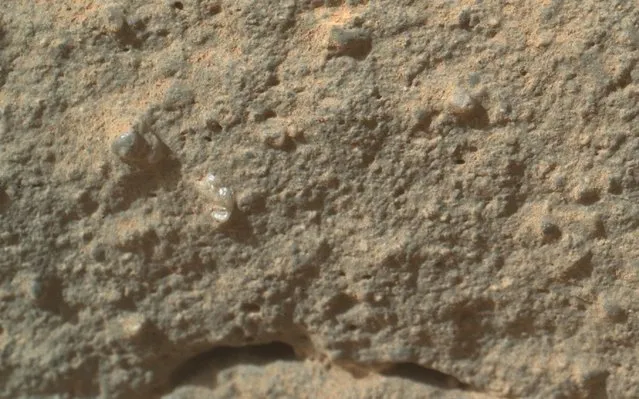
Scientists say that a “Martian flower”, seen here in an image from the Curiosity rover's Mars Hand Lens Imager, is a 2-millimeter-wide grain or pebble that's embedded in the surrounding rock. Another, darker-colored mineral grain can be seen above and to the left. (Photo by NASA)

“The scientists behind NASA's $2.5 billion Curiosity rover mission on Mars on Tuesday explained the nature of a tiny, gleaming "flower" embedded in Red Planet rock, and revealed where they'll be using the SUV-sized robot's drill for the first time”. – Alan Boyle via NBCNews.com

Photo: Scientists say that a “Martian flower”, seen here in an image from the Curiosity rover's Mars Hand Lens Imager, is a 2-millimeter-wide grain or pebble that's embedded in the surrounding rock. Another, darker-colored mineral grain can be seen above and to the left. (Photo by NASA)
Details
16 Jan 2013 11:12:00
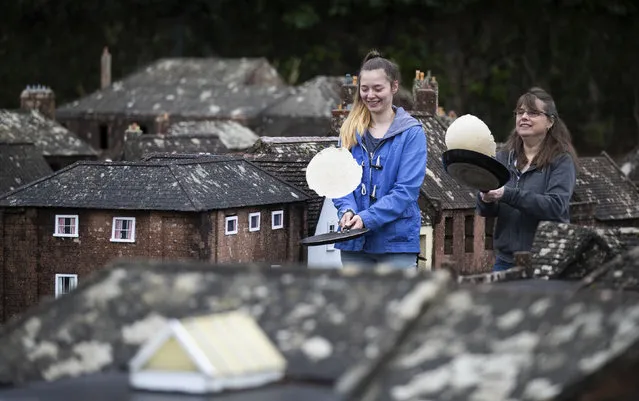
Mother and daughter volunteers Niki, right, and Rachel practice their pancake tossing technique in the streets of Wimborne model town and gardens before taking part in the Wimborne Minster virtual pancake race, in Wimborne, England, Tuesday February 16, 2021.  Although a physical race cannot take place this year due to the coronavirus restrictions, Wimborne Minster has invited people to film themselves tossing a pancake for 30 seconds and posting it to Facebook. (Photo by Andrew Matthews/PA Wire via AP Photo)

Mother and daughter volunteers Niki, right, and Rachel practice their pancake tossing technique in the streets of Wimborne model town and gardens before taking part in the Wimborne Minster virtual pancake race, in Wimborne, England, Tuesday February 16, 2021. Although a physical race cannot take place this year due to the coronavirus restrictions, Wimborne Minster has invited people to film themselves tossing a pancake for 30 seconds and posting it to Facebook. (Photo by Andrew Matthews/PA Wire via AP Photo)
Details
17 Feb 2021 10:01:00
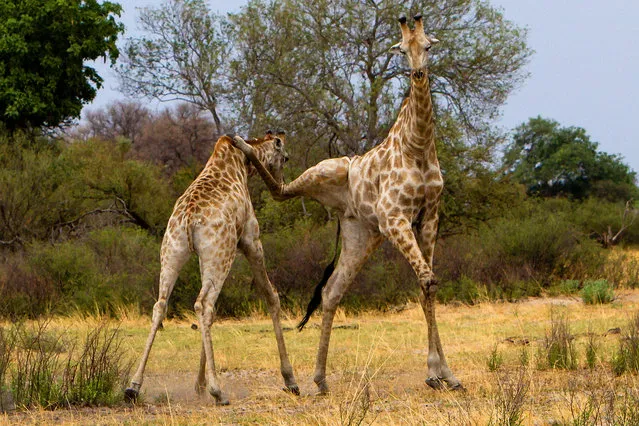
A giraffe lands a karate kick on a rival on the plains of Botswana. (Photo by Thomas Retterath/Caters News)

The Kung Fu King was spotted in Botswana, Africa, as the two giraffes fought for dominance. Thomas Retterath, 53, says hes often seen the mammals fight, but they usually do it by banging their heads against each others bodies.Here: A giraffe lands a karate kick on a rival on the plains of Botswana. (Photo by Thomas Retterath/Caters News)
Details
26 Feb 2017 00:00:00
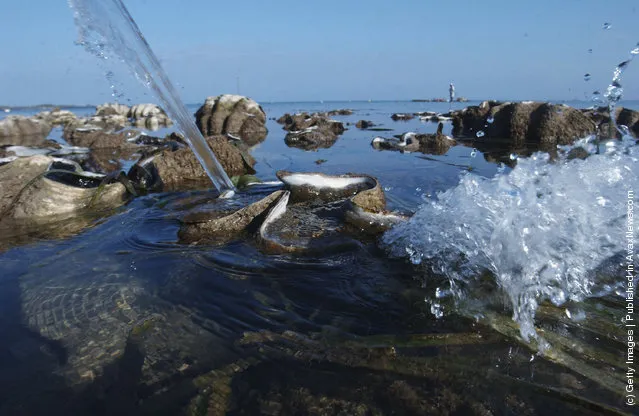
Tridacna Gigas, or Giant Clams

“The giant clam, Tridacna gigas (known as pā’ua in Cook Islands Māori), is the largest living bivalve mollusc. T. gigas is one of the most endangered clam species. It was mentioned as early as 1825 in scientific reports. One of a number of large clam species native to the shallow coral reefs of the South Pacific and Indian oceans, they can weigh more than 200 kilograms (440 lb) measure as much as 120 cm (47 in) across, and have an average lifespan in the wild of 100 years or more”. – Wikipedia

Photo: Tridacna Gigas, or Giant Clams spew water as a traditional fisherman passes by a small sanctuary on January 23, 2004 near Bolinao in the Northern Philippines. The clams, prime builders for coral reefs and providing shelter for spawning fish and other marine life, are exposed by low tides in the sanctuary. Overfishing and pollution throughout the country are not only threatening food security, but are also starting to choke one of the few working clam sanctuaries in the world. (Photo by David Greedy/Getty Images)
Details
01 Oct 2011 13:10:00
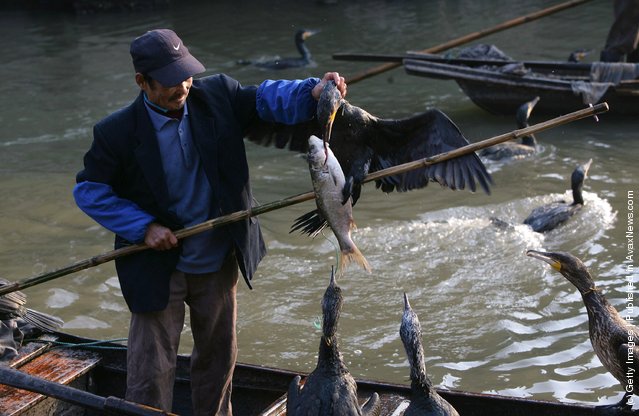
Cormorant Fishing

“Cormorant fishing is a traditional fishing method in which fishermen use trained cormorants to fish in rivers. Historically, cormorant fishing has taken place in Japan and China from around 960 AD. and recorded from other places throughout the world”. – Wikipedia

Photo: A cormorant raised by a fisherman catches a fish on a canal on November 27, 2007 in Xitang Town of Jiashan County, Zhejiang Province, China. (Photo by China Photos/Getty Images)
Details
07 Oct 2011 09:34:00


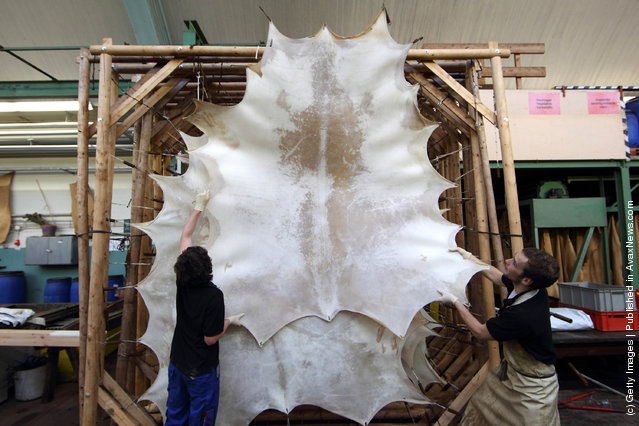
REUTLINGEN, GERMANY - NOVEMBER 17: Students hang out finished parchment leather at the LGR (Lederinstitut Gerberschule Reutlingen) tannery school on November 17, 2010 in Reutlingen, Germany. Even in early antiquity and up their hair or dried goat and sheep skins were used as material for documents. In the small Asian city Pergamon these skins were processed in large quantities for this purpose, so they formed the main trading arm of the city, of which the name is parchment is derived. In medieval times, reached the parchment is of great importance, it was such as France's production under the supervision of the University of Paris. Even now, important documents, placed on their unlimited shelf life as possible large value (eg diplomas, addresses, memory, writings, documents for primary and keystones) written on parchment...
Details
20 Nov 2011 18:17:00
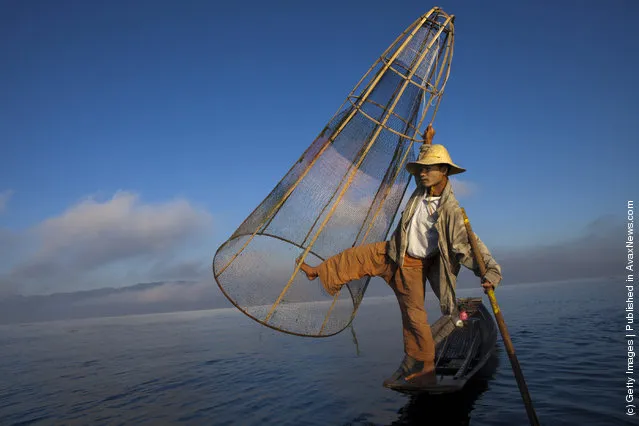
Intha leg rowing fishermen starts to fish in the early morning hours on Inle Lake in Myanmar

An Intha leg rowing fisherman paddles on Inle Lake December 17, 2011 in Inle Lake, Myanmar. The famous lake is 22 kilometers long and 11 wide and has been a fisherman's paradise for years where they use their leg rowing technique, standing on the stern on one leg and wrapping the other leg around the oar. (Photo by Paula Bronstein /Getty Images)
Details
22 Dec 2011 12:17:00