Loading...
Done
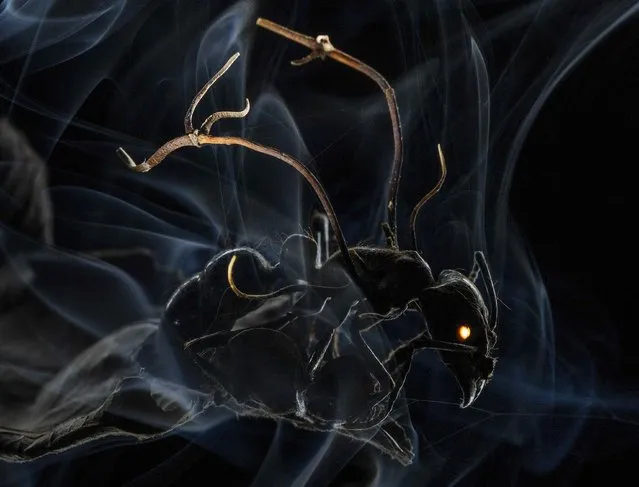
Anand Varma, a U.S. photographer working for the National Geographic, won the First Prize in the Nature Category, Stories, of the 2015 World Press Photo contest with his series of pictures, which includes this one of spores of a fungus landing on an ant, penetrating its exoskeleton and entering its brain, compelling the host to leave its normal habitat on the forest floor and scale a nearby tree, in this picture taken January 22, 2014 and released by the World Press Photo on February 12, 2015. (Photo by Anand Varma/Reuters/National Geographic/World Press Photo)

Anand Varma, a U.S. photographer working for the National Geographic, won the First Prize in the Nature Category, Stories, of the 2015 World Press Photo contest with his series of pictures, which includes this one of spores of a fungus landing on an ant, penetrating its exoskeleton and entering its brain, compelling the host to leave its normal habitat on the forest floor and scale a nearby tree, in this picture taken January 22, 2014 and released by the World Press Photo on February 12, 2015. (Photo by Anand Varma/Reuters/National Geographic/World Press Photo)
Details
15 Feb 2015 15:21:00
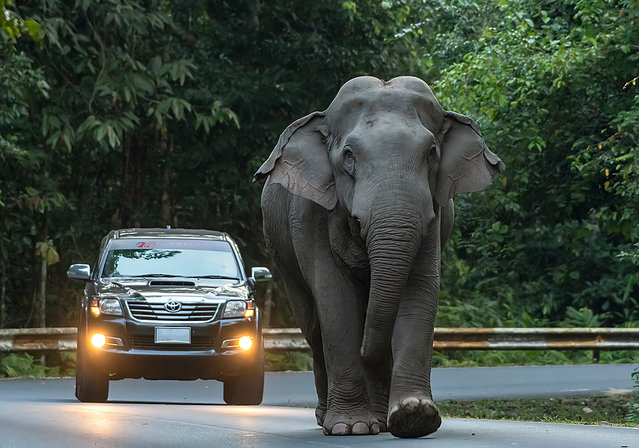
An Asian elephant called “Plai Deaw” goes for a walk on a mountain road in Nakhon Nayok, Thailand on July 11, 2022. The bull has become well known in the area for his taste for venturing out from the deep forest and emerging among cars and village homes. Thailand has an estimated 2,000 Asian elephants living in the wild but there is often conflict when they come into contact with humans on roads and in villages. A similar number of elephants are kept captive where they work in zoos and are hired out for religious festivals and weddings. (Photo by Mongkol Pitakmoo/ViralPress)

An Asian elephant called “Plai Deaw” goes for a walk on a mountain road in Nakhon Nayok, Thailand on July 11, 2022. The bull has become well known in the area for his taste for venturing out from the deep forest and emerging among cars and village homes. Thailand has an estimated 2,000 Asian elephants living in the wild but there is often conflict when they come into contact with humans on roads and in villages. A similar number of elephants are kept captive where they work in zoos and are hired out for religious festivals and weddings. (Photo by Mongkol Pitakmoo/ViralPress)
Details
04 Aug 2022 04:55:00
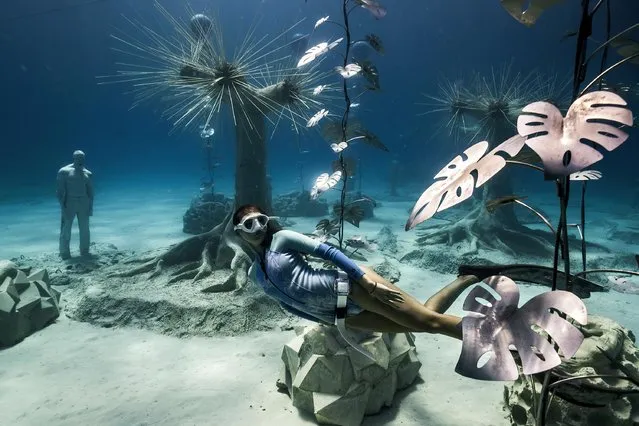
A diver swims near sculptures during the inauguration of the underwater museum in Ayia Napa, Cyprus, 01 August 2021. At the new Ayia Napa Underwater Sculpture Museum (MUSAN), located in the Pernera area of Ayia Napa, visitors, both swimmers with mask and flippers and divers, will be able to tour around an underwater forest, the first of its kind in the world. The whole project is inspired by British acclaimed sculptor Jason deCaires Taylor, a representatives of the eco-art movement who is behind the world's first underwater sculpture park – the Molinere Underwater Sculpture Park in Grenada. (Photo by Jason Decaires Taylor/EPA/EFE)

A diver swims near sculptures during the inauguration of the underwater museum in Ayia Napa, Cyprus, 01 August 2021. At the new Ayia Napa Underwater Sculpture Museum (MUSAN), located in the Pernera area of Ayia Napa, visitors, both swimmers with mask and flippers and divers, will be able to tour around an underwater forest, the first of its kind in the world. (Photo by Jason Decaires Taylor/EPA/EFE)
Details
12 Dec 2021 05:45:00
“Woman with Umbrella in Rain” by Raimund von Stillfried. Artist: Kusakabe Kimbei (Japanese, 1841–1934), 1870s. (Photo courtesy of The Metropolitan Museum of Art)

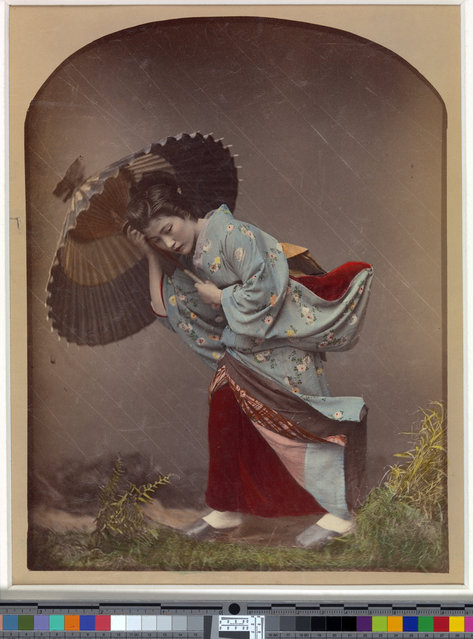
“Woman with Umbrella in Rain” by Raimund von Stillfried. Artist: Kusakabe Kimbei (Japanese, 1841–1934), 1870s. Commercial photography studios in Meiji-era Japan were renowned for the subtlety and refinement of their coloring techniques. This hand-tinted image of a young woman caught in a heavy rainstorm achieved its naturalistic effect by knitting together multiple strands of artifice: the greenery in the foreground was a studio prop; the flaps of the kimono were suspended by thin wires to create the impression of a strong wind; and long, diagonal marks were made on the negative to suggest streaks of rain. (Photo courtesy of The Metropolitan Museum of Art)
Details
12 May 2013 10:13:00
In this photo taken Friday, September 4, 2015, tourists Sarah and John Scott from Worcester, England, take a step back as a male silverback mountain gorilla from the family of mountain gorillas named Amahoro, which means “peace” in the Rwandan language, unexpectedly steps out from the bush to cross their path in the dense forest on the slopes of Mount Bisoke volcano in Volcanoes National Park, northern Rwanda. (Photo by Ben Curtis/AP Photo)

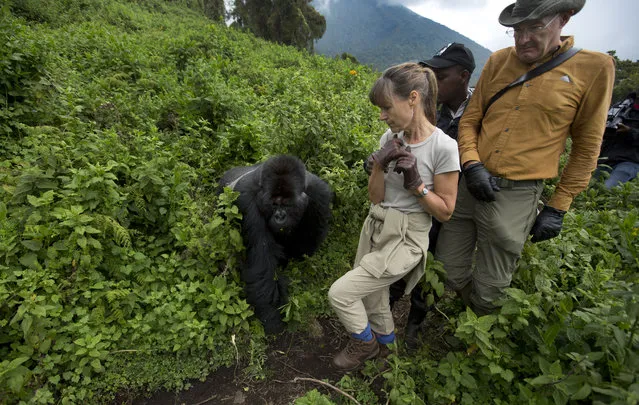
In this photo taken Friday, September 4, 2015, tourists Sarah and John Scott from Worcester, England, take a step back as a male silverback mountain gorilla from the family of mountain gorillas named Amahoro, which means “peace” in the Rwandan language, unexpectedly steps out from the bush to cross their path in the dense forest on the slopes of Mount Bisoke volcano in Volcanoes National Park, northern Rwanda. Deep in Rwanda's steep-sloped forest, increasing numbers of tourists are heading to see the mountain gorillas, a subspecies whose total population is an estimated 900 and who also live in neighboring Uganda and Congo, fueling an industry seen as key to the welfare of the critically endangered species as well as Rwanda's economy. (Photo by Ben Curtis/AP Photo)
Details
18 Sep 2015 14:55:00
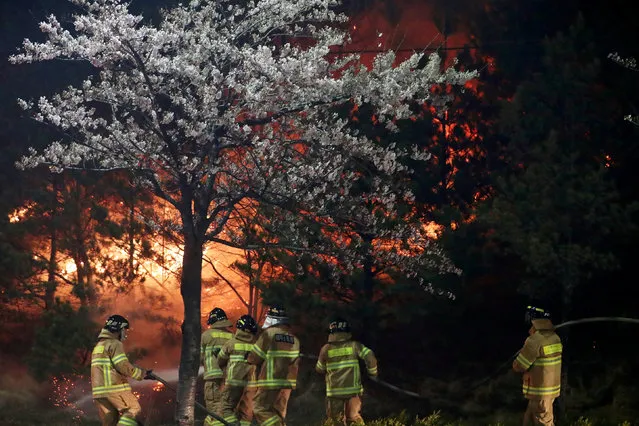
Firefighters work to put out flames during a wildfire in Sokcho, South Korea, April 5, 2019. (Photo by Yonhap via Reuters)

Firefighters work to put out flames during a wildfire in Sokcho, South Korea, April 5, 2019. South Korea grappled with the massive blaze that roared through forests and cities along the eastern coast, declaring a national emergency and mobilizing all available resources to bring the inferno under control. (Photo by Yonhap via Reuters)
Details
07 Apr 2019 00:07:00
Wolfgang (L), member of World War One historical association “Darstellungsgruppe Suddeutsches Militar 1870-1918” (DSM 18), from Munich, Germany, and Florent, member of French association “Le Poilu de la Marne”, dressed in vintage army uniforms, visit the Bezonvaux bunker in the national forest of Verdun, eastern France, March 29, 2014. (Photo by Charles Platiau/Reuters)

Wolfgang (L), member of World War One historical association “Darstellungsgruppe Suddeutsches Militar 1870-1918” (DSM 18), from Munich, Germany, and Florent, member of French association “Le Poilu de la Marne”, dressed in vintage army uniforms, visit the Bezonvaux bunker in the national forest of Verdun, eastern France, March 29, 2014. Members of French and German historical associations, who gather annually, together visited the battlefield of Verdun in France, the site of a bloody World War One battle that dragged on for around 10 months in 1916, claiming hundreds of thousands of lives and destroying many villages. (Photo by Charles Platiau/Reuters)
Details
10 Apr 2014 10:49:00


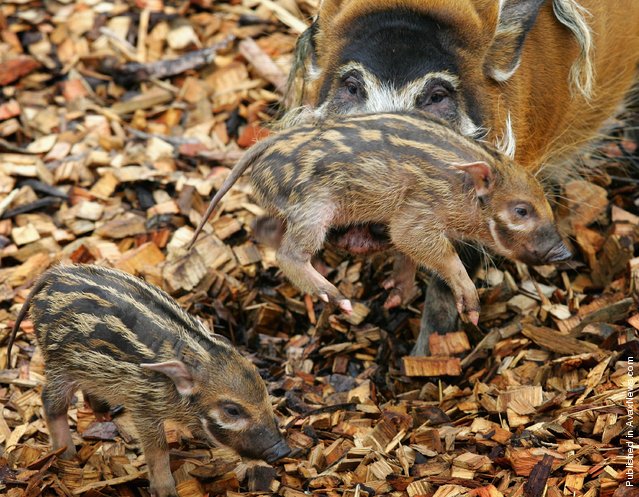
“The Red River Hog (Potamochoerus porcus), also known as the Bush Pig (but not to be confused with P. larvatus, common name “Bushpig”), is a wild member of the pig family living in Africa, with most of its distribution in the Guinean and Congolian forests. It is rarely seen away from rainforests, and generally prefers areas near rivers or swamps.

Red River Hogs eat grass, berries, roots, insects, molluscs, small vertebrates and carrion. They are capable of causing damage to plantations. Red River Hogs typically live in herds of 6-20 members led by a dominant boar. Sows rear 3-6 piglets at a time.”

Photo: Two 17 day old red river hoglet twins forage for food next to their mother Bahiti at London Zoo on August 23, 2007 in London, England. Red River hoglets inhabit the forests and swamps of West and Central Africa. The recent additions to the London Zoo pig pen have been eagerly awaited by zoo keepers. (Photo by Chris Jackson/Getty Images)
Details
18 Mar 2011 15:15:00