Loading...
Done


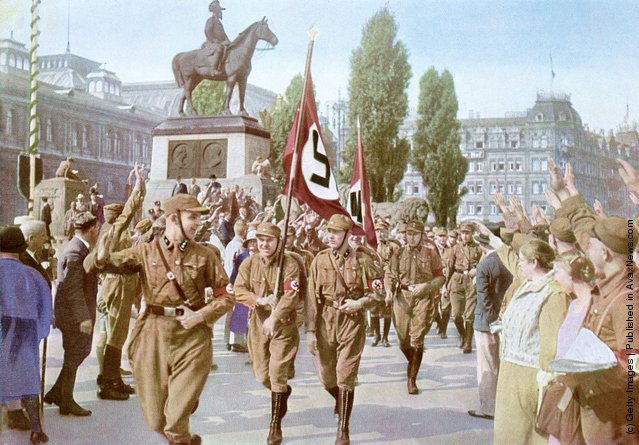
“Horst Ludwig Wessel (October 9, 1907 – February 23, 1930) was a German Nazi activist who was made a posthumous hero of the Nazi movement following his violent death in 1930. He was the author of the lyrics to the song “Die Fahne hoch” (“The Flag On High”), usually known as Horst-Wessel-Lied (“The Horst Wessel Song”), which became the Nazi Party anthem and, de facto, Germany's co-national anthem from 1933 to 1945”. – Wikipedia

Photo: German Nazi activist Horst Wessel (left) at the head of a parade of S.A. stormtroopers, or “brownshirts”, in Nuremberg, Germany, 1929. (Photo by Hulton Archive/Getty Images)
Details
08 Jul 2011 09:38:00


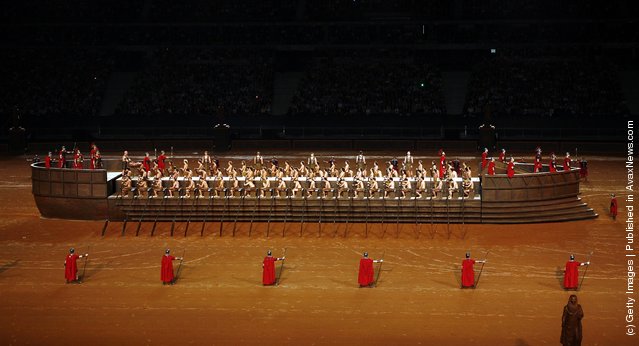
PARIS - SEPTEMBER 22: French actor Christophe Heraut plays Ben-Hur and rides in a Roman chariot during the stage production premiere of 'Ben-Hur' September 22, 2006 in Saint-Denis, Paris, France. After Charlton Heston played the lead in this sword and sandal epic, written by Civil War Union Gen. Lew Wallace, on the big screen, the play is set to return in a live version staged at France's biggest sports stadium. Behind the 13-million-euro (16.5-million-dollar) show is a veteran Paris-born director Robert Hossein, who involved a large crew of hundreds of actors for the show. (Photo by Francois Durand/Getty Images)
Details
16 Nov 2011 12:17:00
Sculptures By Hu Shaoming

Hu Shaoming is a fantastic artist from China, who has learnt Fine Arts at Guangzhou Academy. The most complex sculpture of all his works is a mechanical seahorse, constructed from many tiny details. The whole composition consists of two complete opposites, including the top part of the seahorse`s head that looks like a golden town, and the bottom which resembles an amazing blue creature. An important problem is reflected in such an idea; it shows how a man forces the nature into submission. The contrast in the opposition of the human buildings and conquered Mother Nature suggests the thought of keeping our natural environment safe.
Details
01 Mar 2015 13:02:00
Labourers walk near trucks loaded with logs, which are trapped on a muddy road, near an unreserved forest in the village of Igbatoro, southwest Nigeria, August 28, 2014. (Photo by Akintunde Akinleye/Reuters)

Labourers walk near trucks loaded with logs, which are trapped on a muddy road, near an unreserved forest in the village of Igbatoro, southwest Nigeria, August 28, 2014. Wood, a form of biomass, is the sole source of energy for hundreds of millions of Africans who lack access to modern sources of power, and logging, both legal and illegal, remains a lucrative business that has contributed to the rapid shrinking of Africa's rainforests and woodlands. (Photo by Akintunde Akinleye/Reuters)
Details
21 Nov 2014 12:50:00
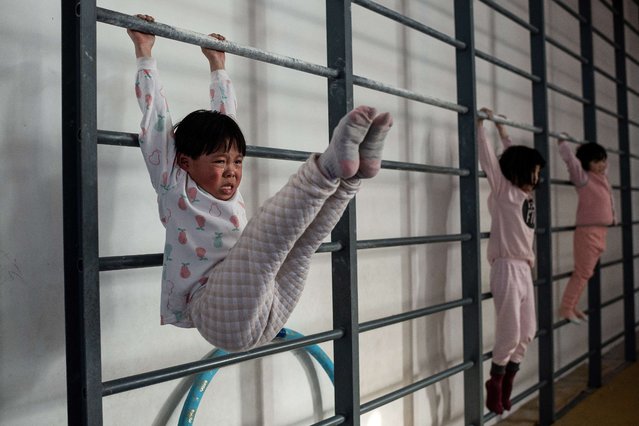
In this picture taken on January 11, 2021, young gymnasts train at the Li Xiaoshuang Gymnastics School in Xiantao, Hubei province. (Photo by Nicolas Asfouri/AFP Photo)

In this picture taken on January 11, 2021, young gymnasts train at the Li Xiaoshuang Gymnastics School in Xiantao, Hubei province. This summer's delayed Tokyo Olympics, which are now due to start on July 23, 2021, will be the defining moment for Chinese gymnasts who have trained relentlessly since as young as age four in the pursuit of gold. (Photo by Nicolas Asfouri/AFP Photo)
Details
23 Apr 2021 09:29:00
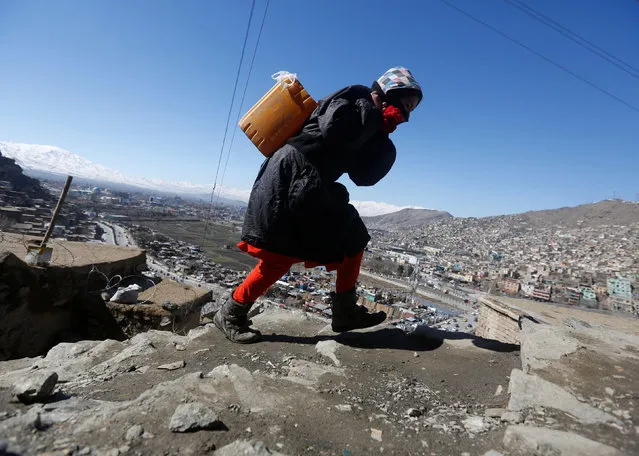
An Afghan girl carries water on her back as she climbs a hill in Kabul, Afghanistan February 20, 2017. (Photo by Omar Sobhani/Reuters)

An Afghan girl carries water on her back as she climbs a hill in Kabul, Afghanistan February 20, 2017. A growing population is straining water supplies in Afghanistan's capital, forcing those who can afford it to dig unregulated wells ever deeper to tap a falling water table. Finding water in arid Afghanistan is virtually always a challenge, but a drop in the groundwater level in Kabul caused by overuse and drought is making it even more difficult for residents, especially the poor. (Photo by Omar Sobhani/Reuters)
Details
02 Mar 2017 00:05:00
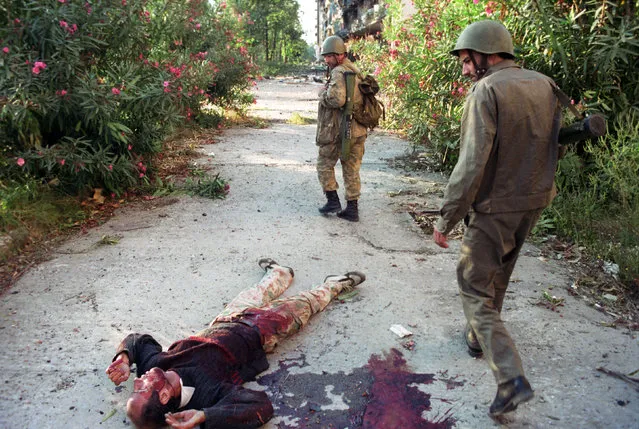
Abkhazia. Sukhumi, 1993. A house-to-house combat. (Photo by Andrei Solovyov/ITAR-TASS)

The War in Abkhazia from 1992 to 1993 was fought between Georgian government forces for the most part, and Abkhaz separatist forces, Russian armed forces and North Caucasian militants. Ethnic Georgians who lived in Abkhazia fought largely on the side of Georgian government forces. Ethnic Armenians and Russians within Abkhazia's population largely supported the Abkhazians, and many fought on their side. The separatists received support from thousands of North Caucasus and Cossack militants and from the Russian Federation forces stationed in and near Abkhazia. Here: Abkhazia. Sukhumi, 1993. A house-to-house combat. (Photo by Andrei Solovyov/ITAR-TASS)
Details
29 Sep 2017 07:31:00
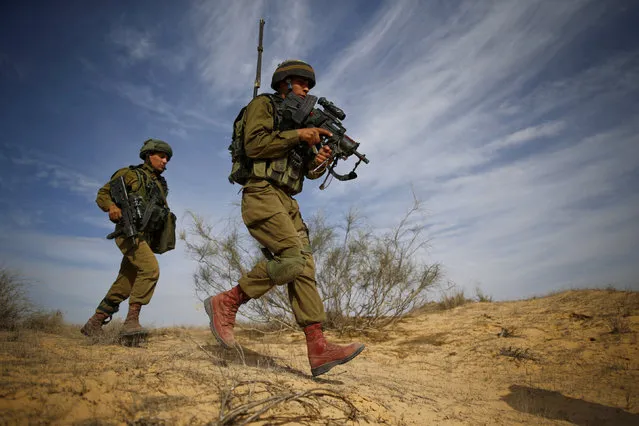
Yussef Saluta (R), 20, an Israeli Arab soldier from the Desert Reconnaissance battalion takes part in a drill near Kissufim in southern Israel November 29, 2016. (Photo by Amir Cohen/Reuters)

Yussef Saluta (R), 20, an Israeli Arab soldier from the Desert Reconnaissance battalion takes part in a drill near Kissufim in southern Israel November 29, 2016. A battalion of soldiers crawls across the desert sand with assault rifles cocked. It's a routine exercise, but these are no ordinary troops – they are Arabs who have chosen to fight for the Jewish state. (Photo by Amir Cohen/Reuters) (Photo by Amir Cohen/Reuters)
Details
07 Dec 2016 11:48:00