Loading...
Done
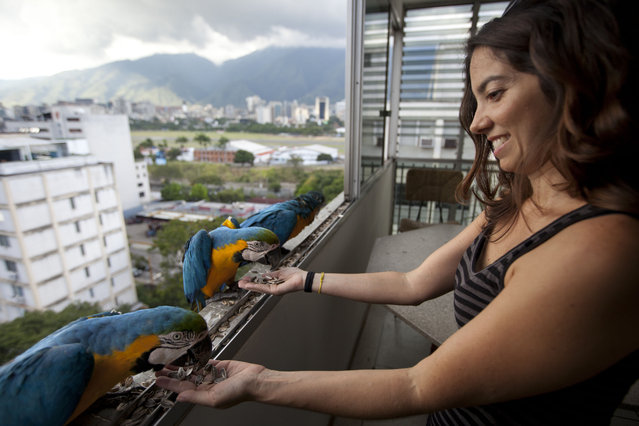
Vanessa Silva, 38, feeds macaws that fly to her apartment window every day looking for food, in Caracas, Venezuela. A group of gold-and-royal blue birds poked their heads through Silva’s window, as if saying “I’m here, is anyone home?” “I’d seen them flying when I was down on the street, and I thought ‘Oh how pretty,’” the 38-year-old said, a macaw eating out of her hand. (Photo by Ariana Cubillos/AP Photo)

Vanessa Silva, 38, feeds macaws that fly to her apartment window every day looking for food, in Caracas, Venezuela, on November 24, 2014. A group of gold-and-royal blue birds poked their heads through Silva’s window, as if saying “I’m here, is anyone home?” “I’d seen them flying when I was down on the street, and I thought ‘Oh how pretty,’” the 38-year-old said, a macaw eating out of her hand. (Photo by Ariana Cubillos/AP Photo)
Details
27 Nov 2014 15:27:00
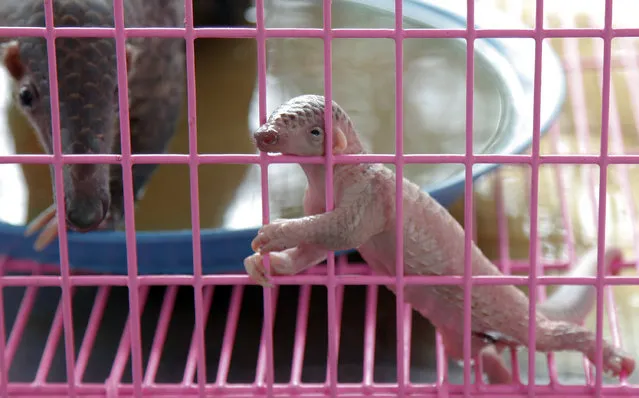
A newborn baby pangolin climbs the walls of a cage in Bangkok, Thailand April 20, 2011. The Thai custom office showed 175 pangolins they found hidden in a truck heading into Bangkok. (Photo by Damir Sagolj/Reuters)

A newborn baby pangolin climbs the walls of a cage in Bangkok, Thailand April 20, 2011. The Thai custom office showed 175 pangolins they found hidden in a truck heading into Bangkok. (Photo by Damir Sagolj/Reuters)
Details
07 May 2015 12:31:00
Naked footballers participate in a Germany v Netherlands soccer match in protest against what they say is increasing commercialization of professional football, in Wuppertal, Germany on September 6, 2020. (Photo by Leon Kuegeler/Reuters)

Naked footballers participate in a Germany v Netherlands soccer match in protest against what they say is increasing commercialization of professional football, in Wuppertal, Germany on September 6, 2020. (Photo by Leon Kuegeler/Reuters)
Details
14 Sep 2020 00:01:00
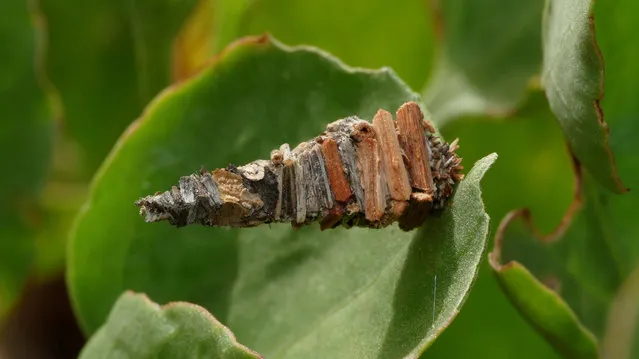
An undated handout photo made available by the Zerynthia Association shows the pupa of an amicta moneiba, a recently discovered species of moth endemic to La Gomera and El Hierro islands in the Canary Islands, Spain (issued 01 July 2020), as those two islands pulled apart from the rest of the Canary Islands 2.5 million years ago. The Institute of Evolutionary Biology of the Spanish National Research Council (CSIC) and the Zerynthia Association have recently discovered two new moth species in El Hierro and La Gomera. (Photo by Yeray Monasterio/Zerynthia/EPA/EFE)

An undated handout photo made available by the Zerynthia Association shows the pupa of an amicta moneiba, a recently discovered species of moth endemic to La Gomera and El Hierro islands in the Canary Islands, Spain (issued 01 July 2020), as those two islands pulled apart from the rest of the Canary Islands 2.5 million years ago. The Institute of Evolutionary Biology of the Spanish National Research Council (CSIC) and the Zerynthia Association have recently discovered two new moth species in El Hierro and La Gomera. (Photo by Yeray Monasterio/Zerynthia/EPA/EFE)
Details
11 Oct 2020 00:01:00
This handout photo taken on September 26, 2025 and released on September 27 by the Philippine Coast Guard shows coast guard personnel (background) evacuating a person at the height of Severe Tropical Storm Bualoi in San Agustin town, Romblon province. The Philippines evacuated hundreds of thousands of people and confirmed at least three deaths on Friday as it faced yet another tropical storm, days after it was battered by deadly Super Typhoon Ragasa. (Photo by Handout/Philippine Coast Guard (PCG)/AFP Photo)

This handout photo taken on September 26, 2025 and released on September 27 by the Philippine Coast Guard shows coast guard personnel (background) evacuating a person at the height of Severe Tropical Storm Bualoi in San Agustin town, Romblon province. The Philippines evacuated hundreds of thousands of people and confirmed at least three deaths on Friday as it faced yet another tropical storm, days after it was battered by deadly Super Typhoon Ragasa. (Photo by Handout/Philippine Coast Guard (PCG)/AFP Photo)
Details
11 Nov 2025 03:59:00
A man carries his wife over an obstacle while competing in the Wife Carrying Championship to mark City Day in Krasnoyarsk, Siberia, Russia, June 25, 2016. (Photo by Ilya Naymushin/Reuters)

A man carries his wife over an obstacle while competing in the Wife Carrying Championship to mark City Day in Krasnoyarsk, Siberia, Russia, June 25, 2016. (Photo by Ilya Naymushin/Reuters)
Details
26 Jun 2016 13:11:00
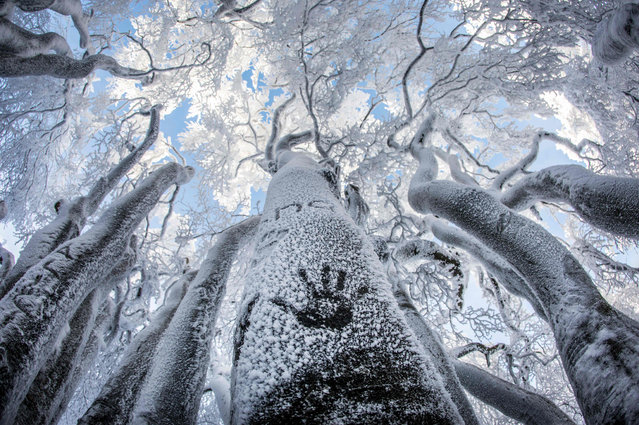
A walker has left a handprint on a snow- covered tree trunk on Grosser Feldberg mountain in the Taunus mountain range, Germany, 16 January 2017. (Photo by Frank Rumpenhorst/DPA)

A walker has left a handprint on a snow- covered tree trunk on Grosser Feldberg mountain in the Taunus mountain range, Germany, 16 January 2017. (Photo by Frank Rumpenhorst/DPA)
Details
18 Jan 2017 07:39:00
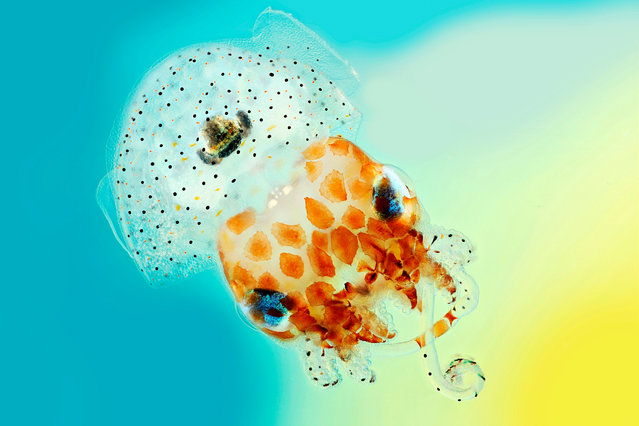
With its huge eyes, comical name and diminutive size, Mark R. Smith’s image of a baby Hawaiian bobtail squid can’t help but raise a smile. A curiously endearing creature, the cephalopod is just 1.5cm across, its mantle cavity bearing more than a passing resemblance to a rather natty shower cap. But it is also a beautiful example of symbiosis – nature’s version of “I’ll scratch your back if you scratch mine” – for on the underside of the squid is a light organ which houses bioluminescent bacteria. The squid offers the bacteria protection and food, while the bacteria emit a glow – a handy trait that the squid uses to offset its silhouette, helping it to evade predators in the depths below. Mark R. Smith’s entry combines several images of a Hawaiian bobtail squid with different focus lengths to create a final picture with greater depth of field than normal. (Photo by Mark R. Smith/Wellcome Images/Macroscopic Solutions)

With its huge eyes, comical name and diminutive size, Mark R. Smith’s image of a baby Hawaiian bobtail squid can’t help but raise a smile. A curiously endearing creature, the cephalopod is just 1.5cm across, its mantle cavity bearing more than a passing resemblance to a rather natty shower cap. But it is also a beautiful example of symbiosis – nature’s version of “I’ll scratch your back if you scratch mine” – for on the underside of the squid is a light organ which houses bioluminescent bacteria. The squid offers the bacteria protection and food, while the bacteria emit a glow – a handy trait that the squid uses to offset its silhouette, helping it to evade predators in the depths below. Mark R. Smith’s entry combines several images of a Hawaiian bobtail squid with different focus lengths to create a final picture with greater depth of field than normal. (Photo by Mark R. Smith/Wellcome Images/Macroscopic Solutions)
Details
08 Mar 2017 00:05:00