Loading...
Done
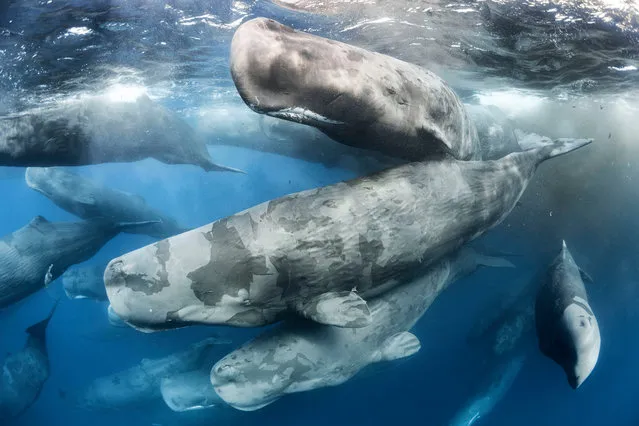
Behaviour: Mammals category. Giant Gathering by Tony Wu, USA. Dozens of sperm whales mingled noisily off Sri Lanka’s northeast coast, stacked as far down as Tony could see. This was a congregation of dozens of social units, like a gathering of the clans. Aggregations like this could be a critical part of the whales’ rich social lives but are rarely reported. Some two thirds of the population was wiped out before commercial whaling was banned in 1986. This kind of major gathering could be “a sign that populations are recovering”, says Tony. (Photo by Tony Wu/Wildlife Photographer of the Year 2017)

Behaviour: Mammals category. Giant Gathering by Tony Wu, USA. Dozens of sperm whales mingled noisily off Sri Lanka’s northeast coast, stacked as far down as Tony could see. This was a congregation of dozens of social units, like a gathering of the clans. Aggregations like this could be a critical part of the whales’ rich social lives but are rarely reported. Some two thirds of the population was wiped out before commercial whaling was banned in 1986. This kind of major gathering could be “a sign that populations are recovering”, says Tony. (Photo by Tony Wu/Wildlife Photographer of the Year 2017)
Details
19 Oct 2017 09:38:00
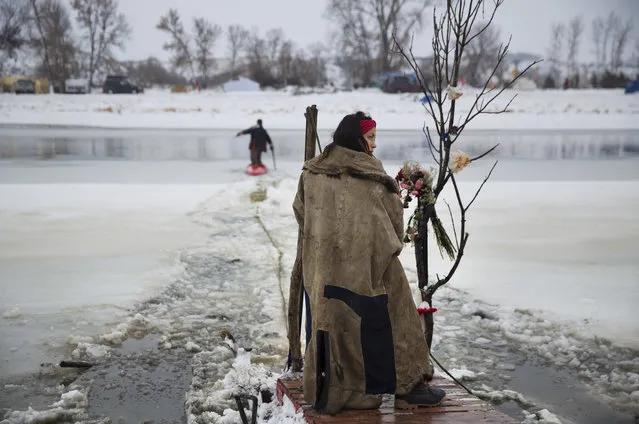
In this Thursday, December 1, 2016 photo, Cat Bigney, part of the Oglala Native American tribe, waits on the shore of the Cannonball river for travelers to arrive by canoe at the Oceti Sakowin camp where people have gathered to protest the Dakota Access oil pipeline in Cannon Ball, N.D. So far, those at the camp have shrugged off the heavy snow, icy winds and frigid temperatures. But if they defy next week's government deadline to abandon the camp, demonstrators know the real deep freeze lies ahead. Life-threatening wind chills and towering snow drifts could mean the greatest challenge is simple survival. (Photo by David Goldman/AP Photo)

In this Thursday, December 1, 2016 photo, Cat Bigney, part of the Oglala Native American tribe, waits on the shore of the Cannonball river for travelers to arrive by canoe at the Oceti Sakowin camp where people have gathered to protest the Dakota Access oil pipeline in Cannon Ball, N.D. So far, those at the camp have shrugged off the heavy snow, icy winds and frigid temperatures. But if they defy next week's government deadline to abandon the camp, demonstrators know the real deep freeze lies ahead. Life-threatening wind chills and towering snow drifts could mean the greatest challenge is simple survival. (Photo by David Goldman/AP Photo)
Details
06 Dec 2016 10:22:00
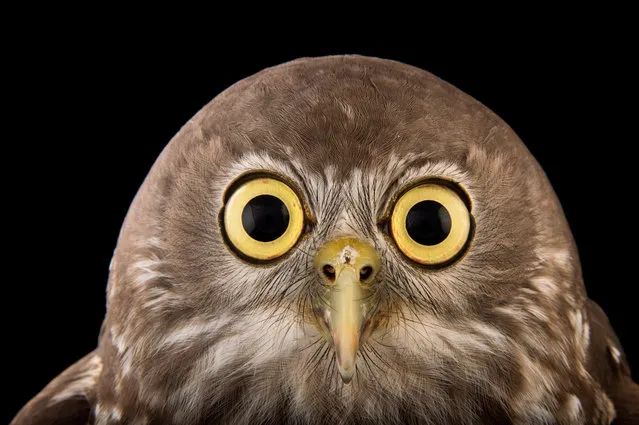
The National Geographic Photo Ark is a travelling exhibition of photographer Joel Sartore’s quest to create a photo archive of biodiversity around the world. So far, Sartore has captured studio portraits of more than 6,000 species – a number that he hopes to double. On 1 July, the ark will open at Melbourne zoo – the first time it has been exhibited in the southern hemisphere. More than 50 portraits will be on display, including many of Australian endangered animals being protected by programs at the zoo itself. These captions have been edited from text supplied by Melbourne zoo. Here: Barking owl. So-named because its call sounds like a barking dog, these birds are native to Australia, Indonesia and Papua New Guinea. In Victoria they are listed as an endangered species, and in 2003 there were estimated to be fewer than 50 breeding pairs. The main threat to the species in Victoria is loss of habitat, especially large trees with hollows in which they can nest and on which many of their prey depend. Apart from a bark, they may utter a chilling scream when they feel threatened. (Photo by Joel Sartore/National Geographic Photo Ark/The Guardian)

The National Geographic Photo Ark is a travelling exhibition of photographer Joel Sartore’s quest to create a photo archive of biodiversity around the world. So far, Sartore has captured studio portraits of more than 6,000 species – a number that he hopes to double. On 1 July, the ark will open at Melbourne zoo – the first time it has been exhibited in the southern hemisphere. More than 50 portraits will be on display, including many of Australian endangered animals being protected by programs at the zoo itself. These captions have been edited from text supplied by Melbourne zoo. Here: Barking owl. (Photo by Joel Sartore/National Geographic Photo Ark/The Guardian)
Details
01 Jul 2017 07:45:00
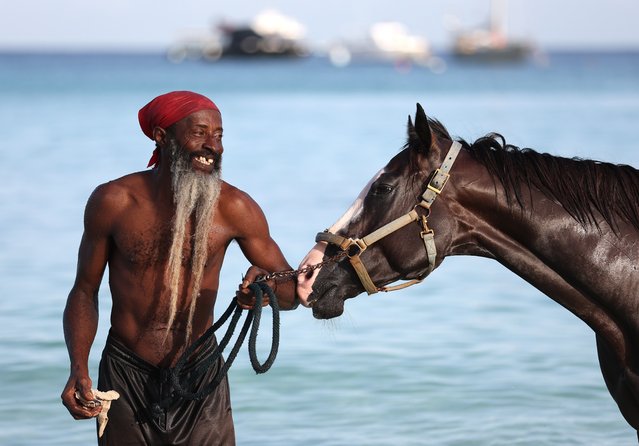
A horse trainer takes his horse into the water at Pebble Beach on June 28, 2024 in Bridgetown, Barbados. The swimming horses of Barbados offer a unique and remarkable experience at Pebbles Beach, where racehorses from the nearby Garrison Savannah enjoy their morning swim almost daily between 5:30 am and 7 am. During this ritual, horses swim out surprisingly far to the moored boats before returning to shore, with some staying longer in the water if recovering from injury or soreness after a race. Visitors can observe the horses' individual personalities as they swim and interact with the water, but are advised to respect the guidance of the grooms and maintain a safe distance, as horses can behave unpredictably, especially if frightened. (Photo by Robert Cianflone/Getty Images)

A horse trainer takes his horse into the water at Pebble Beach on June 28, 2024 in Bridgetown, Barbados. The swimming horses of Barbados offer a unique and remarkable experience at Pebbles Beach, where racehorses from the nearby Garrison Savannah enjoy their morning swim almost daily between 5:30 am and 7 am. During this ritual, horses swim out surprisingly far to the moored boats before returning to shore, with some staying longer in the water if recovering from injury or soreness after a race. Visitors can observe the horses' individual personalities as they swim and interact with the water, but are advised to respect the guidance of the grooms and maintain a safe distance, as horses can behave unpredictably, especially if frightened. (Photo by Robert Cianflone/Getty Images)
Details
07 Jul 2024 03:07:00


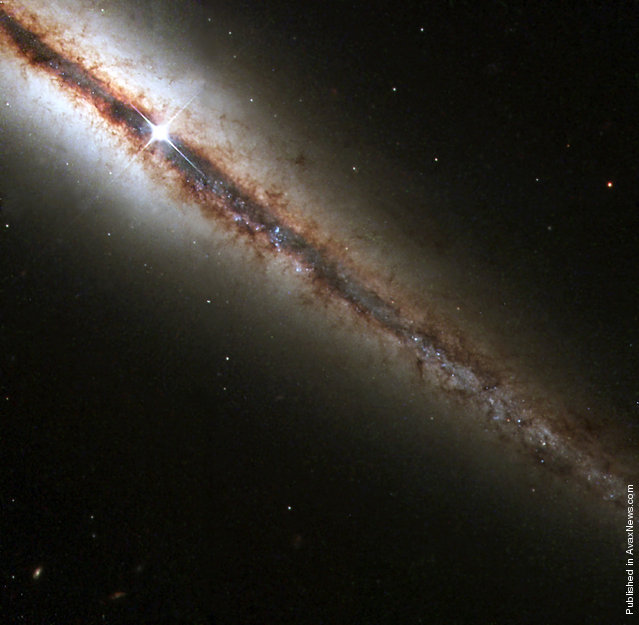
An image produced by the Hubble telescope of the perfectly “edge-on” galaxy, or NGC 4013, March 1, 2001. This new Hubble picture reveals, with great detail, huge clouds of dust and gas extending along, as well as far above, the galaxy's main disk. NGC 4013 is a spiral galaxy, similar to the Milky Way, lying some 55 million light-years from Earth in the direction of the constellation Ursa Major. Viewed face-on, it would look like a nearly circular pinwheel, but NGC 4013 happens to be seen edge-on from our vantage point. Even at 55 million light-years, the galaxy is larger than Hubble's field of view, and the image shows only a little more than half of the object, albeit with unprecedented detail. (Photo Courtesy of NASA/Newsmakers)
Details
28 Feb 2015 22:33:00
“The sustainable development goals cannot be met unless waste management is addressed as a priority”, says UK waste management charity Waste Aid. “E-waste is one of the fastest growing categories of the 7-10bn tonnes of waste produced globally every year”, adds director Mike Webster. “In our view, decent waste management is a basic right and we want governments around the world take this issue much more seriously – in 2012 only 0.2% of international aid went on improving solid waste management – it’s just not enough”. (Photo by Kai Loeffelbein/laif Agentur)

Sustainable development goal target 12.5 is to reduce waste. But with a planet increasingly dependent on technology, is that even possible? As of today, over 30m tonnes of electronic waste has been thrown out so far this year, according to the World Counts. Most e-waste is sent to landfills in Asia and Africa where it is recycled by hand, exposing the people who do it to environmental hazards. Kai Loeffelbein’s photographs of e-waste recycling in Guiyu, southern China show what happens to discarded computers. (Photo by Kai Loeffelbein/laif Agentur)
Details
19 Oct 2016 12:14:00
An aerial view shows the Amazon rainforest at the Bom Futuro National Forest near Rio Pardo in Porto Velho, Rondonia State, Brazil, September 3, 2015. The town of Rio Pardo, a settlement of about 4,000 people in the Amazon rainforest, rises where only jungle stood less than a quarter of a century ago. Loggers first cleared the forest followed by ranchers and farmers, then small merchants and prospectors. (Photo by Nacho Doce/Reuters)

An aerial view shows the Amazon rainforest at the Bom Futuro National Forest near Rio Pardo in Porto Velho, Rondonia State, Brazil, September 3, 2015. The town of Rio Pardo, a settlement of about 4,000 people in the Amazon rainforest, rises where only jungle stood less than a quarter of a century ago. Loggers first cleared the forest followed by ranchers and farmers, then small merchants and prospectors. Brazil's government has stated a goal of eliminating illegal deforestation, but enforcing the law in remote corners like Rio Pardo is far from easy. (Photo by Nacho Doce/Reuters)
Details
08 Nov 2015 08:00:00
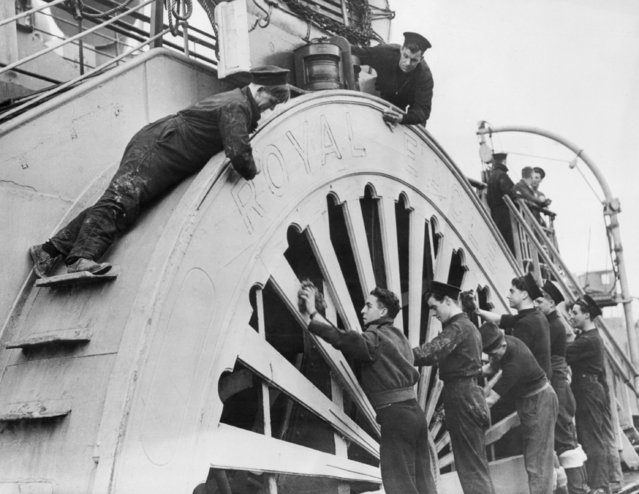
One of the largest paddle steamers afloat in Britain is the H.M.S. Royal Eagle, former peacetime excursion boat which carried passengers on pleasure jaunts from Tower Bridge to Southend, Ramscate and Margate. Commissioned two years ago as a warship of the Royal Navy, the craft has been in action 52 times against enemy aircraft. The Eagle took part in the evacuation from Dunkirk where she was dive-bombed 48 times and brought home nearly 3,000 British troops. Members of the crew cleaning the paddle boxes of H.M.S. Royal Eagle in London on January 18, 1943. (Photo by AP Photo)

One of the largest paddle steamers afloat in Britain is the H.M.S. Royal Eagle, former peacetime excursion boat which carried passengers on pleasure jaunts from Tower Bridge to Southend, Ramscate and Margate. Commissioned two years ago as a warship of the Royal Navy, the craft has been in action 52 times against enemy aircraft. The Eagle took part in the evacuation from Dunkirk where she was dive-bombed 48 times and brought home nearly 3,000 British troops. Members of the crew cleaning the paddle boxes of H.M.S. Royal Eagle in London on January 18, 1943. (Photo by AP Photo)
Details
21 Apr 2018 00:05:00