Loading...
Done
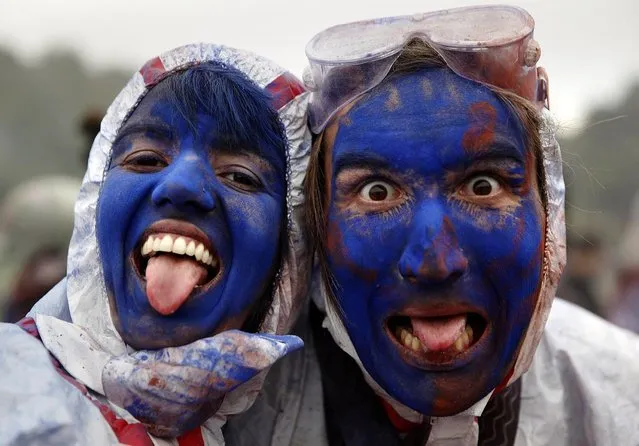
Revellers celebrate "Ash Monday" by participating in a colourful "flour war", a traditional festivity marking the end of the carnival season and the start of the 40-day Lent period until the Orthodox Easter,in the port town of Galaxidi, some 215 km (134 miles) north west of Athens, March 18, 2013. The revellers "fight" by throwing coloured flour, charcoal dust and powder painting until they essentially run out of supplies. (Photo by Yannis Behrakis/Reuters)

Revellers celebrate "Ash Monday" by participating in a colourful "flour war", a traditional festivity marking the end of the carnival season and the start of the 40-day Lent period until the Orthodox Easter,in the port town of Galaxidi, some 215 km (134 miles) north west of Athens, March 18, 2013. The revellers "fight" by throwing coloured flour, charcoal dust and powder painting until they essentially run out of supplies. (Photo by Yannis Behrakis/Reuters)
Details
20 Mar 2013 07:23:00
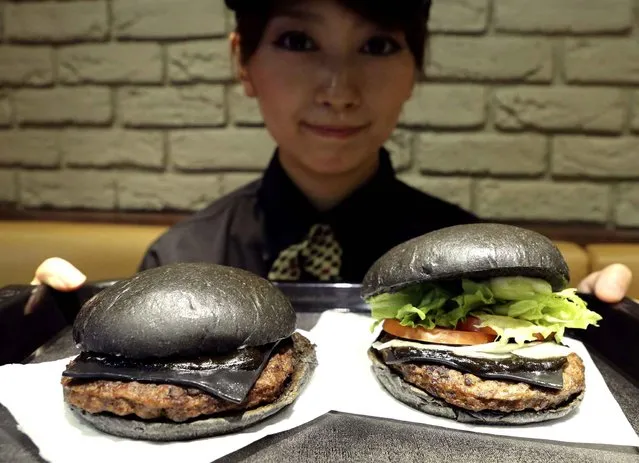
Burger King employee Rumi Sekine shows the Kuro Diamond burger, right, and the Kuro Pearl burger at its Shibuya restaurant in Tokyo Tuesday, September 16, 2014. The international hamburger chain in Japan will launch the two new “kuro burger”, or “black burger” menus that sport buns, cheese and sauce all in black color, starting on Friday, Sept. 19, for a limited period. The buns and cheese are darkened with bamboo charcoal while the beef patties made with black-pepper are topped with the garlic sauce using squid ink. (Photo by Koji Sasahara/AP Photo)

Burger King employee Rumi Sekine shows the Kuro Diamond burger, right, and the Kuro Pearl burger at its Shibuya restaurant in Tokyo Tuesday, September 16, 2014. The international hamburger chain in Japan will launch the two new “kuro burger”, or “black burger” menus that sport buns, cheese and sauce all in black color, starting on Friday, Sept. 19, for a limited period. The buns and cheese are darkened with bamboo charcoal while the beef patties made with black-pepper are topped with the garlic sauce using squid ink. (Photo by Koji Sasahara/AP Photo)
Details
19 Sep 2014 09:31:00
A giant biodegradable landart painting entitled “Vers l'equilibre” (Towards balance) by French-Swiss artist Saype is pictured near the summit of the Grand Chamossaire mountain, above the alpine resort of Villars-sur-Ollon, Switzerland, Wednesday, July 06, 2022. Extending over an area of 2500 square meters, this fresco was created using biodegradable pigments made out of charcoal, chalk, water and milk proteins. (Photo by Valentin Flauraud/Keystone via AP Photo)

A giant biodegradable landart painting entitled “Vers l'equilibre” (Towards balance) by French-Swiss artist Saype is pictured near the summit of the Grand Chamossaire mountain, above the alpine resort of Villars-sur-Ollon, Switzerland, Wednesday, July 06, 2022. Extending over an area of 2500 square meters, this fresco was created using biodegradable pigments made out of charcoal, chalk, water and milk proteins. (Photo by Valentin Flauraud/Keystone via AP Photo)
Details
10 Aug 2022 05:26:00
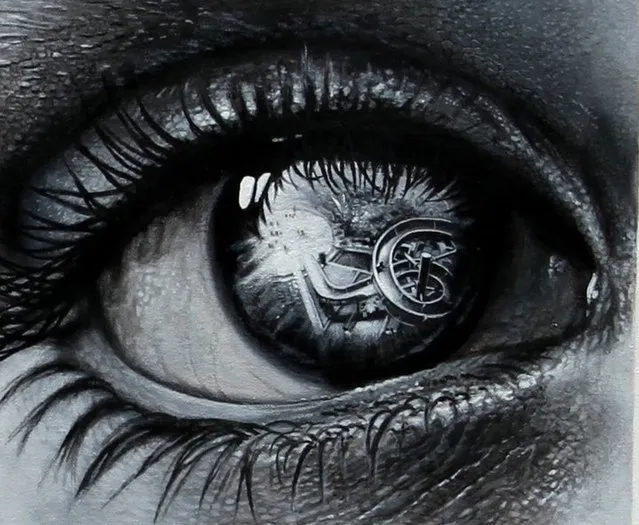
Photorealistic Paintings Of Eyes By Veri Apriyatno

Though it is often said that the human eye can be revealing about a person, Jakarta-based Indonesian artist Veri Apriyatno's series titled The Witnesses reveals a lot more about a person's surroundings through the reflection of their eyes. Each hyperrealistic mixed media creation in the series (made with charcoal, pencil, and acrylics on canvas) presents an entire world within the gaze of a glistening eye.
Details
13 Jun 2015 10:47:00
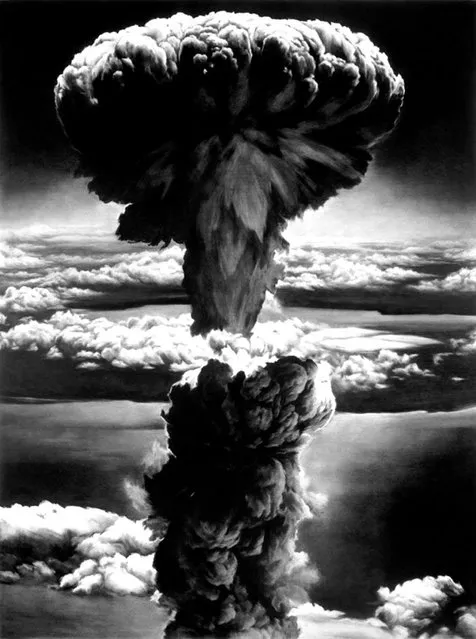
The Sickness of Reason By Robert Longo

Massive, roiling, atomic explosions are the central subjects of The Sickness of Reason, Robert Longo's exhibition of large, highly detailed, and intensely black charcoal drawings.
Details
05 Aug 2013 07:25:00
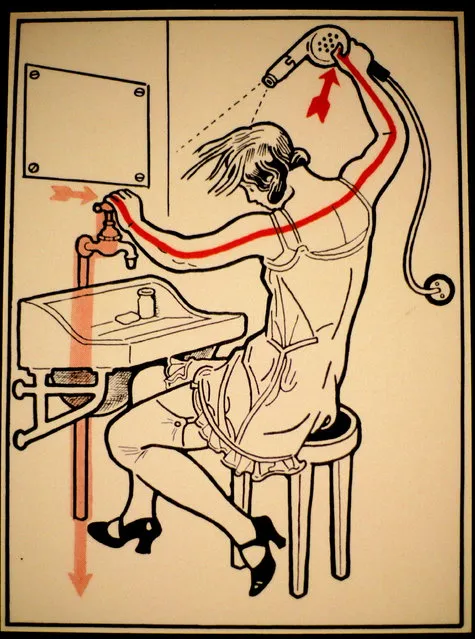
The book “Elektroschutz in 132 Bildern” (Electrical Protection in 132 Pictures) was published in Vienna in the early 1900s by a Viennese physician named Stefan Jellinek (1878-1968, a founder of the Electro-Pathological Museum). The pictures are nice and direct and unambiguous; they teach, graphically, that the surest way to kill yourself with electricity is to form a complete path from source (usually the bright red arrow) to ground (the screened back, pink arrow). Arrowheads provide the path for current flow. (Photo by The Vienna Technical Museum)

The book “Elektroschutz in 132 Bildern” (Electrical Protection in 132 Pictures) was published in Vienna in the early 1900s by a Viennese physician named Stefan Jellinek (1878-1968, a founder of the Electro-Pathological Museum). The pictures are nice and direct and unambiguous; they teach, graphically, that the surest way to kill yourself with electricity is to form a complete path from source (usually the bright red arrow) to ground (the screened back, pink arrow). Arrowheads provide the path for current flow. (Photo by The Vienna Technical Museum)
Details
11 Aug 2014 11:10:00
Employees work on an electric train assembly line at the “Stadler Minsk” plant in Fanipol, Belarus February 10, 2016. (Photo by Vasily Fedosenko/Reuters)

Employees work on an electric train assembly line at the “Stadler Minsk” plant in Fanipol, Belarus February 10, 2016. (Photo by Vasily Fedosenko/Reuters)
Details
12 Feb 2016 12:35:00
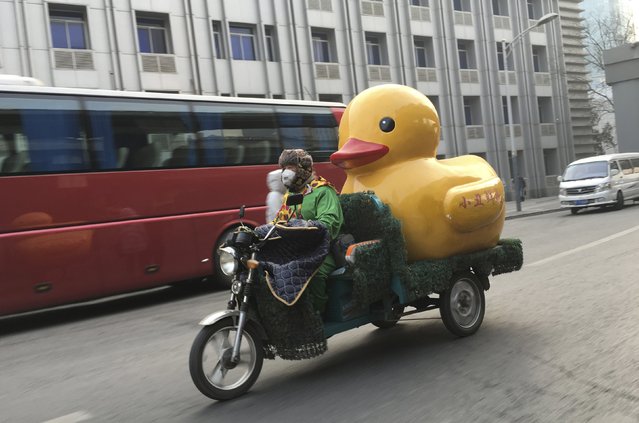
A man wearing a mask and dressed in a clown costume rides an electric tricycle while carrying a container in the shape of a rubber duck amid heavy smog in Beijing, China, December 29, 2015. (Photo by Jason Lee/Reuters)

A man wearing a mask and dressed in a clown costume rides an electric tricycle while carrying a container in the shape of a rubber duck amid heavy smog in Beijing, China, December 29, 2015. (Photo by Jason Lee/Reuters)
Details
12 Jan 2016 08:00:00