Loading...
Done


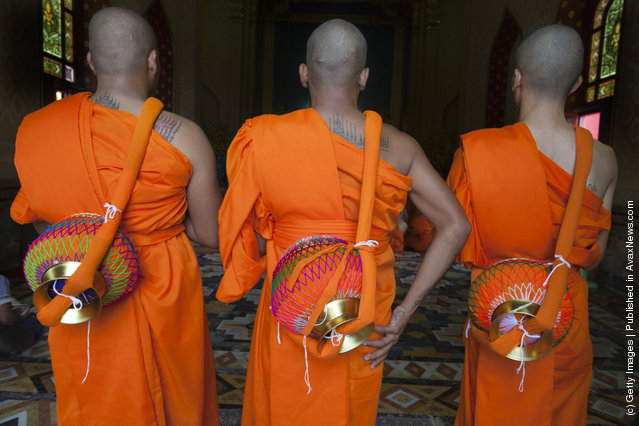
Thai military officers dressed in traditional orange monk robes arrive to attend their official ordination ceremony on July 13, 2011 at the Benchamabopit temple, also known as Marble temple, in Bangkok, Thailand. Eighty four of the military officers were ordinated into the Buddhist community over two days, taking leave of absence from their jobs in the Army for three months during the Buddhist lent period. July 16 will mark the first day of the yearly three-month retreat of Buddhist monks where they will practice meditation in temples and study dharma. (Photo by Paula Bronstein /Getty Images)
Details
14 Jul 2011 09:36:00
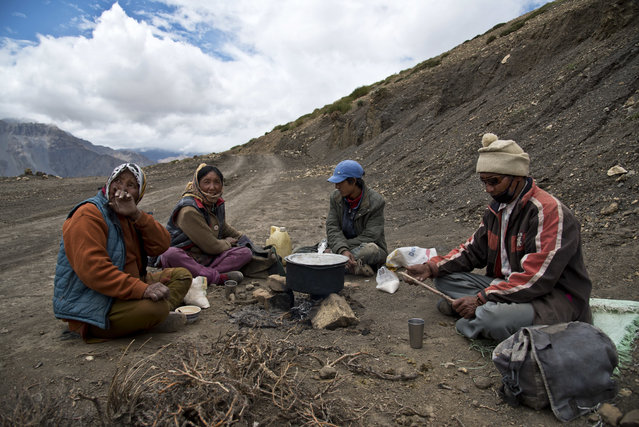
In this August 17, 2016, photo, from left to right, Chhering Chodom, 60, Tashi Yangzom, 50, Lobsang Chhering, 27, and Dorje Tandup, 58, drink milk tea on the side of the road. For centuries, the sleepy valley nestled in the Indian Himalayas remained a hidden Buddhist enclave forbidden to outsiders. Enduring the harsh year-round conditions of the high mountain desert, the people of Spiti Valley lived by a simple communal code – share the Earth's bounty, be hospitable to neighbors, and eschew greed and temptation at all turns. That's all starting to change, for better or worse. Since India began allowing its own citizens as well as outsiders to visit the valley in the early 1990s, tourism and trade have boomed. And the marks of modernization, such as solar panels, asphalt roads and concrete buildings, have begun to appear around some of the villages that dot the remote landscape at altitudes above 4,000 meters (13,000 feet). (Photo by Thomas Cytrynowicz/AP Photo)

In this August 17, 2016, photo, from left to right, Chhering Chodom, 60, Tashi Yangzom, 50, Lobsang Chhering, 27, and Dorje Tandup, 58, drink milk tea on the side of the road. For centuries, the sleepy valley nestled in the Indian Himalayas remained a hidden Buddhist enclave forbidden to outsiders. Enduring the harsh year-round conditions of the high mountain desert, the people of Spiti Valley lived by a simple communal code – share the Earth's bounty, be hospitable to neighbors, and eschew greed and temptation at all turns. That's all starting to change, for better or worse. (Photo by Thomas Cytrynowicz/AP Photo)
Details
15 Sep 2016 09:22:00


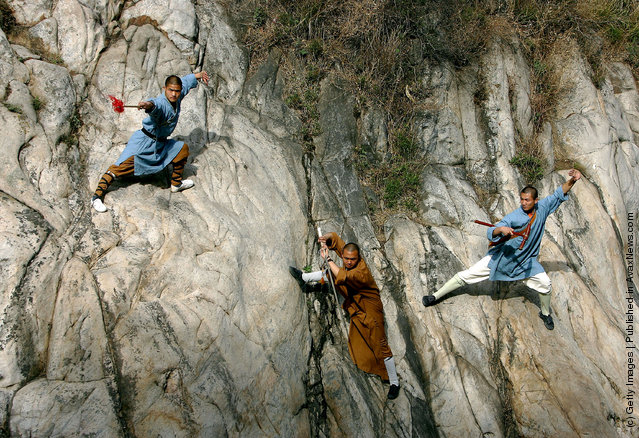
Warrior monks of the Shaolin Temple display their Kung Fu skills at the Songshan Mountain near the temple April 12, 2005 in Dengfeng, Henan Province, China. Shaolin Temple, built in AD 495 in the period of the Northern and Southern Dynasties (420–581) and located in the Songshan Mountain area, is the birthplace of Shaolin Kung Fu. (Photo by Cancan Chu/Getty Images)
Details
17 Jun 2011 11:25:00
An initiate sprays out his fan as he enjoys the view from atop his father's shoulders during the ceremony in Mae Hong Son, Thailand, April 2016. (Photo by Claudio Sieber/Barcroft Images)

An initiate sprays out his fan as he enjoys the view from atop his father's shoulders during the ceremony in Mae Hong Son, Thailand, April 2016. (Photo by Claudio Sieber/Barcroft Images)
Details
01 Dec 2016 11:46:00
A Buddhist monk lights a candle at Wat Phra Dhammakaya during a ceremony on Makha Bucha Day in Pathum Thani province, north of Bangkok February 22, 2016. (Photo by Jorge Silva/Reuters)

A Buddhist monk lights a candle at Wat Phra Dhammakaya during a ceremony on Makha Bucha Day in Pathum Thani province, north of Bangkok February 22, 2016. Makha Bucha Day honours Buddha and his teachings, and falls on the full moon day of the third lunar month. (Photo by Jorge Silva/Reuters)
Details
23 Feb 2016 11:32:00
In this photograph taken on July 7, 2018, an Indian Buddhist monk plays with the wind amongst prayer flags on a hill overlooking Tnagyud Gompa monastery in Komik in Spiti Valley in the northern state of Himachal Pradesh. (Photo by Xavier Galiana/AFP Photo)

In this photograph taken on July 7, 2018, an Indian Buddhist monk plays with the wind amongst prayer flags on a hill overlooking Tnagyud Gompa monastery in Komik in Spiti Valley in the northern state of Himachal Pradesh. (Photo by Xavier Galiana/AFP Photo)
Details
10 Aug 2018 00:03:00
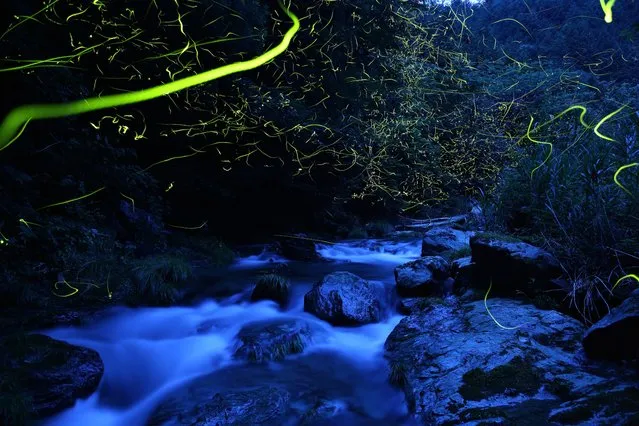
“In the late afternoon after a rain, genji botaru fireflies (luciola cruciate) dance above the swollen creek. The rocks darkened by the rain reflecting the blue sky, and the yellow-green ribbon of the glow from the fireflies, make a beautiful contrast”. – Takehito Miyatake. (Photo by Takehito Miyatake/Steven Kasher Gallery)

“In the late afternoon after a rain, genji botaru fireflies (luciola cruciate) dance above the swollen creek. The rocks darkened by the rain reflecting the blue sky, and the yellow-green ribbon of the glow from the fireflies, make a beautiful contrast”. – Takehito Miyatake. (Photo by Takehito Miyatake/Steven Kasher Gallery)
Details
19 Jun 2014 09:13:00
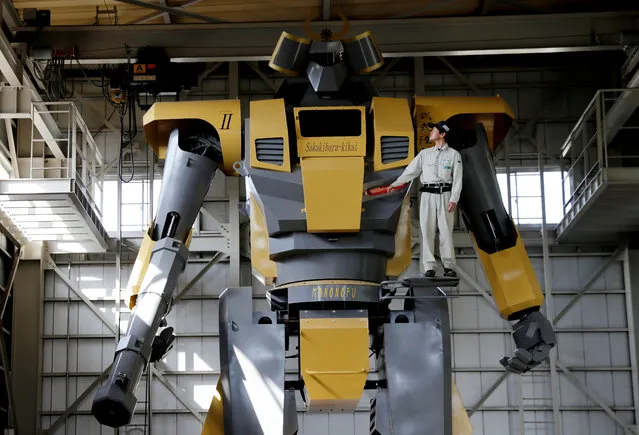
Sakakibara Kikai's engineer Go Sakakibara poses with the bipedal robot Mononofu during its demonstration at its factory in Shinto Village, Gunma Prefecture, Japan on April 12, 2018. Developed at Sakakibara Kikai, a maker of farming machinery, LW-Mononofu is a 28-feet tall, two-legged robot weighing in at more than 7 tonnes. It contains a cockpit with monitors and levers for the pilot to control the robot's arms and legs. (Photo by Kim Kyung-Hoon/Reuters)

Sakakibara Kikai's engineer Go Sakakibara poses with the bipedal robot Mononofu during its demonstration at its factory in Shinto Village, Gunma Prefecture, Japan on April 12, 2018. Developed at Sakakibara Kikai, a maker of farming machinery, LW-Mononofu is a 28-feet tall, two-legged robot weighing in at more than 7 tonnes. It contains a cockpit with monitors and levers for the pilot to control the robot's arms and legs. (Photo by Kim Kyung-Hoon/Reuters)
Details
17 Apr 2018 00:01:00