Loading...
Done
Life Fox And Hound

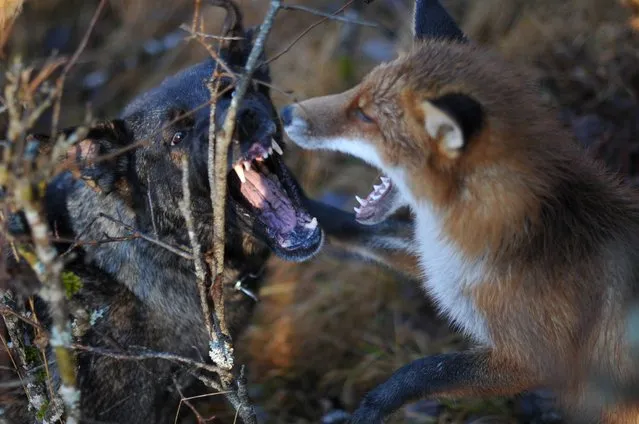
Tinni the dog and Sniffer the fox became quick friends, prompting the pooch's owner Torgeir Berge to start a campaign against the highly controversial fur trade after he noticed "how similar foxes and dogs actually are," calling the fox the "dog of the forest." Berge and his friend Berit Helberg plan to release a book sometime next year chronicling the duo, because "no animals should be living like the animals in the fur industry are living." According to animal advocacy group PETA, many creatures bound for the fur industry are allegedly kept in small, restrictive cages for their entire lives. Berge and Helberg said they plan to donate a portion of the proceeds to help save the Sniffers of the world, and we can totally see why.
Details
24 Apr 2014 14:40:00
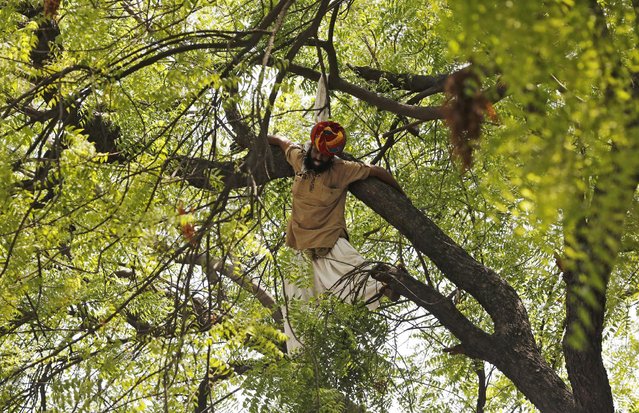
A farmer is seen hanging from a tree during a rally organized by Aam Aadmi (Common Man) Party (AAP) in New Delhi April 22, 2015. The farmer hanged himself from a tree during a political rally in New Delhi on Wednesday, in what appeared to be a desperate protest against the hardship felt by many people scratching a living in rural India. (Photo by Adnan Abidi/Reuters)

A farmer is seen hanging from a tree during a rally organized by Aam Aadmi (Common Man) Party (AAP) in New Delhi April 22, 2015. The farmer hanged himself from a tree during a political rally in New Delhi on Wednesday, in what appeared to be a desperate protest against the hardship felt by many people scratching a living in rural India. Four people climbed the tree to try to save the man after he was seen hanging. (Photo by Adnan Abidi/Reuters)
Details
23 Apr 2015 11:38:00


“Sektor gaza” (Russian: Сектор газа) was a Russian rock band formed on 5 December 1987 in the city of Voronezh, Russia. Despite only semi-officially existing (due to obscene lyrics), the group remains popular in Russia today. The group name was taken from an eponymous industrial district of Voronezh (itself named for high levels of environmental contamination). Their music style could be defined as Russian punk, integrated with elements of different musical genres such as rock, rap, and Russian folk. On 4 July 2000, group leader Yuri “Hoy” Klinskih complained of strong pains in his stomach and the left side of his chest. He suffered heart failure shortly thereafter. Klinskikh died in Voronezh (Russia)at the age of 35. He is buried in the Levoberezhniy Cemetery. The group ceased to exist.

About the music video: The First Chechen War, also known as the War in Chechnya, was a conflict between the Russian Federation and the Chechen Republic of Ichkeria, fought from December 1994 to August 1996. After the initial campaign of 1994 – 1995, culminating in the devastating Battle of Grozny, Russian federal forces attempted to seize control of the mountainous area of Chechnya but were set back by Chechen guerrilla warfare and raids on the flatlands in spite of Russia's overwhelming manpower, weaponry, and air support...
Details
24 May 2012 14:38:00
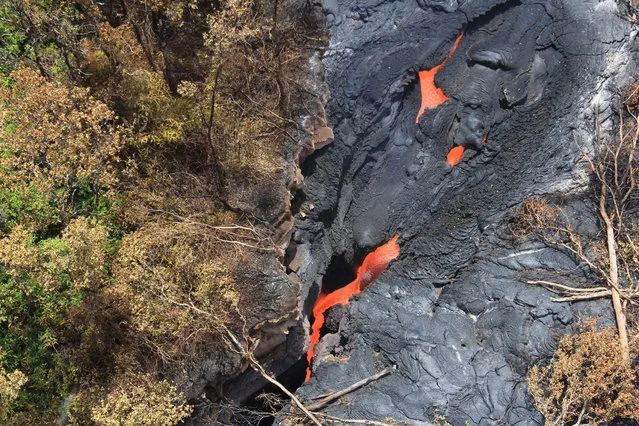
In this September 1, 2014 photo released by the U.S. Geological Survey, fluid lava streams from the June 27 lava flow from the Kilauea volcano in Pahoa, Hawaii. The June 27 lava flow is named for the date it began erupting from a new vent. The Hawaiian Volcano Observatory issued a warning Thursday, September 4, 2014 to a rural community in the path of a lava flow on Hawaii's Big Island, as the molten rock moved to within a mile of homes. (Photo by AP Photo/U.S. Geological Survey)

In this September 1, 2014 photo released by the U.S. Geological Survey, fluid lava streams from the June 27 lava flow from the Kilauea volcano in Pahoa, Hawaii. The June 27 lava flow is named for the date it began erupting from a new vent. The Hawaiian Volcano Observatory issued a warning Thursday, September 4, 2014 to a rural community in the path of a lava flow on Hawaii's Big Island, as the molten rock moved to within a mile of homes. Observatory scientists said lava from the Kilauea volcano could reach the Kaohe Homesteads in five to seven days if it continues advancing through cracks in the earth. (Photo by AP Photo/U.S. Geological Survey)
Details
07 Sep 2014 12:47:00
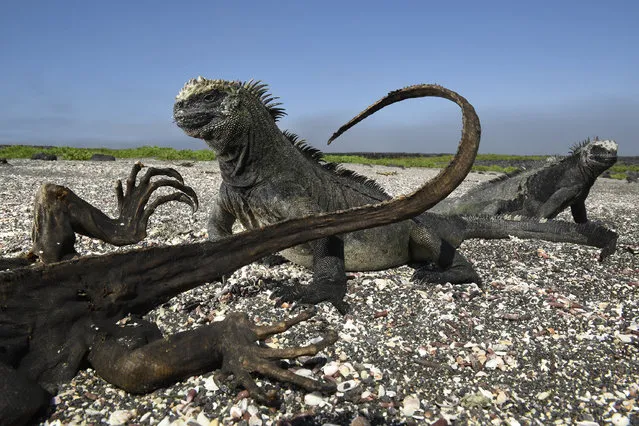
Galapagos – Rocking the Cradle: Four major ocean currents converge along the Galapagos archipelago, creating the conditions for an extraordinary diversity of animal life, April 25, 2016. The islands are home to at least 7,000 flora and fauna species, of which 97 percent of the reptiles, 80 percent of the land birds, 50 percent of the insects and 30 percent of the plants are endemic. The local ecosystem is highly sensitive to the changes in temperature, rainfall and ocean currents that characterize the climatic events known as El Niño and La Niña. These changes cause marked fluctuations in weather and food availability. Many scientists expect the frequency of El Niño and La Niña to increase as a result of climate change, making the Galapagos a possible early-warning location for its effects. (Photo by Thomas P. Peschak for National Geographic/World Press Photo)

Galapagos – Rocking the Cradle: Four major ocean currents converge along the Galapagos archipelago, creating the conditions for an extraordinary diversity of animal life, April 25, 2016. The islands are home to at least 7,000 flora and fauna species, of which 97 percent of the reptiles, 80 percent of the land birds, 50 percent of the insects and 30 percent of the plants are endemic. (Photo by Thomas P. Peschak for National Geographic/World Press Photo)
Details
16 Apr 2018 00:01:00
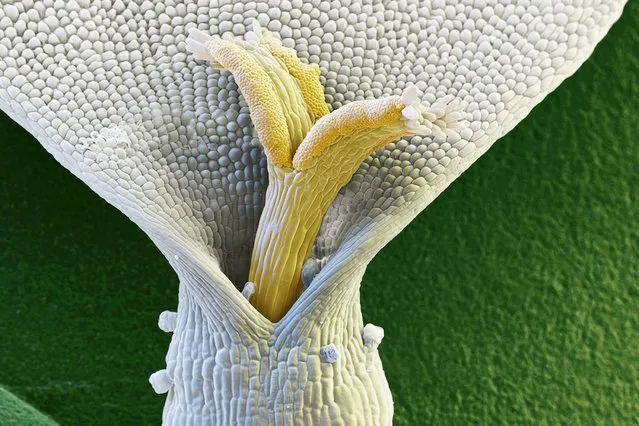
The floret of a Chamomile flower up close and personal. (Photo by Oliver Meckes/Barcroft Media)

These images have been created using a colour scanning electron microscope (SEM) by the award-winning Eye of Science, comprised of snapper Oliver Meckes and biologist Nicole Ottawa. For a decade the pair, based in Reutlingen in the south of Germany, worked with an old SEM they saved from the scrapheap, but for the last five years they have used a £250,000 FEI Quanta Series Field Emission SEM. Oliver said: “Flowers are beautiful in 'normal' view, but when you look closer, some parts get very bizarre and unexpected structures appear – flowers within flowers, worlds within worlds”. Photo: The floret of a Chamomile flower up close and personal. (Photo by Oliver Meckes/Barcroft Media)
Details
26 May 2014 13:51:00
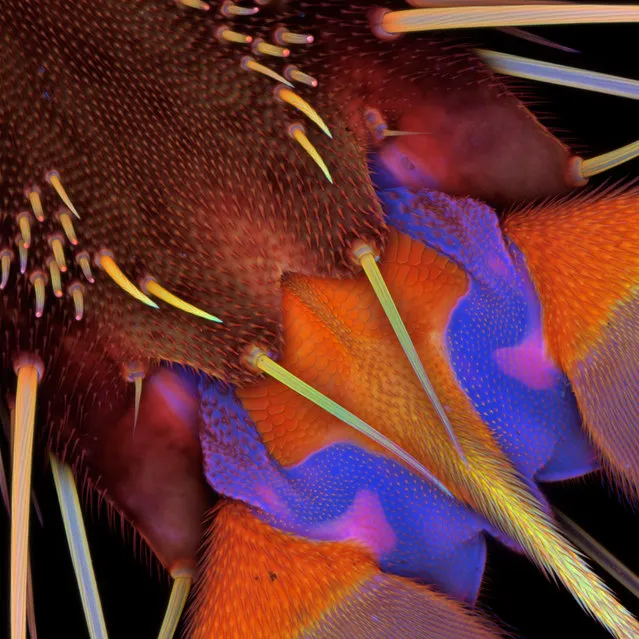
Pretarsus of the third leg of a female drone fly (Eristalis tenax), ventral view, by Dr. Jan Michels, Institute of Zoology, Christian-Albrechts-University of Kiel, Germany. (Photo by Olympus BioScapes)

“Microscope images forge an extraordinary bond between science and art, said Hidenao Tsuchiya, Olympus America's Vice President and General Manager for the Scientific Equipment Group. We founded this competition to focus on the fascinating stories coming out of today's life science research laboratories. The thousands of images that people have shared with the competition over the years reflect some of the most exciting work going on in research today – work that can help shed light on the living universe and ultimately save lives. We look at BioScapes and these beautiful images as sources of education and inspiration to us and the world”. – OlympusBioScapes

Photo: Pretarsus of the third leg of a female drone fly (Eristalis tenax), ventral view, by Dr. Jan Michels, Institute of Zoology, Christian-Albrechts-University of Kiel, Germany. (Photo by Olympus BioScapes)
Details
29 Jul 2012 09:20:00
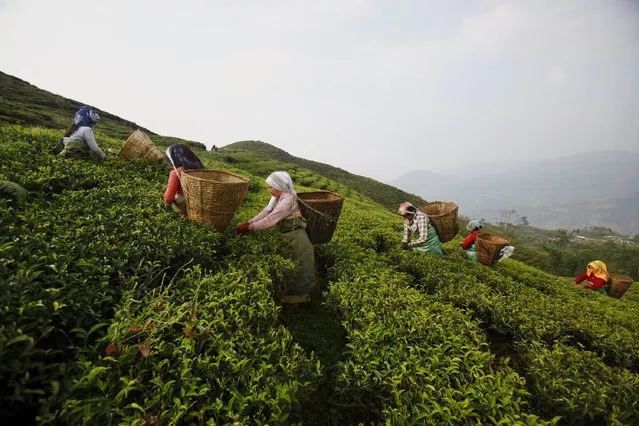
In this Sunday, November 16, 2014 photo, Nepalese women pick tea at a tea garden of Kanyam in Illam district, around 500 kilometers (310 miles) from Katmandu, Nepal. Illam is a hilly district of tea gardens and estates in eastern Nepal's Himalayan region with one of its largest and most productive tea estate being Kanyam estates. (Photo by Niranjan Shrestha/AP Photo)

In this Sunday, November 16, 2014 photo, Nepalese women pick tea at a tea garden of Kanyam in Illam district, around 500 kilometers (310 miles) from Katmandu, Nepal. Illam is a hilly district of tea gardens and estates in eastern Nepal's Himalayan region with one of its largest and most productive tea estate being Kanyam estates. The district produces orthodox tea, hand-processed or machine rolled, which is generally exported to international markets, specially Europe and the United States. Most of the tea pickers here are paid 186 Nepalese Rupees (US $ 2) for 8 hours of work everyday. (Photo by Niranjan Shrestha/AP Photo)
Details
19 Nov 2014 14:28:00