Loading...
Done
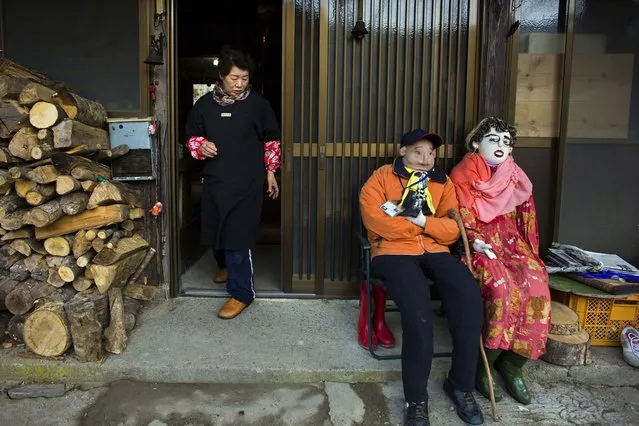
Tsukimi Ayano steps out of her house in the village of Nagoro on Shikoku Island in southern Japan February 24, 2015. (Photo by Thomas Peter/Reuters)

Tsukimi Ayano steps out of her house in the village of Nagoro on Shikoku Island in southern Japan February 24, 2015. Tsukimi Ayano made her first scarecrow 13 years ago to frighten off birds pecking at seeds in her garden. The life-sized straw doll resembled her father, so she made more. Today, the tiny village of Nagoro in southern Japan is teeming with Ayano's hand-sewn creations, frozen in time for a tableau that captures the motions of everyday life. (Photo by Thomas Peter/Reuters)
Details
17 Mar 2015 12:38:00
For her series “Japanese Whispers”, Belgian photographer Zaza Bertrand headed inside the intimate world of rabuhos – Japanese love hotels. Love hotels became popular in Japan from the 1960s onwards, due to a lack of privacy in many family homes. There are now around 37,000 of these hotels in Japan, allowing short daytime “rests” or overnight stays. (Photo by Zaza Bertrand/The Guardian)

For her series “Japanese Whispers”, Belgian photographer Zaza Bertrand headed inside the intimate world of rabuhos – Japanese love hotels. Love hotels became popular in Japan from the 1960s onwards, due to a lack of privacy in many family homes. There are now around 37,000 of these hotels in Japan, allowing short daytime “rests” or overnight stays. (Photo by Zaza Bertrand/The Guardian)
Details
02 Dec 2016 11:30:00


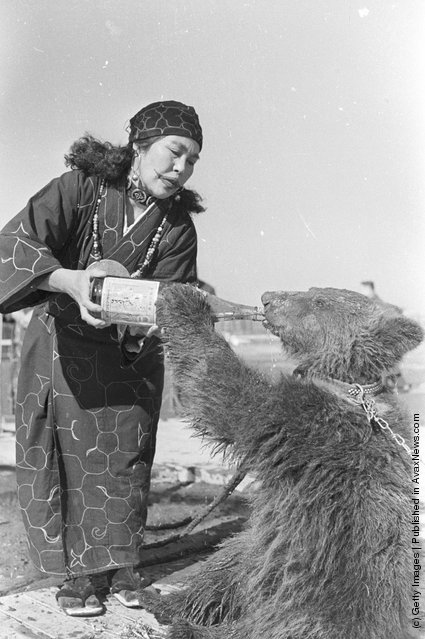
“The Ainu (アイヌ?), also called Aynu, Aino (アイノ), and in historical texts Ezo (蝦夷), are indigenous people or groups in Japan and Russia. Historically they spoke the Ainu language and related varieties and lived in Hokkaidō, the Kuril Islands, and much of Sakhalin. Most of those who identify themselves as Ainu still live in this same region, though the exact number of living Ainu is unknown. This is due to ethnic issues in Japan resulting in those with Ainu backgrounds hiding their identities and confusion over mixed heritages. In Japan, because of intermarriage over many years with Japanese, the concept of a 'pure Ainu' ethnic group is no longer feasible. Official estimates of the population are of around 25,000, while the unofficial number is upwards of 200,000 people”. – Wkipedia

Photo: A captive bear drinking from a large bottle held by an Ainu tribeswoman. (Photo by Evans/Three Lions/Getty Images). Circa 1955
Details
24 Mar 2011 14:01:00
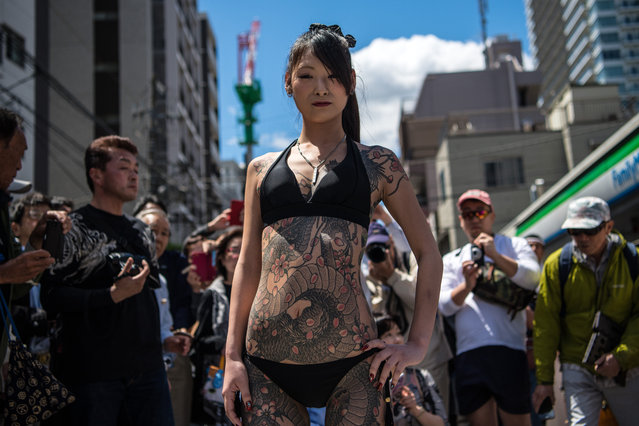
A heavily tattooed Japanese woman poses for photographs near Asakusa Temple during the third and final day of Sanja Festival, on May 20, 2018 in Tokyo, Japan. Sanja Festival is one of Japan's major festivals and is held annually in the Asakusa area of Tokyo. The three day event starts with a grand parade with people in traditional costumes performing dances before around a hundred mikoshi (portable shrines) from the local communities are carried to and from Asakusa Temple watched on by an audience of locals and tourists. (Photo by Carl Court/Getty Images)

A heavily tattooed Japanese woman poses for photographs near Asakusa Temple during the third and final day of Sanja Festival, on May 20, 2018 in Tokyo, Japan. Sanja Festival is one of Japan's major festivals and is held annually in the Asakusa area of Tokyo. (Photo by Carl Court/Getty Images)
Details
22 May 2018 07:21:00
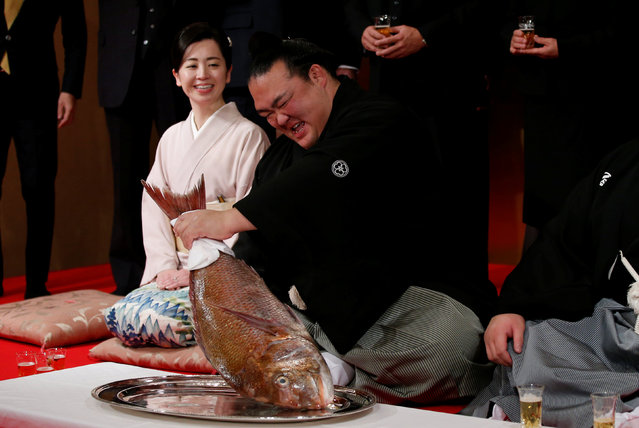
Japanese sumo wrestler Kisenosato (C) holds a red sea bream next to his stablemaster Tagonoura's wife Kotomi as he celebtares after receiving messengers from the Japan Sumo Association bringing official notice of his promotion to Yokozuna, or grand champion, during a ceremony in Tokyo, Japan, January 25, 2017. (Photo by Toru Hanai/Reuters)

Japanese sumo wrestler Kisenosato (C) holds a red sea bream next to his stablemaster Tagonoura's wife Kotomi as he celebtares after receiving messengers from the Japan Sumo Association bringing official notice of his promotion to Yokozuna, or grand champion, during a ceremony in Tokyo, Japan, January 25, 2017. (Photo by Toru Hanai/Reuters)
Details
26 Jan 2017 13:11:00


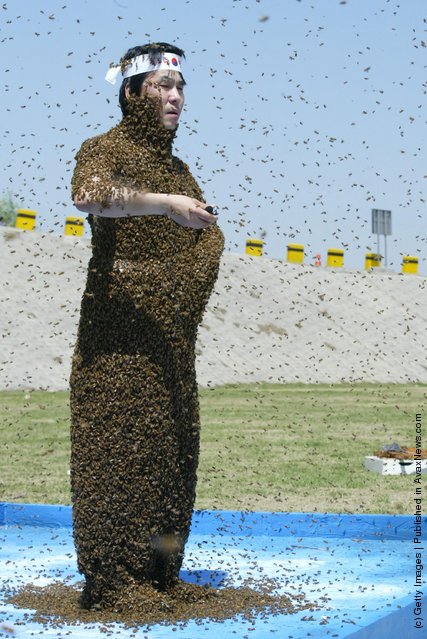
South Korean bee farmer Ahn Sang-Kyu protests Japan's claim of sovereignty over disputed islets May 2, 2006 in Seoul, South Korea. Ahn, a local bee farmer, released over 140,000 bees and attracted them to his body to protest Japan's sovereignty claims over a tiny group of islands located off the east coast of South Korea, called the Dokdo islets by the Koreans and Takeshima by the Japanese. The volcanic islets located about 90 kilometres east of South Korea's Ullung Island, have been a source of diplomatic friction between South Korea and Japan for years. (Photo by Chung Sung-Jun/Getty Images)
Details
05 May 2011 10:32:00
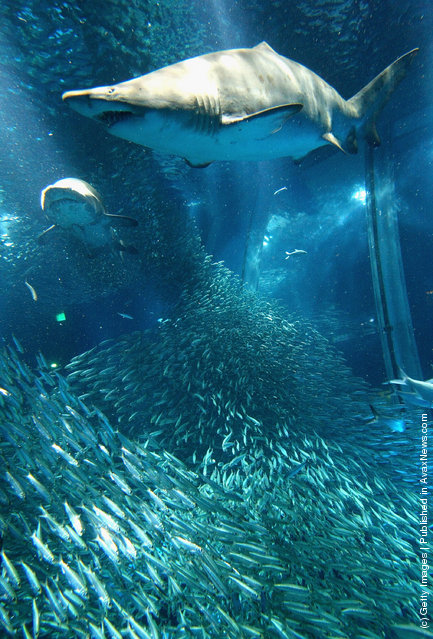
Shoal of sardines and sharks swim in a tank at Yokohama Hakkeijima Sea Paradise on March 19, 2009 in Yokohama, Japan

“Yokohama Hakkeijima Sea Paradise is an amusement park consisting of an aquarium, shopping mall, hotel, marina and amusement rides. It is located in Kanazawa-ku, Yokohama, Japan. It opened for business on May 8, 1993”. – Wikipedia

Photo: Shoal of sardines and sharks swim in a tank at Yokohama Hakkeijima Sea Paradise on March 19, 2009 in Yokohama, Japan. (Photo by Junko Kimura/Getty Images)
Details
31 Jul 2011 12:47:00
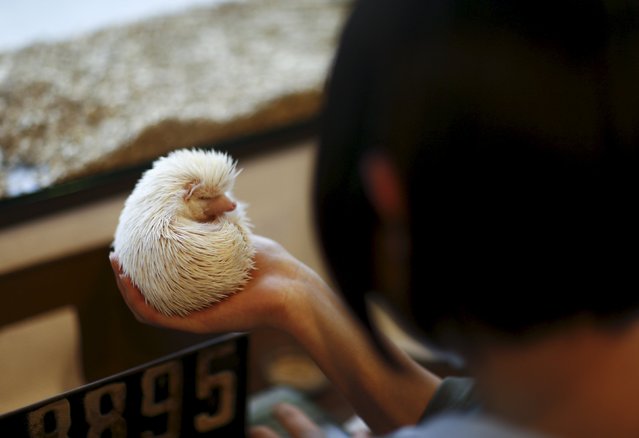
A woman holds a hedgehog at the Harry hedgehog cafe in Tokyo, Japan, April 5, 2016. (Photo by Thomas Peter/Reuters)

A woman holds a hedgehog at the Harry hedgehog cafe in Tokyo, Japan, April 5, 2016. In a new animal-themed cafe, 20 to 30 hedgehogs of different breeds scrabble and snooze in glass tanks in Tokyo's Roppongi entertainment district. Customers have been queuing to play with the prickly mammals, which have long been sold in Japan as pets. The cafe's name Harry alludes to the Japanese word for hedgehog, harinezumi. (Photo by Thomas Peter/Reuters)
Details
08 Apr 2016 14:56:00