Loading...
Done
A foreign passenger wearing a protective suit poses as they prepare for their flight at Manila's International Airport, Philippines, Monday, January 18, 2021. (Photo by Aaron Favila/AP Photo)

A foreign passenger wearing a protective suit poses as they prepare for their flight at Manila's International Airport, Philippines, Monday, January 18, 2021. Coronavirus infections in the Philippines have surged past 500,000 in a new bleak milestone with the government facing criticisms for failing to immediately launch a vaccination program amid a global scramble for COVID-19 vaccines. (Photo by Aaron Favila/AP Photo)
Details
19 Jan 2021 00:07:00
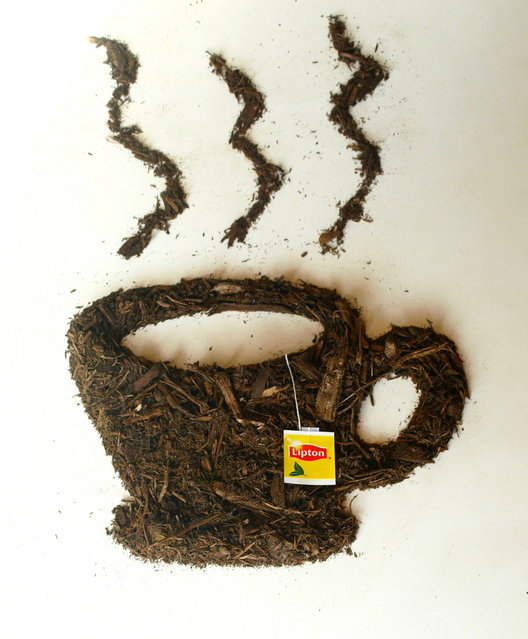
Art By Sarah Rosado

Sarah Rosado was born in New York. Her passion for Art began to develop at an early age. In school she excelled in Art class and was awarded many certificates for her detailed drawings. It wasn't until a couple of years ago when she decided to dedicate herself to her Art, completely. She mastered the paint program in microsoft and later moved on to more sophisticated paint software. Her work is a combination of Cartoon with Humor. Today, she has over 70 Art pieces that are part of her collection and it continues to grow
Details
25 May 2013 12:10:00


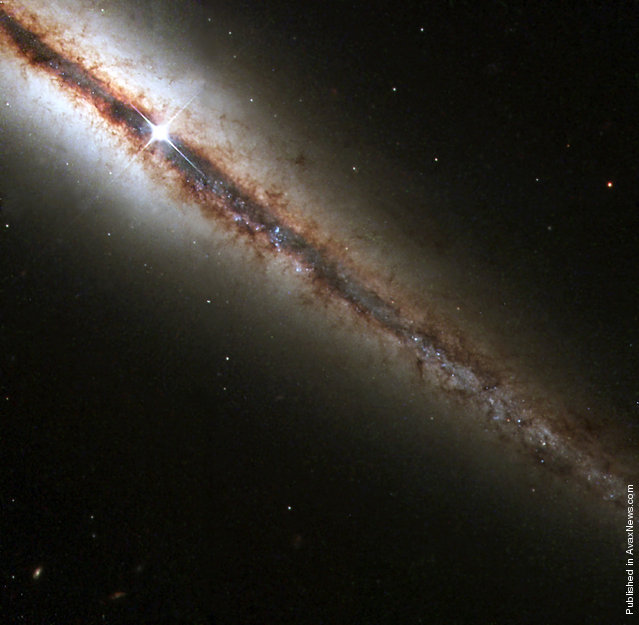
An image produced by the Hubble telescope of the perfectly “edge-on” galaxy, or NGC 4013, March 1, 2001. This new Hubble picture reveals, with great detail, huge clouds of dust and gas extending along, as well as far above, the galaxy's main disk. NGC 4013 is a spiral galaxy, similar to the Milky Way, lying some 55 million light-years from Earth in the direction of the constellation Ursa Major. Viewed face-on, it would look like a nearly circular pinwheel, but NGC 4013 happens to be seen edge-on from our vantage point. Even at 55 million light-years, the galaxy is larger than Hubble's field of view, and the image shows only a little more than half of the object, albeit with unprecedented detail. (Photo Courtesy of NASA/Newsmakers)
Details
28 Feb 2015 22:33:00
United States Coast Guard Academy Cadets Second Class Aurimas Juodka, left, and Sheila Bertrand get in the face of “swab” Kevin Lennox as Bravo Company finishes at the barber shop and mailroom during R-Day, the reporting-in day that marks the beginning of the 7-week “Swab Summer” for the class of 2018 Monday, June 30, 2014, in New London, Conn. (Photo by Sean D. Elliot/AP Photo/The Day)

United States Coast Guard Academy Cadets Second Class Aurimas Juodka, left, and Sheila Bertrand get in the face of “swab” Kevin Lennox as Bravo Company finishes at the barber shop and mailroom during R-Day, the reporting-in day that marks the beginning of the 7-week “Swab Summer” for the class of 2018 Monday, June 30, 2014, in New London, Conn. About 250 prospective cadets, Swabs, start the program designed to indoctrinate them to the military life of the academy and at the end will be accepted into the corps of cadets. (Photo by Sean D. Elliot/AP Photo/The Day)
Details
05 Jul 2014 12:20:00
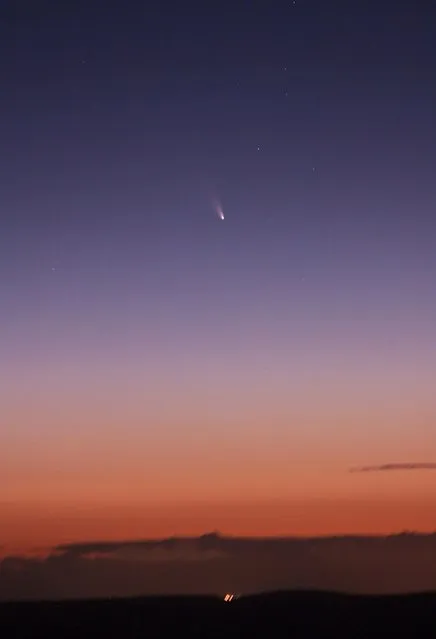
This image provided by NASA shoaws the comet PANSTARRS as seen from Mount Dale, Western Australia on March 5, 2013. According to NASA on March 10, it will make its closest approach to the sun about 28 million miles (45 million kilometers) away. As it continues its nightly trek across the sky, the comet may get lost in the sun's glare but should return and be visible to the naked eye by March 12. (Photo by AP Photo/NASA)

It’s time to start watching for Comet PANSTARRS, one of two comets to get excited about in 2013. Photo: This image provided by NASA shoaws the comet PANSTARRS as seen from Mount Dale, Western Australia on March 5, 2013. According to NASA on March 10, it will make its closest approach to the sun about 28 million miles (45 million kilometers) away. As it continues its nightly trek across the sky, the comet may get lost in the sun's glare but should return and be visible to the naked eye by March 12. (Photo by AP Photo/NASA)
Details
13 Mar 2013 08:03:00
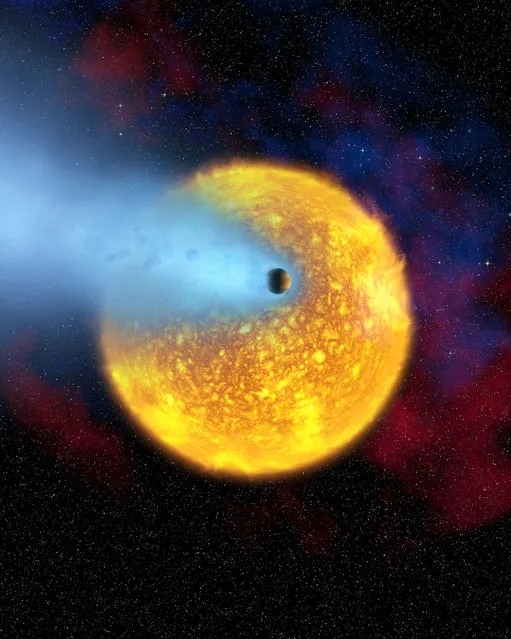
Dramatic changes spotted in HD 189733b exoplanet atmosphere

This artist's rendering illustrates the evaporation of HD 189733b's atmosphere in response to a powerful eruption from its host star. NASA's Hubble Space Telescope detected the escaping gases and NASA's Swift satellite caught the stellar flare. (Credit: NASA's Goddard Space Flight Center)
Details
29 Jun 2012 09:45:00
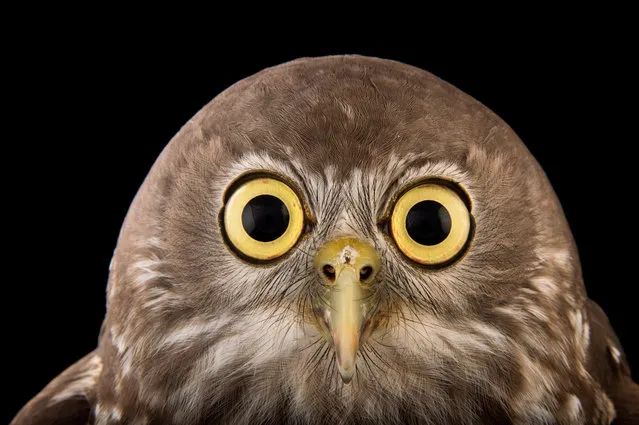
The National Geographic Photo Ark is a travelling exhibition of photographer Joel Sartore’s quest to create a photo archive of biodiversity around the world. So far, Sartore has captured studio portraits of more than 6,000 species – a number that he hopes to double. On 1 July, the ark will open at Melbourne zoo – the first time it has been exhibited in the southern hemisphere. More than 50 portraits will be on display, including many of Australian endangered animals being protected by programs at the zoo itself. These captions have been edited from text supplied by Melbourne zoo. Here: Barking owl. So-named because its call sounds like a barking dog, these birds are native to Australia, Indonesia and Papua New Guinea. In Victoria they are listed as an endangered species, and in 2003 there were estimated to be fewer than 50 breeding pairs. The main threat to the species in Victoria is loss of habitat, especially large trees with hollows in which they can nest and on which many of their prey depend. Apart from a bark, they may utter a chilling scream when they feel threatened. (Photo by Joel Sartore/National Geographic Photo Ark/The Guardian)

The National Geographic Photo Ark is a travelling exhibition of photographer Joel Sartore’s quest to create a photo archive of biodiversity around the world. So far, Sartore has captured studio portraits of more than 6,000 species – a number that he hopes to double. On 1 July, the ark will open at Melbourne zoo – the first time it has been exhibited in the southern hemisphere. More than 50 portraits will be on display, including many of Australian endangered animals being protected by programs at the zoo itself. These captions have been edited from text supplied by Melbourne zoo. Here: Barking owl. (Photo by Joel Sartore/National Geographic Photo Ark/The Guardian)
Details
01 Jul 2017 07:45:00
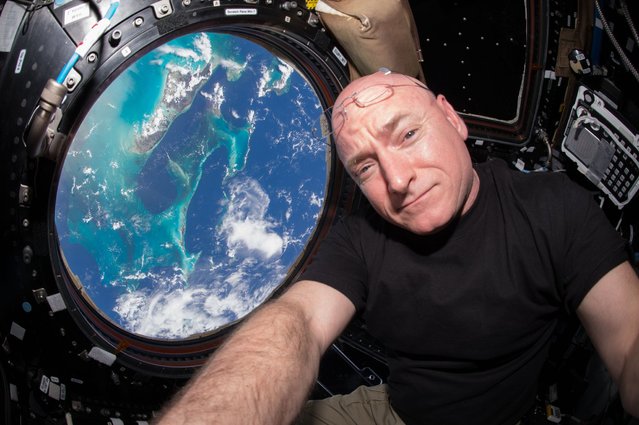
Expedition 44 flight engineer and NASA astronaut Scott Kelly seen inside the Cupola, a special module which provides a 360-degree viewing of the Earth and the International Space Station. Kelly is one of two crew members spending an entire year in space. (Photo by Scott Kelly/NASA)

Expedition 44 flight engineer and NASA astronaut Scott Kelly seen inside the Cupola, a special module which provides a 360-degree viewing of the Earth and the International Space Station. Kelly is one of two crew members spending an entire year in space. (Photo by Scott Kelly/NASA)
Details
25 Feb 2016 12:05:00