Loading...
Done
Delta CEO Ed Bastian talks about the century-old airline's past and technology such as generative artificial intelligence that he sees shaping its future during a Consumer Electronics Show (CES) presentation at The Sphere concert venue in Las Vegas on January 7, 2025. Delta on January 7 marked a century of flying with visions of a future in which artificial intelligence and internet age partnerships make air travel fun and seamless. (Photo by Glenn Chapman/AFP Photo)

Delta CEO Ed Bastian talks about the century-old airline's past and technology such as generative artificial intelligence that he sees shaping its future during a Consumer Electronics Show (CES) presentation at The Sphere concert venue in Las Vegas on January 7, 2025. Delta on January 7 marked a century of flying with visions of a future in which artificial intelligence and internet age partnerships make air travel fun and seamless. (Photo by Glenn Chapman/AFP Photo)
Details
05 Mar 2025 04:24:00
Titanoboa: Monster Snake

Titanoboa, meaning "titanic boa," is an extinct genus of snake that lived approximately 60–58 million years ago, during the Paleocene epoch, a 10-million-year period immediately following the dinosaur extinction event. The only known species is Titanoboa cerrejonensis, the largest, longest, and heaviest snake ever discovered, which supplanted the previous record holder, Gigantophis.

A full-scale model of the snake was unveiled at New York City's Grand Central station before the exhibit opens at the Smithsonian in Washington DC.
Details
06 Feb 2014 12:38:00
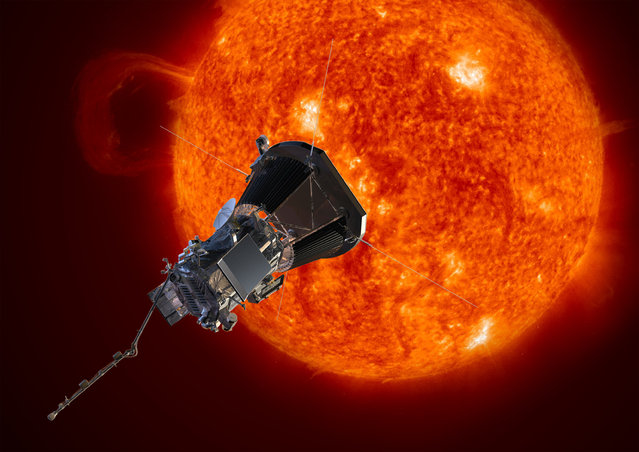
This image made available by the Johns Hopkins University Applied Physics Laboratory on Wednesday, May 31, 2017 depicts NASA's Solar Probe Plus spacecraft approaching the sun. On Wednesday, NASA announced it will launch the probe in summer 2018 to explore the solar atmosphere. It will be subjected to brutal heat and radiation like no other man-made structure before. (Photo by Johns Hopkins University Applied Physics Laboratory via AP Photo)

This image made available by the Johns Hopkins University Applied Physics Laboratory on Wednesday, May 31, 2017 depicts NASA's Solar Probe Plus spacecraft approaching the sun. On Wednesday, NASA announced it will launch the probe in summer 2018 to explore the solar atmosphere. It will be subjected to brutal heat and radiation like no other man-made structure before. (Photo by Johns Hopkins University Applied Physics Laboratory via AP Photo)
Details
08 Sep 2017 09:42:00
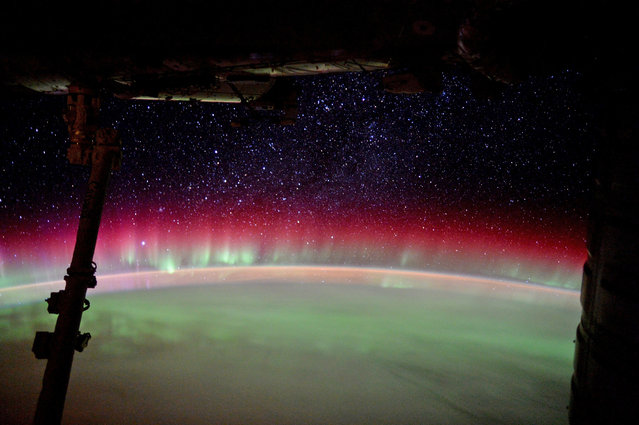
ESA astronaut Tim Peake posted this stunning image on his social media channels, commenting: “Station passed through magnificent aurora Australis last night”. Tim is set to return to Earth on 18 June 2016, bringing his six-month Principia mission to the ISS to an end. During his stay he performed more than 30 scientific experiments for ESA and taking part in numerous others from ESA's international partners. ESA and the UK Space Agency have partnered to develop many exciting educational activities around the Principia mission, aimed at sparking the interest of young children in science and space. (Photo by Tim Peake/ESA/NASA)

ESA astronaut Tim Peake posted this stunning image on his social media channels, commenting: “Station passed through magnificent aurora Australis last night”. Tim is set to return to Earth on 18 June 2016, bringing his six-month Principia mission to the ISS to an end. During his stay he performed more than 30 scientific experiments for ESA and taking part in numerous others from ESA's international partners. ESA and the UK Space Agency have partnered to develop many exciting educational activities around the Principia mission, aimed at sparking the interest of young children in science and space. (Photo by Tim Peake/ESA/NASA)
Details
31 Dec 2016 10:21:00
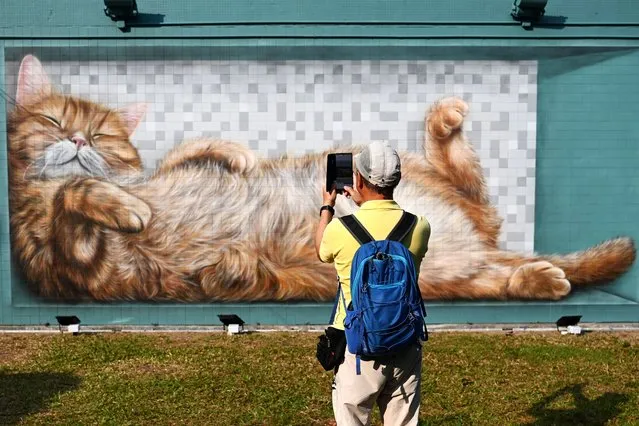
A mural depicting a resting cat by Russian street artist Vladi is photographed by a man outside a hotel in Hong Kong on November 27, 2023. (Photo by Peter Parks/AFP Photo)

A mural depicting a resting cat by Russian street artist Vladi is photographed by a man outside a hotel in Hong Kong on November 27, 2023. (Photo by Peter Parks/AFP Photo)
Details
02 Apr 2024 03:52:00
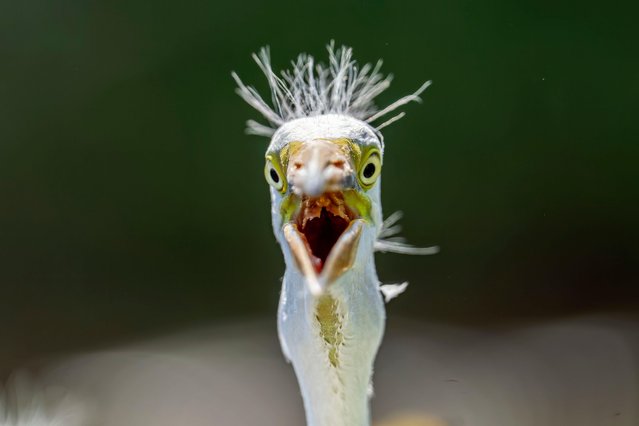
An egret in the second decade of April 2025 cools off in the Florida heat by gular fluttering, rapidly vibrating its throat muscles with an open beak. The mechanism helps to dissipate heat through evaporation. (Photo by Ronen Tivony/ZUMA Press Wire/Alamy Live News)

An egret in the second decade of April 2025 cools off in the Florida heat by gular fluttering, rapidly vibrating its throat muscles with an open beak. The mechanism helps to dissipate heat through evaporation. (Photo by Ronen Tivony/ZUMA Press Wire/Alamy Live News)
Details
11 May 2025 03:40:00
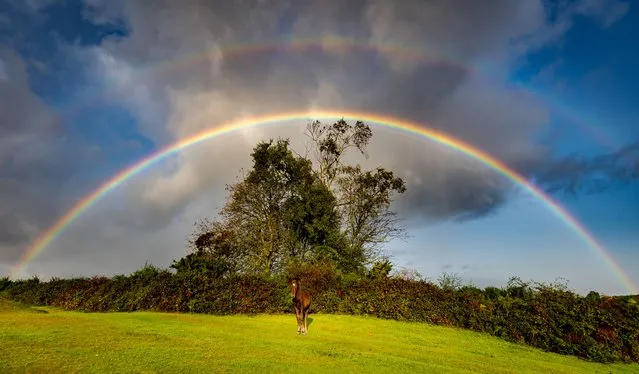
Photographer Will Evans captured this New Forest foal under an incredible double rainbow at Wilverley Inclosure near Brockenhurst, UK on September 21, 2023. (Photo by Will Evans/SnapPhotography/Bournemouth News)

Photographer Will Evans captured this New Forest foal under an incredible double rainbow at Wilverley Inclosure near Brockenhurst, UK on September 21, 2023. (Photo by Will Evans/SnapPhotography/Bournemouth News)
Details
02 Feb 2024 07:52:00
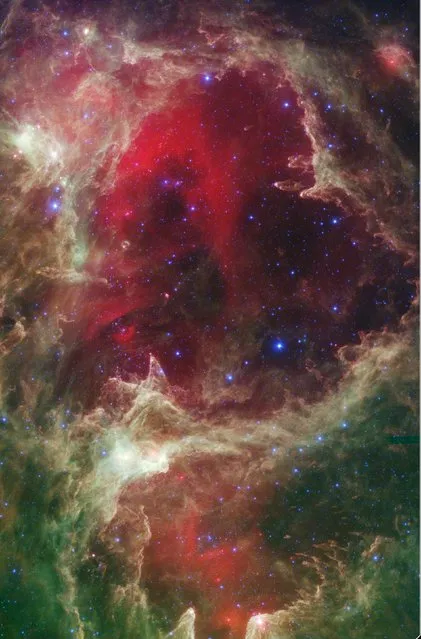
An infrared portrait from NASA's Spitzer Space Telescope which shows generations of stars is seen in this undated NASA handout image released February 14, 2013. In this wispy star-forming region, called W5, the oldest stars can be seen as blue dots in the centers of the two hollow cavities (other blue dots are background and foreground stars not associated with the region). Red shows heated dust that pervades the region's cavities, while green highlights dense clouds. (Photo by NASA/Reuters/JPL-Caltech/Harvard-Smithsonian/Handout)

An infrared portrait from NASA's Spitzer Space Telescope which shows generations of stars is seen in this undated NASA handout image released February 14, 2013. In this wispy star-forming region, called W5, the oldest stars can be seen as blue dots in the centers of the two hollow cavities (other blue dots are background and foreground stars not associated with the region). Red shows heated dust that pervades the region's cavities, while green highlights dense clouds. (Photo by NASA/Reuters/JPL-Caltech/Harvard-Smithsonian/Handout)
Details
03 Mar 2013 08:44:00