Loading...
Done


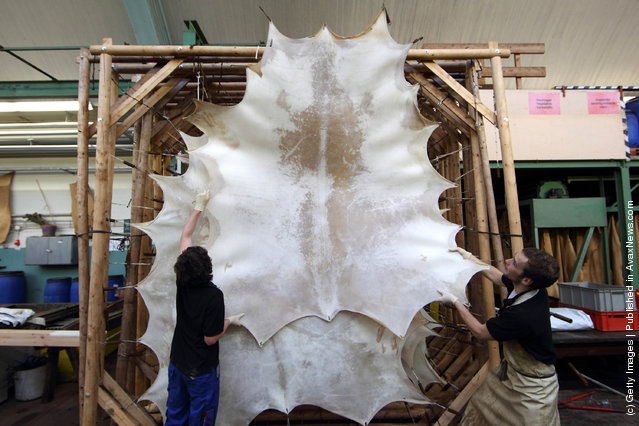
REUTLINGEN, GERMANY - NOVEMBER 17: Students hang out finished parchment leather at the LGR (Lederinstitut Gerberschule Reutlingen) tannery school on November 17, 2010 in Reutlingen, Germany. Even in early antiquity and up their hair or dried goat and sheep skins were used as material for documents. In the small Asian city Pergamon these skins were processed in large quantities for this purpose, so they formed the main trading arm of the city, of which the name is parchment is derived. In medieval times, reached the parchment is of great importance, it was such as France's production under the supervision of the University of Paris. Even now, important documents, placed on their unlimited shelf life as possible large value (eg diplomas, addresses, memory, writings, documents for primary and keystones) written on parchment...
Details
20 Nov 2011 18:17:00
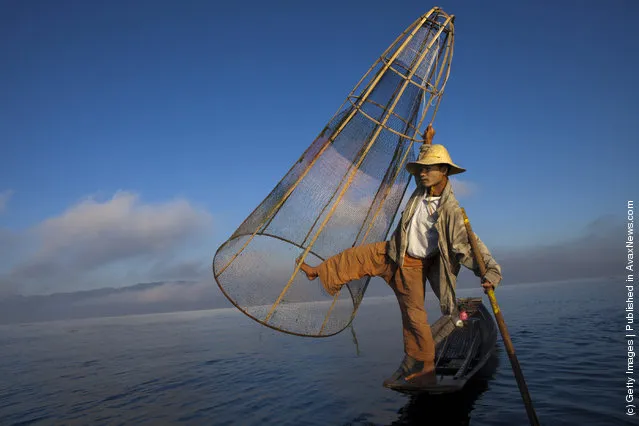
Intha leg rowing fishermen starts to fish in the early morning hours on Inle Lake in Myanmar

An Intha leg rowing fisherman paddles on Inle Lake December 17, 2011 in Inle Lake, Myanmar. The famous lake is 22 kilometers long and 11 wide and has been a fisherman's paradise for years where they use their leg rowing technique, standing on the stern on one leg and wrapping the other leg around the oar. (Photo by Paula Bronstein /Getty Images)
Details
22 Dec 2011 12:17:00
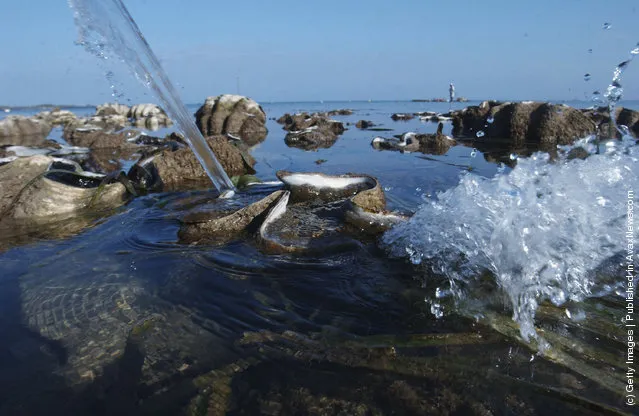
Tridacna Gigas, or Giant Clams

“The giant clam, Tridacna gigas (known as pā’ua in Cook Islands Māori), is the largest living bivalve mollusc. T. gigas is one of the most endangered clam species. It was mentioned as early as 1825 in scientific reports. One of a number of large clam species native to the shallow coral reefs of the South Pacific and Indian oceans, they can weigh more than 200 kilograms (440 lb) measure as much as 120 cm (47 in) across, and have an average lifespan in the wild of 100 years or more”. – Wikipedia

Photo: Tridacna Gigas, or Giant Clams spew water as a traditional fisherman passes by a small sanctuary on January 23, 2004 near Bolinao in the Northern Philippines. The clams, prime builders for coral reefs and providing shelter for spawning fish and other marine life, are exposed by low tides in the sanctuary. Overfishing and pollution throughout the country are not only threatening food security, but are also starting to choke one of the few working clam sanctuaries in the world. (Photo by David Greedy/Getty Images)
Details
01 Oct 2011 13:10:00
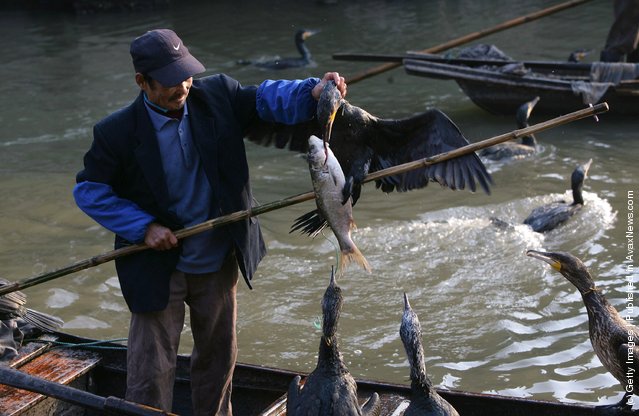
Cormorant Fishing

“Cormorant fishing is a traditional fishing method in which fishermen use trained cormorants to fish in rivers. Historically, cormorant fishing has taken place in Japan and China from around 960 AD. and recorded from other places throughout the world”. – Wikipedia

Photo: A cormorant raised by a fisherman catches a fish on a canal on November 27, 2007 in Xitang Town of Jiashan County, Zhejiang Province, China. (Photo by China Photos/Getty Images)
Details
07 Oct 2011 09:34:00
WWII: Women And The War Effort

These stunning color portraits, produced by the U.S. Office of War Information during World War II depict the role of women in the US war effort. All of the images were shot on 4x5 color transparency film by Howard R. Hollem and Alfred T. Palmer during 1942 and 1943 and were turned over to the Library of Congress Prints and Photographs Division in 1944. They are seen here with their original captions.
Details
18 Aug 2013 13:26:00
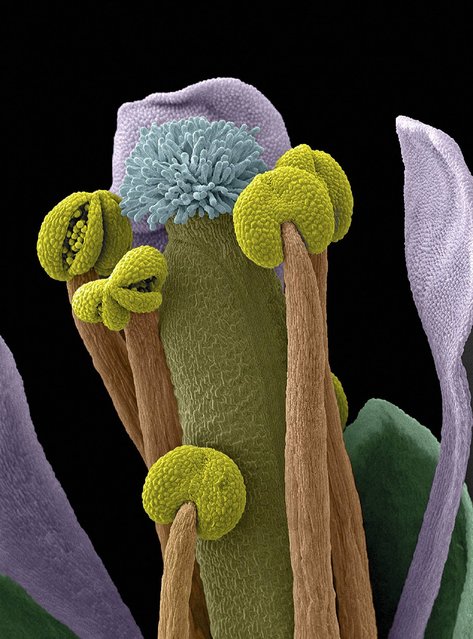
Scanning electron micrograph (SEM) of an Arabidopsis thaliana flower, also commonly known as thale cress. Some of the anthers are open, revealing pollen grains ready for dispersal. Arabidopsis was the first plant to have its entire genome sequenced and is widely used as a model organism in molecular and plant biology. Horizontal width of image is 1200 microns. Magnification 100x. (Photo by Stefan Eberhard/Wellcome Images)

Beautiful, strange and occasionally alarming pictures from the shortlist for this year’s Wellcome image awards – which celebrate the very best in science photography and imaging – from an x-ray of a bat to a micrograph of a kidney stone. The exhibition opens on 12 March at three science centres and the Museum of Science and Industry in Manchester. Photo: Scanning electron micrograph (SEM) of an Arabidopsis thaliana flower, also commonly known as thale cress. Some of the anthers are open, revealing pollen grains ready for dispersal. Arabidopsis was the first plant to have its entire genome sequenced and is widely used as a model organism in molecular and plant biology. Horizontal width of image is 1200 microns. Magnification 100x. (Photo by Stefan Eberhard/Wellcome Images)
Details
11 Mar 2014 05:58:00
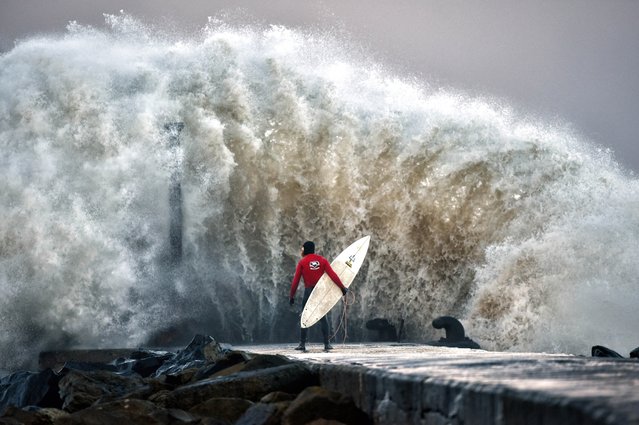
A huge wave crashes against Castlerock pier as professional surfer Al Mennie waits on a break in the swell on December 22, 2016 in Coleraine, Northern Ireland. Storm Barbara is expected to cause major travel disruption when it hits northern parts of the UK later with 90mph winds predicted. The Met Office has issued an amber warning with the worst effects of the storm expected on Friday and Saturday. (Photo by Charles McQuillan/Getty Images)

A huge wave crashes against Castlerock pier as professional surfer Al Mennie waits on a break in the swell on December 22, 2016 in Coleraine, Northern Ireland. Storm Barbara is expected to cause major travel disruption when it hits northern parts of the UK later with 90mph winds predicted. The Met Office has issued an amber warning with the worst effects of the storm expected on Friday and Saturday. (Photo by Charles McQuillan/Getty Images)
Details
23 Dec 2016 11:35:00
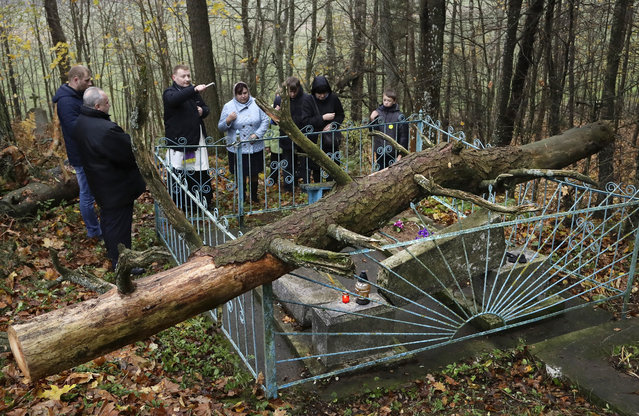
A Catholic priest blesses a grave, marking All Saints' Day as the people stand next to monument partially destroyed by an old fallen tree at a cemetery in the village of Zubkovo, 150 km (93 miles) west of Minsk, Belarus, Wednesday, November 1, 2017. Belarusian Catholics marked All Saints Day by visiting graves of their relatives. (Photo by Sergei Grits/AP Photo)

A Catholic priest blesses a grave, marking All Saints' Day as the people stand next to monument partially destroyed by an old fallen tree at a cemetery in the village of Zubkovo, 150 km (93 miles) west of Minsk, Belarus, Wednesday, November 1, 2017. Belarusian Catholics marked All Saints Day by visiting graves of their relatives. (Photo by Sergei Grits/AP Photo)
Details
02 Nov 2017 08:38:00