Loading...
Done
Anne Lamb – Art

Allyson Anne Lamb is a Brooklyn based fine artist primarily working in photography. Her work uses the body to explore the complexity of human emotions and the continuous invisible transformations we experience, revealing them as monstrosities or fantastical beings. Through the assembling of body parts, bright colors and fictional spaces that exist in Lamb's magical realm where sexual anxiety, female identity and altered sensorial perceptions are explored, Lamb invites us to participate in an altered state of consciousness. We step in to quaint fragmented realities where we are welcomed to engage in lucid dreaming populated by colorful mutations.
Details
14 Jun 2012 12:51:00
“The Hero”. (Christophe Kiciak)

“I started photography in June 2009. At the time, I was searching for a way to express both the rigorous scientist and the creative artist in me. There are few hobbies that let these two approaches work together, so I really was enthusiastic about it: I am now spending all my free time studying various techniques, contemplating others' fantastic work, and of course, making pictures”. – Christophe Kiciak. Photo: “The Hero”. (Photo by Christophe Kiciak)
Details
11 Jan 2013 15:40:00
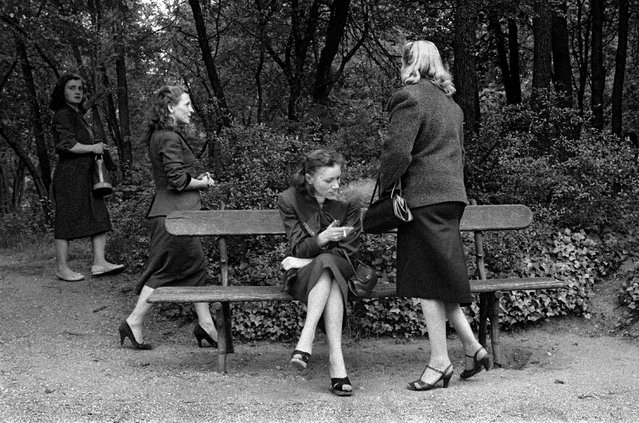
Horvat started out as a photojournalist. Meeting Henri Cartier-Bresson in 1951 proved to be a milestone in his career, leading to a two-year trip to Asia and exhibiting internationally, including in the 1955 show The Family of Man at New York's Museum of Modern Art. Here: Prostitutes, Bois de Boulogne, 1956. (Photo by Frank Horvat/The Guardian)

Born in 1958 in Abbazia, Italy, Frank Horvat is considered one of the founding fathers of French fashion photography. Frank Horvat: Storia di un Fotografo is on at Palazzo Chiablese Musei Reali, Turin, until 16 June. Here: Prostitutes, Bois de Boulogne, 1956. (Photo by Frank Horvat/The Guardian)
Details
01 Jun 2018 00:05:00
Daily Life in Tokyo by Photographer Tatsuo Suzuki. (Photo by Tatsuo Suzuki)

“Born in 1965 at Tokyo, living at Tokyo. Starting shooting since 2008. 2011: 1x Photo Awards Honorable Mention (Street). 2012: Black and White Spider Awards 2nd Place (Portrait), Honorable Mention (Fashion); PX3 Gold Awards (Press); Israel Harvanism Street Contest 1st Place. 2013: Urban Picnic Street Contest Top30 Finalist; PX3 3rd Place (Portrait), Gold (Portrait - Personality), Gold (Press - People/Personality); Photolux + PhotoVogue Photo Contest 1st Place. 2014: Sony World Photography Awards Commended (Smile Category)”. – Tatsuo Suzuki. Photo: “Spring”. (Photo by Tatsuo Suzuki)
Details
13 Apr 2014 10:19:00
What the World Eats By Peter Menzel And Faith D'Aluisio Part 1

A stunning photographic collection featuring portraits of people from 30 countries and the food they eat in one day. In this fascinating study of people and their diets, 80 profiles are organized by the total number of calories each person puts away in a day. Featuring a Japanese sumo wrestler, a Massai herdswoman, world-renowned Spanish chef Ferran Adria, an American competitive eater, and more, these compulsively readable personal stories also include demographic particulars, including age, activity level, height, and weight. Essays from Harvard primatologist Richard Wrangham, journalist Michael Pollan, and others discuss the implications of our modern diets for our health and for the planet. This compelling blend of photography and investigative reportage expands our understanding of the complex relationships among individuals, culture, and food.
Details
23 Apr 2014 14:34:00
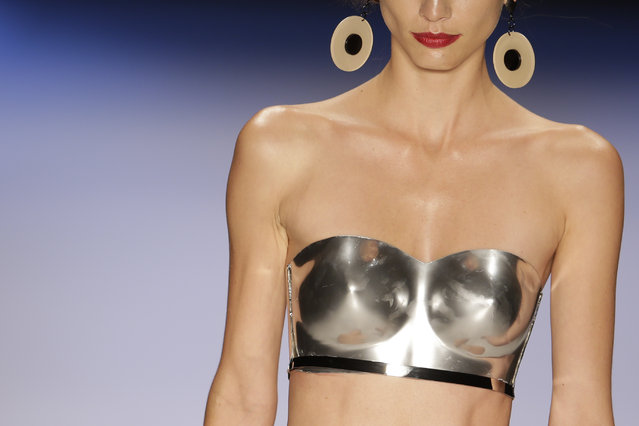
A model wears a creation from the Triya summer collection during Fashion Rio in Rio de Janeiro, Brazil, Friday, April 19, 2013. (Photo by Felipe Dana/AP Photo)

Felipe Dana discovered photography at age 15 when he started working as an assistant for event and commercial photographers. At the close of 2009, he decided to focus his career solely on photojournalism. Dana has focused his work on documenting the consequences of social changes in slums due to upcoming major sports events scheduled for 2014 and 2016 in Rio de Janeiro, where he currently lives and works as a staff photographer for The Associated Press. Photo: A model wears a creation from the Triya summer collection during Fashion Rio in Rio de Janeiro, Brazil, Friday, April 19, 2013. (Photo by Felipe Dana/AP Photo)
Details
15 May 2014 07:29:00
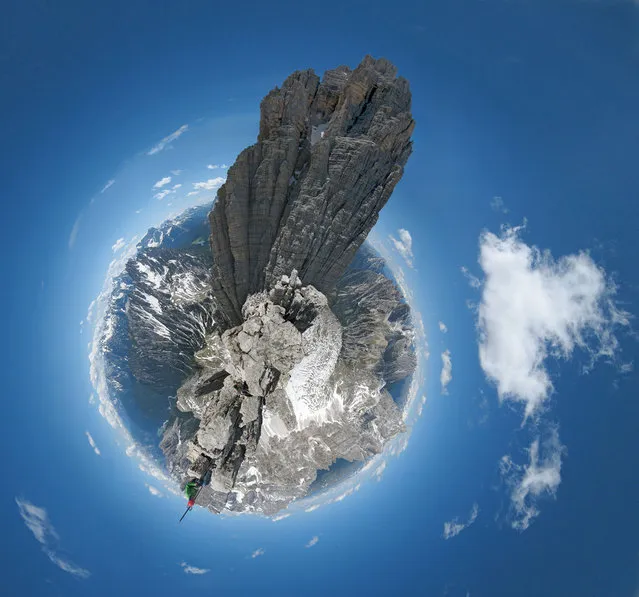
“Taken at the tiny summit of Cima Piccola in the the Tre Cima group in the Dolomites, Italy. The large peak is Cima Grande Some remote peaks have a summit register, and my climbing partner Steve can be seen signing this in the bottom of the picture”. (“Little Planets” Project. Photo and comment by Dan Arkle)

These are the amazing panoramic photographs that look like little planets. They were taken by photographer Dan Arkle, 34, from Sheffield, UK. He said: “On a sharp summit, you feel literally on top of the world, with dramatic views in all directions, including straight down. I tried using conventional photography to capture this feeling, but even with a wide angle lens I couldnt get all the view in the image”. Here: “Taken at the tiny summit of Cima Piccola in the the Tre Cima group in the Dolomites, Italy. The large peak is Cima Grande Some remote peaks have a summit register, and my climbing partner Steve can be seen signing this in the bottom of the picture”. (“Little Planets” Project. Photo and comment by Dan Arkle)
Details
06 Jun 2015 09:52:00
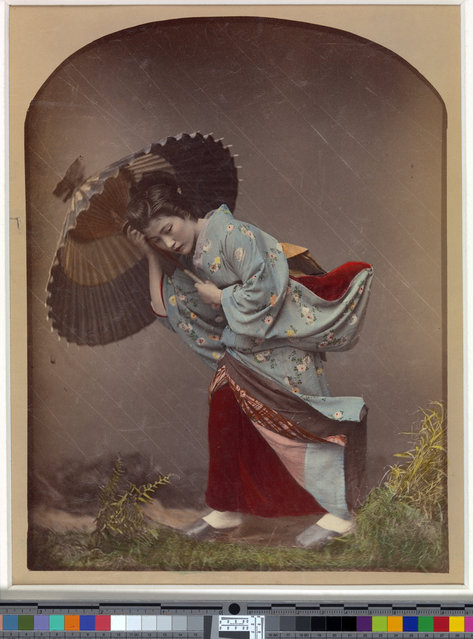
“Woman with Umbrella in Rain” by Raimund von Stillfried. Artist: Kusakabe Kimbei (Japanese, 1841–1934), 1870s. (Photo courtesy of The Metropolitan Museum of Art)

“Woman with Umbrella in Rain” by Raimund von Stillfried. Artist: Kusakabe Kimbei (Japanese, 1841–1934), 1870s. Commercial photography studios in Meiji-era Japan were renowned for the subtlety and refinement of their coloring techniques. This hand-tinted image of a young woman caught in a heavy rainstorm achieved its naturalistic effect by knitting together multiple strands of artifice: the greenery in the foreground was a studio prop; the flaps of the kimono were suspended by thin wires to create the impression of a strong wind; and long, diagonal marks were made on the negative to suggest streaks of rain. (Photo courtesy of The Metropolitan Museum of Art)
Details
12 May 2013 10:13:00