Loading...
Done
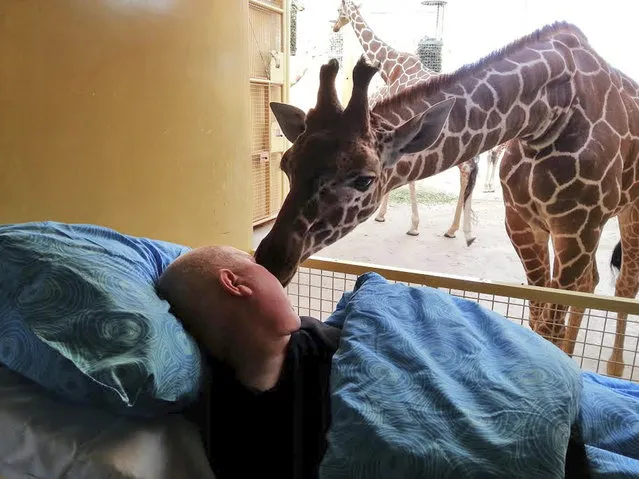
This photo released Saturday March 22, 2014 by Stichting Ambulance Wens or Ambulance Wish Foundation shows a giraffe at Blijdorp Zoo in Rotterdam giving a lick to terminally ill Mario Eijs on Wednesday March 19, 2014. The Stichting Ambulancewens “Ambulance Wish Foundation” offers transport for terminally ill patients who cannot walk to help fulfill a last wish, in Eijs' case to be taken to the Blijdorp Zoo in Rotterdam where he worked doing odd jobs for 25 years. (Photo by AP Photo/Stichting Ambulance Wens)

This photo released Saturday March 22, 2014 by Stichting Ambulance Wens or Ambulance Wish Foundation shows a giraffe at Blijdorp Zoo in Rotterdam giving a lick to terminally ill Mario Eijs on Wednesday March 19, 2014. The Stichting Ambulancewens “Ambulance Wish Foundation” offers transport for terminally ill patients who cannot walk to help fulfill a last wish, in Eijs' case to be taken to the Blijdorp Zoo in Rotterdam where he worked doing odd jobs for 25 years. Eijs, who has a mental handicap, is dying of a brain tumor and has difficulty walking or speaking. (Photo by AP Photo/Stichting Ambulance Wens)
Details
29 Mar 2014 14:20:00


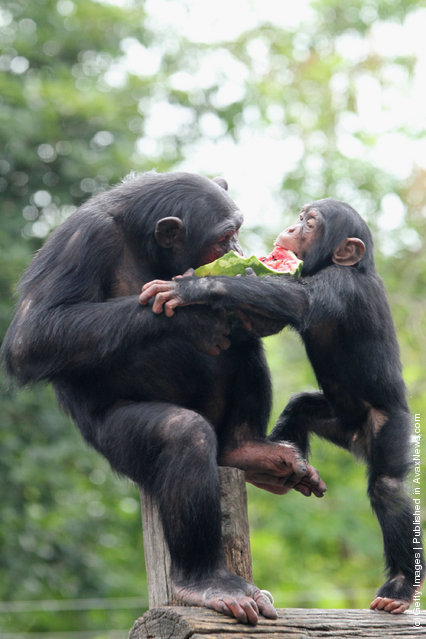
Two chimpanzees share a piece of watermelon at Taronga Zoo on December 23, 2010 in Sydney, Australia. (Photo by Rick Stevens/Taronga Zoo via Getty Images)
Details
29 May 2011 10:52:00
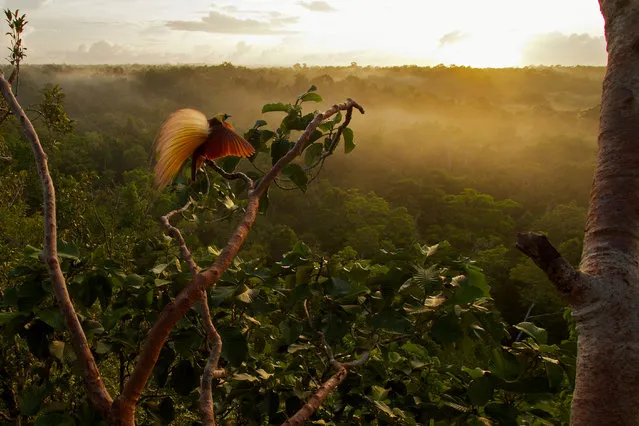
A greater bird of paradise (Paradisaea apoda) displaying in Badigaki Forest, Wokam Island (Aru Islands, Indonesia). Found here in Aru and on adjacent New Guinea, the greater bird of paradise represents about 40 different species of birds of paradise that depend on intact rainforest across the New Guinea region spanning eastern Indonesia and Papua New Guinea. With more than 80% of forest cover still intact, this region represents the largest remaining block of rainforest in the entire Asia-Pacific. (Photo by Tim Laman/naturepl.com/LDY Agency)

A greater bird of paradise (Paradisaea apoda) displaying in Badigaki Forest, Wokam Island (Aru Islands, Indonesia). Found here in Aru and on adjacent New Guinea, the greater bird of paradise represents about 40 different species of birds of paradise that depend on intact rainforest across the New Guinea region spanning eastern Indonesia and Papua New Guinea. With more than 80% of forest cover still intact, this region represents the largest remaining block of rainforest in the entire Asia-Pacific. (Photo by Tim Laman/naturepl.com/LDY Agency)
Details
14 Nov 2021 05:57:00
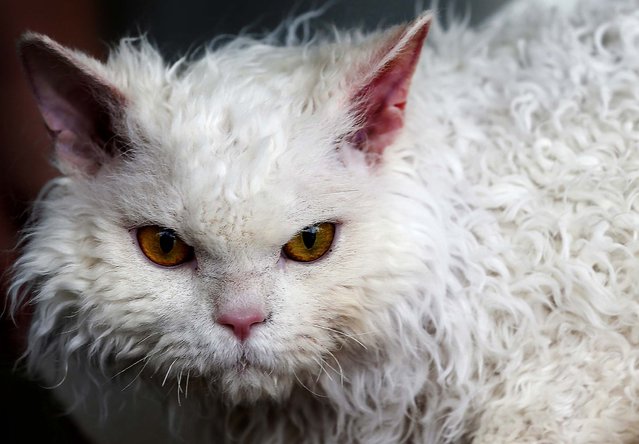
A Selkirk Rex cat is one of more than 400 breeds of cats being presented at the World Cat Federation two-day show in Dortmund, Germany, on April 21, 2013. (Photo by Frank Augstein/Associated Press)

A Selkirk Rex cat is one of more than 400 breeds of cats being presented at the World Cat Federation two-day show in Dortmund, Germany, on April 21, 2013. (Photo by Frank Augstein/Associated Press)
Details
27 Apr 2013 14:58:00
Emma the Maltese's fur blows in the wind as she rides in her owner's purse on 5th Avenue at Central Park in New York December 2, 2014. (Photo by Carlo Allegri/Reuters)

Emma the Maltese's fur blows in the wind as she rides in her owner's purse on 5th Avenue at Central Park in New York December 2, 2014. (Photo by Carlo Allegri/Reuters)
Details
06 Dec 2014 13:07:00
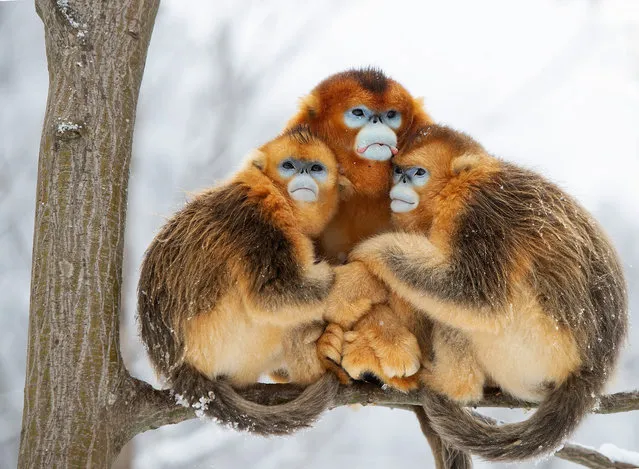
A golden huddle by Minqiang Lu, China. Two females and a male golden snub-nosed monkey huddle together to keep warm in the extreme cold. Threatened by forest loss and fragmentation, this endangered species is confined to central China. Restricted to living high up in the temperate forests, these monkeys – here in the Qinling mountains in Shaanxi province – feed mostly in the trees, on leaves, bark, buds and lichen. In heavy wind and snow, Minqiang walked up the mountain carrying his equipment. He stayed for half an hour in temperatures of –10C opposite the tree where the group was huddled before achieving this eye-level composition. (Photo by Minqiang Lu/Wildlife Photographer of the Year)

A golden huddle by Minqiang Lu, China. Two females and a male golden snub-nosed monkey huddle together to keep warm in the extreme cold. Threatened by forest loss and fragmentation, this endangered species is confined to central China. Restricted to living high up in the temperate forests, these monkeys – here in the Qinling mountains in Shaanxi province – feed mostly in the trees, on leaves, bark, buds and lichen. In heavy wind and snow, Minqiang walked up the mountain carrying his equipment. He stayed for half an hour in temperatures of –10C opposite the tree where the group was huddled before achieving this eye-level composition. (Photo by Minqiang Lu/Wildlife Photographer of the Year)
Details
12 Jan 2023 01:19:00
A sculptural artwork depicting former Chilean dictator Augusto Pinochet and headless presidents shot by a hooded high school student (not pictured) is seen at the Contemporary Art Museum in Santiago, December 2, 2014. (Photo by Ivan Alvarado/Reuters)

A sculptural artwork depicting former Chilean dictator Augusto Pinochet and headless presidents shot by a hooded high school student (not pictured) is seen at the Contemporary Art Museum in Santiago, December 2, 2014. The artwork, part of the “El ladrillo angular” (The angular brick) exhibition, portrays a student fighting against the ongoing continuity of dictatorship because of a political and economic system which has been impossible to destroy, according to “Papas Fritas” the artwork's creator. (Photo by Ivan Alvarado/Reuters)
Details
03 Dec 2014 14:45:00
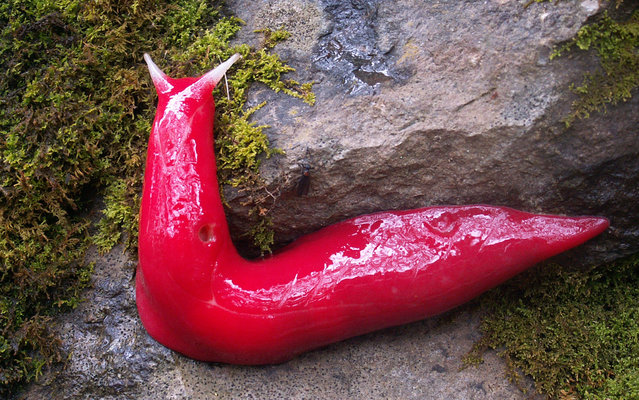
It would seem to be something you'd see only in a cartoon or at a Phish concert, but according to park rangers in New South Wales, Australia, dozens of giant, fluorescent pink slugs have been popping up on a mountaintop there. (Photo by Michael Murphy/AFP Photo/NSW Environment Office)

It would seem to be something you'd see only in a cartoon or at a Phish concert, but according to park rangers in New South Wales, Australia, dozens of giant, fluorescent pink slugs have been popping up on a mountaintop there. The eight-inch creatures have been spotted only on Mount Kaputar, a 5,000-foot peak in the Nandewar Range in northern New South Wales. Scientists believe the eye-catching organisms are survivors from an era when Australia was home to rainforests. A series of volcanoes, millions of years of erosion and other geological changes “have carved a dramatic landscape at Mount Kaputar”, the park service wrote on its Facebook page, and unique arid conditions spared the slugs from extinction. (Photo by Michael Murphy/AFP Photo/NSW Environment Office)
Details
01 Jun 2013 14:09:00