Loading...
Done
Broken Mirrors By  Bing Wright

We pleased to present Broken Mirror/Evening Sky, a new series of striking landscape photographs by New York based artist Bing Wright. Departing from his usual pared down images in grey palettes, Wright offers us moving skyscape photographs of richly colored sunsets reflected onto broken mirrors. This new body of work marks his first return to color photography in almost a decade.
Details
01 Mar 2014 11:35:00
American Alligator By Masa Ushioda

Brave photographer Masa Ushioda captured the shots of this wild gator in vast marsh land in the Everglades National Park, in Florida, USA. He said: “Bright sunlight and blue sky were critical elements in this picture – in addition to getting a wild 10-foot alligator in the middle of the viewfinder with a perfect angle”.

Details
29 Mar 2014 12:02:00
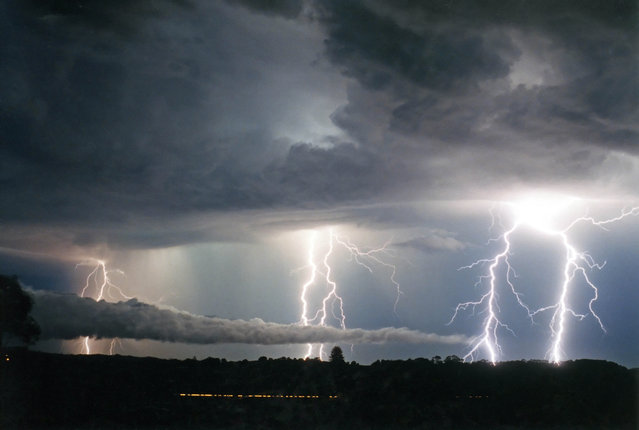
“Lightning Flash Photography”. Alstonville, New South Wales, Australia – January 8, 2003. (Photo by Michael Bath/Caters News)

Michael Bath, from McLeans Ridges in New South Wales, Australia, estimates that in his lifetime he has taken more than 3,500 images of lightning bolts illuminating the sky. Photo: Alstonville, New South Wales, Australia – January 8, 2003. (Photo by Michael Bath/Caters News)
Details
04 Apr 2014 11:44:00
Fireworks Welcome In The New Year In Utrecht

New Year's Eve fireworks display illuminates the sky over the Dom Tower on January 01, 2012 in Utrecht, Netherlands. The Dom tower is with 112.5 metres high the tallest church tower of the Netherlands. Built in Gothic-style, the tower, part of the Cathedral of Saint Martin, is the symbol of the city of Utrecht. (Photo by Jasper Juinen/Getty Images)
Details
01 Jan 2012 11:27:00
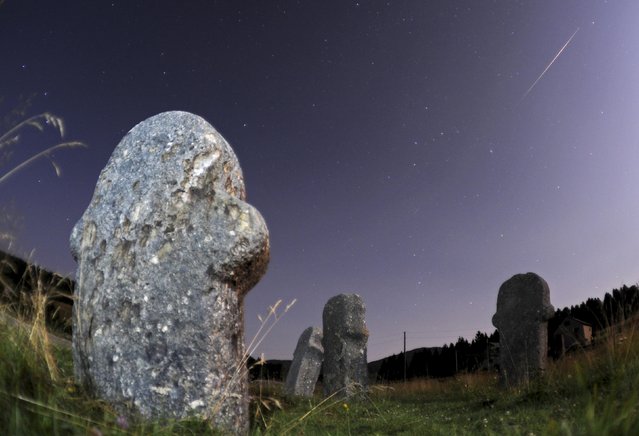
A meteor streaks over the sky during the Perseid meteor shower at the Maculje archaeological site near Novi Travnik August 12, 2014. According to NASA, the annual Perseid meteor shower reaches its peak on August 12 and 13 in Europe. The fireballs from the meteorites are fast and plentiful, although a nearly full moon (Supermoon) makes it difficult to view them this year, the agency adds. (Photo by Dado Ruvic/Reuters)

A meteor streaks over the sky during the Perseid meteor shower at the Maculje archaeological site near Novi Travnik August 12, 2014. According to NASA, the annual Perseid meteor shower reaches its peak on August 12 and 13 in Europe. The fireballs from the meteorites are fast and plentiful, although a nearly full moon (Supermoon) makes it difficult to view them this year, the agency adds. (Photo by Dado Ruvic/Reuters)
Details
14 Aug 2014 10:45:00
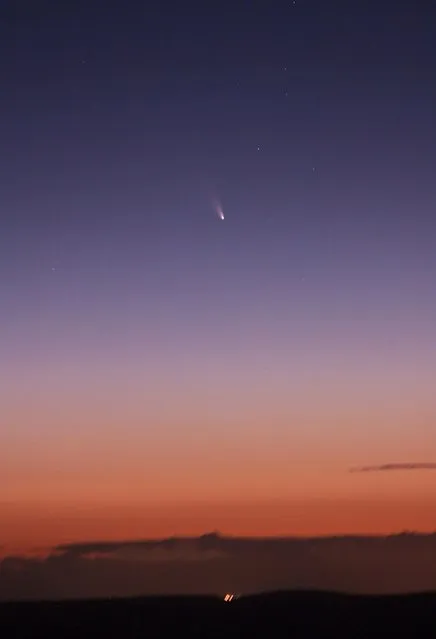
This image provided by NASA shoaws the comet PANSTARRS as seen from Mount Dale, Western Australia on March 5, 2013. According to NASA on March 10, it will make its closest approach to the sun about 28 million miles (45 million kilometers) away. As it continues its nightly trek across the sky, the comet may get lost in the sun's glare but should return and be visible to the naked eye by March 12. (Photo by AP Photo/NASA)

It’s time to start watching for Comet PANSTARRS, one of two comets to get excited about in 2013. Photo: This image provided by NASA shoaws the comet PANSTARRS as seen from Mount Dale, Western Australia on March 5, 2013. According to NASA on March 10, it will make its closest approach to the sun about 28 million miles (45 million kilometers) away. As it continues its nightly trek across the sky, the comet may get lost in the sun's glare but should return and be visible to the naked eye by March 12. (Photo by AP Photo/NASA)
Details
13 Mar 2013 08:03:00
Highly commended birds : Crested guan by Tim Hunt (UK). ‘This photo shows a crested guan in the cloud forests of Costa Rica as it pauses while foraging on a lone branch. Due to the clouds that are so typical for this habitat, I could often only photograph the bird’s silhouette against a grey sky. (Photo by Tim Hunt/GDT European Wildlife Photographer of the Year 2015)

Highly commended birds : Crested guan by Tim Hunt (UK). ‘This photo shows a crested guan in the cloud forests of Costa Rica as it pauses while foraging on a lone branch. Due to the clouds that are so typical for this habitat, I could often only photograph the bird’s silhouette against a grey sky. But then, for a short moment only, the sun broke through the clouds, and I overexposed the image by over two stops in order to blow out the background and allow this beautifully marked bird to stand out’. (Photo by Tim Hunt/GDT European Wildlife Photographer of the Year 2015)
Details
24 Nov 2015 08:01:00
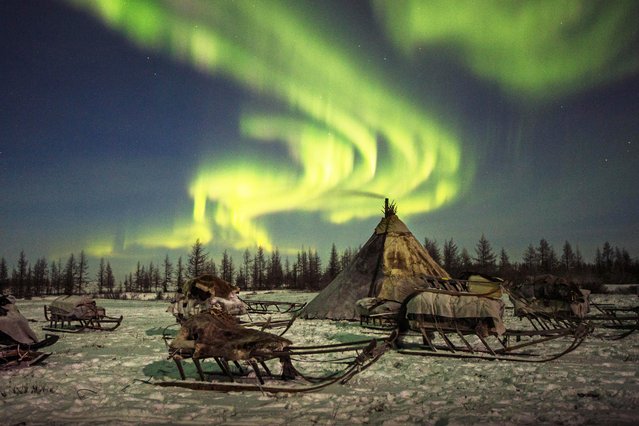
An empty camp is shown beneath a colourful sky in Siberia, December 2016. (Photo by Timothy Allen/Barcroft Productions)

A British photographer has captured life at the “edge of the world”. Timothy Allen, best known for his work on BBC's Human Planet, trekked through the freezing Siberian wilderness for 16 days as he joined part of an 800km migration of reindeer in the Yamal-Nenets region – a name that roughly translates to “edge of the world”. The stunning pictures feature the nomadic Nenets tribe, who drink blood to survive in -45°C temperatures. Timothy's epic journey, which will be revealed in an eight-minute documentary on Animal Planet USA, saw him travel across the bleak terrain of the frozen Ob River with the Nenets people in December last year. Here: An empty camp is shown beneath a colourful sky in Siberia, December 2016. (Photo by Timothy Allen/Barcroft Productions)
Details
19 Sep 2017 07:48:00