Loading...
Done
While the lido was described as bringing “modernism to the masses” on the British coast it was just the latest example of a trend that had been developing since Victorian times – transforming seaside towns into resorts for leisure and entertainment. In the latter half of the nineteenth century, the fashion was for local authorities to build great piers stretching from the promenade out into the sea

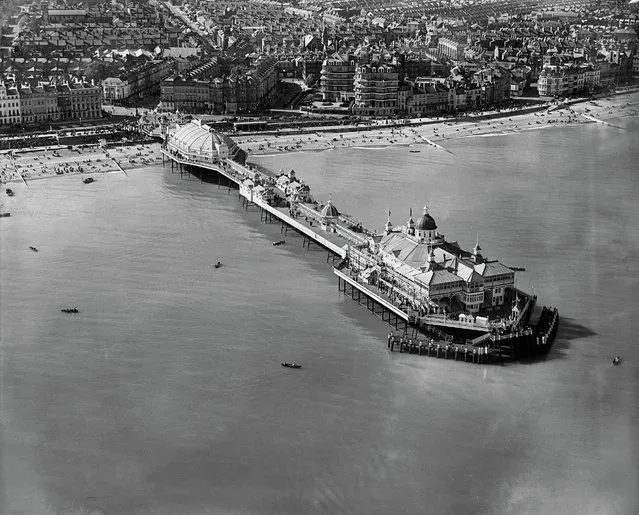
While the lido was described as bringing “modernism to the masses” on the British coast it was just the latest example of a trend that had been developing since Victorian times – transforming seaside towns into resorts for leisure and entertainment. In the latter half of the nineteenth century, the fashion was for local authorities to build great piers stretching from the promenade out into the sea. The Eastbourne Pier, pictured here in May 1931, was erected between 1866 and 1870 to an ingenious design by Eugenius Birch, which saw the structure sitting on special cups allowing the supporting struts to “move” in bad weather. Arranged on the pier's 1,000-foot length were kiosks, a theatre, a ballroom and a camera obscura. 1931. (Photo by Aerofilms Collection via “A History of Britain From Above”)
Details
25 Feb 2014 12:59:00
Young revelers take part in a parade called "La Calabiuza" on November 1, 2015, on the eve of the Day of the Dead in Tonacatepeque, 20 kms (13 miles) north of San Salvador. During the celebration, the residents of Tonacatepeque, originally an indigenous community, recall the characters from the mythology of Cuscatlan – pre-Columbian west and central regions of El Salvador – and their dead relatives. (Photo by Marvin Recinos/AFP Photo)

Young revelers take part in a parade called "La Calabiuza" on November 1, 2015, on the eve of the Day of the Dead in Tonacatepeque, 20 kms (13 miles) north of San Salvador. During the celebration, the residents of Tonacatepeque, originally an indigenous community, recall the characters from the mythology of Cuscatlan – pre-Columbian west and central regions of El Salvador – and their dead relatives. (Photo by Marvin Recinos/AFP Photo)
Details
04 Nov 2015 11:50:00
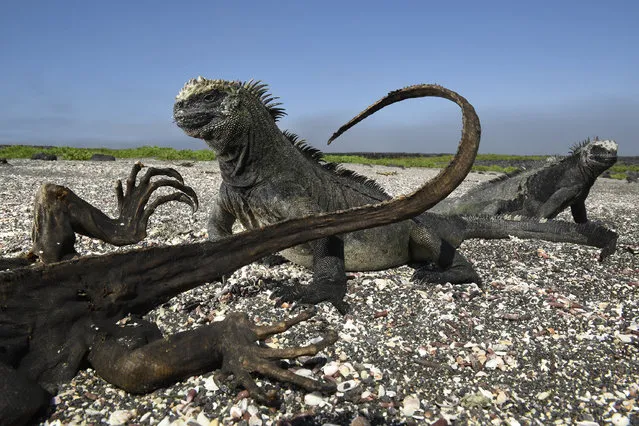
Galapagos – Rocking the Cradle: Four major ocean currents converge along the Galapagos archipelago, creating the conditions for an extraordinary diversity of animal life, April 25, 2016. The islands are home to at least 7,000 flora and fauna species, of which 97 percent of the reptiles, 80 percent of the land birds, 50 percent of the insects and 30 percent of the plants are endemic. The local ecosystem is highly sensitive to the changes in temperature, rainfall and ocean currents that characterize the climatic events known as El Niño and La Niña. These changes cause marked fluctuations in weather and food availability. Many scientists expect the frequency of El Niño and La Niña to increase as a result of climate change, making the Galapagos a possible early-warning location for its effects. (Photo by Thomas P. Peschak for National Geographic/World Press Photo)

Galapagos – Rocking the Cradle: Four major ocean currents converge along the Galapagos archipelago, creating the conditions for an extraordinary diversity of animal life, April 25, 2016. The islands are home to at least 7,000 flora and fauna species, of which 97 percent of the reptiles, 80 percent of the land birds, 50 percent of the insects and 30 percent of the plants are endemic. (Photo by Thomas P. Peschak for National Geographic/World Press Photo)
Details
16 Apr 2018 00:01:00
Anti-racist Loldiers of Odin clowns speak with police as they take to the streets against anti-immigration marchers in Tampere, Finland January 23, 2016. Police prevented the groups from confronting each other. On the northern fringes of Europe, Finland has little history of welcoming large numbers of refugees, unlike neighbouring Sweden. But as with other European countries, it is now struggling with a huge increase in asylum seekers and the authorities are wary of any anti-immigrant vigilantism. (Photo by Kalle Parkkinen/Reuters/Lehtikuva)

Anti-racist Loldiers of Odin clowns speak with police as they take to the streets against anti-immigration marchers in Tampere, Finland January 23, 2016. Police prevented the groups from confronting each other. On the northern fringes of Europe, Finland has little history of welcoming large numbers of refugees, unlike neighbouring Sweden. But as with other European countries, it is now struggling with a huge increase in asylum seekers and the authorities are wary of any anti-immigrant vigilantism. (Photo by Kalle Parkkinen/Reuters/Lehtikuva)
Details
24 Jan 2016 15:49:00
Policemen look at a wax figure of Rowan Atkinson, dressed as his popular television character Mr. Bean, on display outside a wax figure museum in Guangzhou, Guangdong province, August 24, 2014. (Photo by Alex Lee/Reuters)

Policemen look at a wax figure of Rowan Atkinson, dressed as his popular television character Mr. Bean, on display outside a wax figure museum in Guangzhou, Guangdong province, August 24, 2014. (Photo by Alex Lee/Reuters)
Details
30 Aug 2014 10:18:00
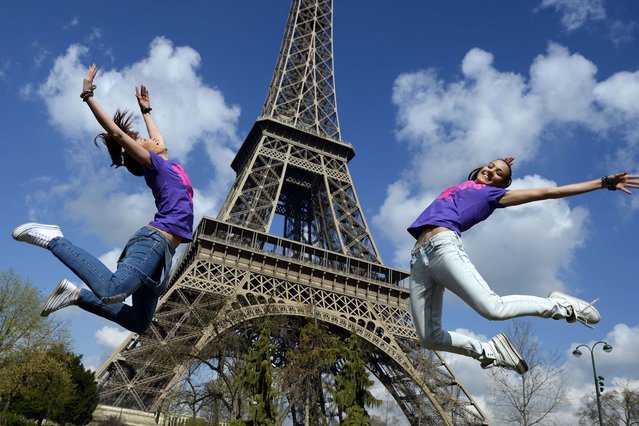
Two Bulgarian tourists pose in front of the Eiffel Tower in Paris on their last day in the capital on March 24, 2014. (Photo by Franck Fife/AFP Photo)

Two Bulgarian tourists pose in front of the Eiffel Tower in Paris on their last day in the capital on March 24, 2014. (Photo by Franck Fife/AFP Photo)
Details
29 Mar 2014 13:13:00
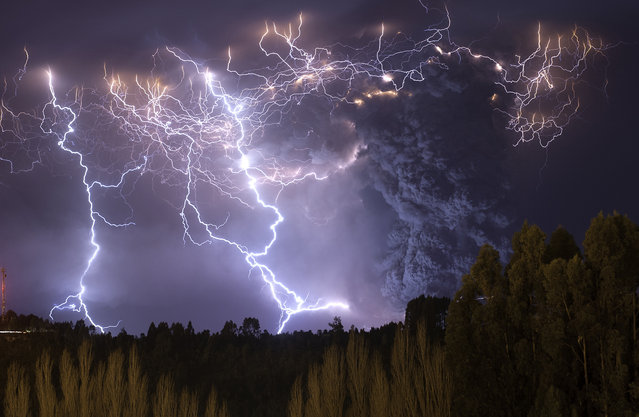
The eruption of Cordon Caulle began on June 4, 2011, located in the Region of Los Rios in Chile. For about 12 months, people and animals became accustomed to living with the daily fall of ash, which also caused problems in the air traffic in South America. The explosions and lightning during first days of the eruption could be seen from hundreds of miles around. This photograph was taken on the second night of eruption from the town of Lago Ranco. (Photo and caption by Francisco Negroni/National Geographic Traveler Photo Contest)

The eruption of Cordon Caulle began on June 4, 2011, located in the Region of Los Rios in Chile. For about 12 months, people and animals became accustomed to living with the daily fall of ash, which also caused problems in the air traffic in South America. The explosions and lightning during first days of the eruption could be seen from hundreds of miles around. This photograph was taken on the second night of eruption from the town of Lago Ranco. (Photo and caption by Francisco Negroni/National Geographic Traveler Photo Contest)

ATTENTION! All pictures are presented in high resolution. To see Hi-Res images – just TWICE click on any picture. In other words, click small picture – opens the BIG picture. Click BIG picture – opens VERY BIG picture.
Details
23 Jun 2013 11:24:00
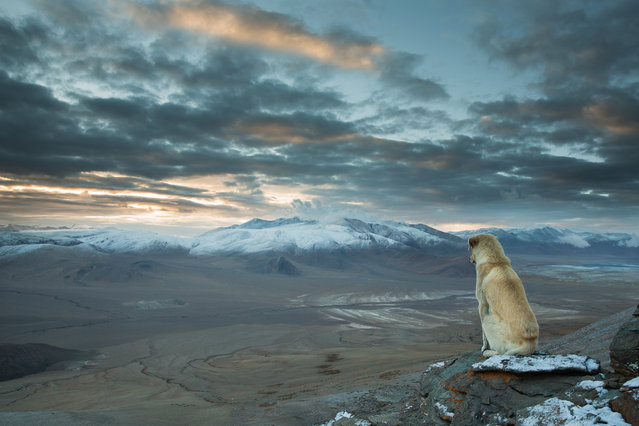
“Himalayan Dog”. This dog just appeared out of nowhere and followed us for an entire week during our trekking trip in the Himalayan outback. He always used to sleep in front of our tent and guarded us in the nights. When I decided to get up at 4 a.m. to climb the next 5000 m peak for sunrise he accompanied me as well. On the top he was sitting for the entire 30 minutes on this place looking straight into the countryside. Photo location: Ladakh, India. (Photo and caption by Sebastian Wahlhuetter/National Geographic Photo Contest)

“Himalayan Dog”. This dog just appeared out of nowhere and followed us for an entire week during our trekking trip in the Himalayan outback. He always used to sleep in front of our tent and guarded us in the nights. When I decided to get up at 4 a.m. to climb the next 5000 m peak for sunrise he accompanied me as well. On the top he was sitting for the entire 30 minutes on this place looking straight into the countryside. Photo location: Ladakh, India. (Photo and caption by Sebastian Wahlhuetter/National Geographic Photo Contest)
Details
01 Apr 2014 10:47:00