Loading...
Done
Tim Laman - Wildlife Photojournalist

Tim Laman is a field biologist and wildlife photojournalist. His pioneering research in the rain forest canopy in Borneo led to a PhD from Harvard and his first National Geographic article in 1997. Since then, he has pursued his passion for exploring wild places and documenting little-known and endangered wildlife by becoming a regular contributor to National Geographic. He has eighteen articles to his credit to date, all of which have had a conservation message. Some have focused on endangered species such as Orangutans or Hornbills, while others, such as a series of articles on Conservation International’s Biodiversity Hotspots, have highlighted regions under intense pressure.
Details
14 Sep 2013 10:13:00
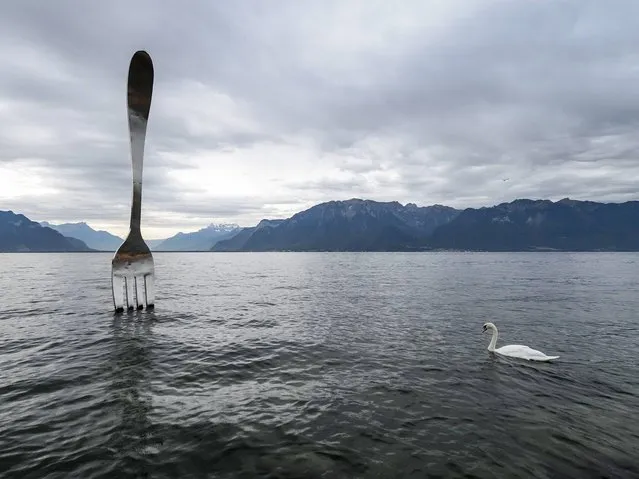
A picture taken on October 17, 2014 in Vevey shows a giant fork designed by Switzerland's artist Jean-Pierre Zaugg to commemorate Nestle's Alimentarium Food Museum 10th anniversary. World's biggest food company, Swiss Nestle Group announced results sales down by 3.1% for the first nine months of 2014 to 66.2 billion Swiss francs (55.1 billion euros). (Photo by Fabrice Coffrini/AFP Photo)

A picture taken on October 17, 2014 in Vevey shows a giant fork designed by Switzerland's artist Jean-Pierre Zaugg to commemorate Nestle's Alimentarium Food Museum 10th anniversary. World's biggest food company, Swiss Nestle Group announced results sales down by 3.1% for the first nine months of 2014 to 66.2 billion Swiss francs (55.1 billion euros). (Photo by Fabrice Coffrini/AFP Photo)
Details
17 Oct 2014 13:04:00
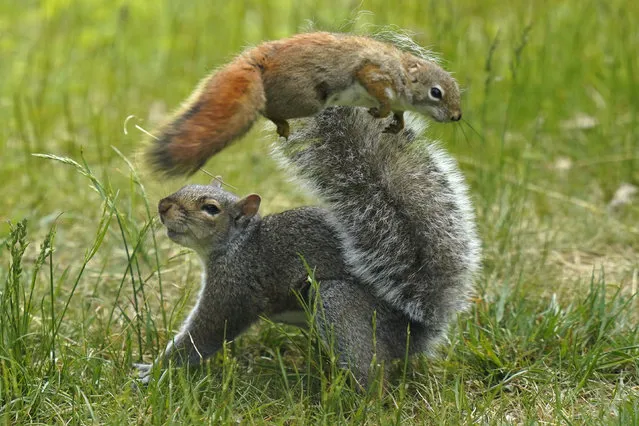
A red squirrel leaps over a gray squirrel after the larger squirrel became annoyed with its territory being encroached upon, Saturday, May 28, 2022, in Freeport, Maine. (Photo by Robert F. Bukaty/AP Photo)

A red squirrel leaps over a gray squirrel after the larger squirrel became annoyed with its territory being encroached upon, Saturday, May 28, 2022, in Freeport, Maine. (Photo by Robert F. Bukaty/AP Photo)
Details
12 Jun 2022 04:01:00
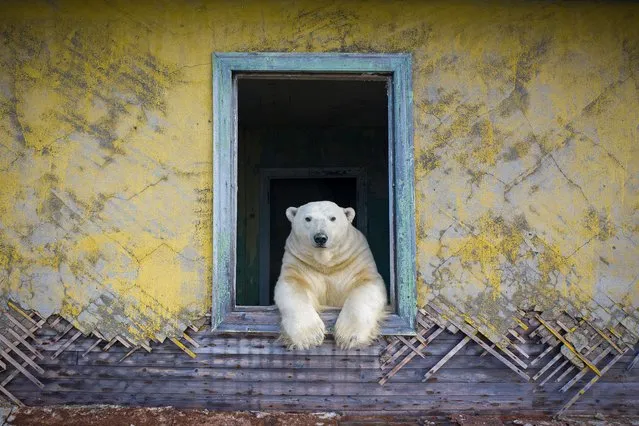
Polar frame, by Dmitry Kokh, Russia. When Kokh’s boat approached the small island of Kolyuchin in the Russian High Arctic, which had been abandoned by humans since 1992, he was surprised to spot movement in one of the houses. Binoculars revealed polar bears – more than 20 in total – exploring the ghost town. Dmitry used a low-noise drone to document them. (Photo by Dmitry Kokh/Wildlife Photographer of the Year 2022)

Polar frame, by Dmitry Kokh, Russia. When Kokh’s boat approached the small island of Kolyuchin in the Russian High Arctic, which had been abandoned by humans since 1992, he was surprised to spot movement in one of the houses. Binoculars revealed polar bears – more than 20 in total – exploring the ghost town. Dmitry used a low-noise drone to document them. (Photo by Dmitry Kokh/Wildlife Photographer of the Year 2022)
Details
03 Sep 2022 05:43:00
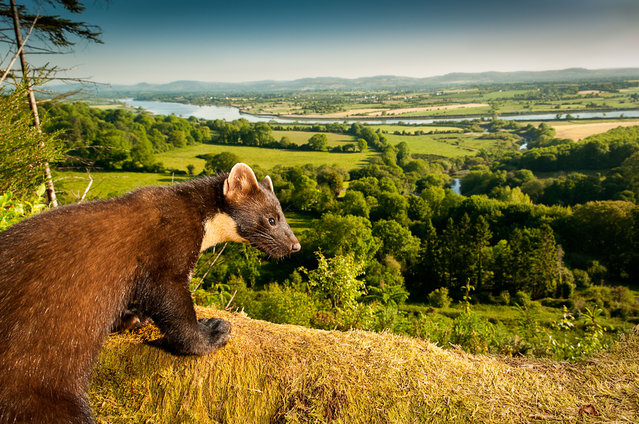
A pine marten – one of a few wild mammals doing well in Britain (although they number just 3,700). A fifth of the country’s wild mammals are at high risk of extinction, research shows. (Photo by Maurice Flynn/The Mammal Society)

A pine marten – one of a few wild mammals doing well in Britain (although they number just 3,700). A fifth of the country’s wild mammals are at high risk of extinction, research shows. (Photo by Maurice Flynn/The Mammal Society)
Details
08 Jul 2018 00:01:00
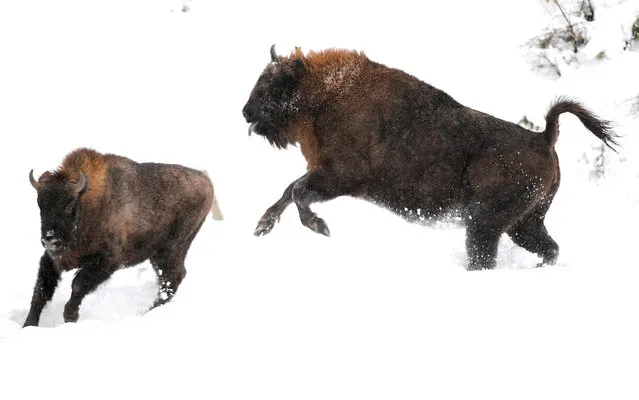
European bisons (also known as Wisent) at the Bison farm in Muczne, southeastern Poland, 30 December 2018. The Bison farm is a continuation of bison breeding in Bieszczady, which was started in 1963. Here visitors can admire the bison of Bialowieza-Caucasian line, also called the mountain race. The European Bison is the national animal of Poland. (Photo by Darek Delmanowicz/EPA/EFE)

European bisons (also known as Wisent) at the Bison farm in Muczne, southeastern Poland, 30 December 2018. The Bison farm is a continuation of bison breeding in Bieszczady, which was started in 1963. Here visitors can admire the bison of Bialowieza-Caucasian line, also called the mountain race. The European Bison is the national animal of Poland. (Photo by Darek Delmanowicz/EPA/EFE)
Details
06 Jan 2019 00:03:00
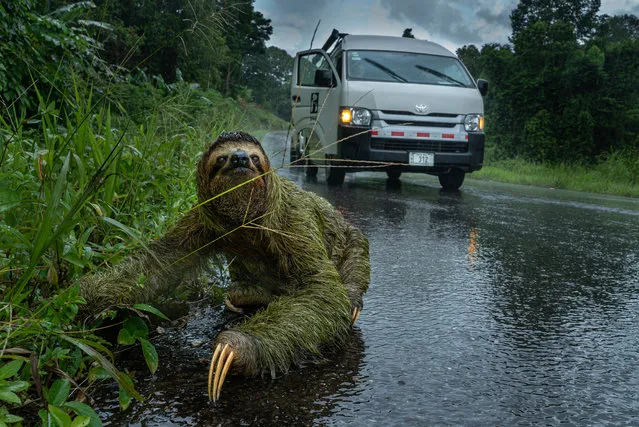
People and Nature category winner: Why did the sloth cross the road? by Andrew Whitworth (Osa Conservation and University of Glasgow), taken in Osa Peninsula, Costa Rica. “I was driving out from the Osa Peninsula, located on the southern Pacific coast of Costa Rica on a dark, stormy day. This female three-toed sloth (Bradypus variegatus) had luckily just about made it across the road, and the drivers of the Toyota on this occasion had spotted her in good time”. (Photo by Andrew Whitworth/2019 British Ecological Society Photography Competition)

People and Nature category winner: Why did the sloth cross the road? by Andrew Whitworth (Osa Conservation and University of Glasgow), taken in Osa Peninsula, Costa Rica. “I was driving out from the Osa Peninsula, located on the southern Pacific coast of Costa Rica on a dark, stormy day. This female three-toed sloth (Bradypus variegatus) had luckily just about made it across the road, and the drivers of the Toyota on this occasion had spotted her in good time”. (Photo by Andrew Whitworth/2019 British Ecological Society Photography Competition)
Details
30 Nov 2019 00:05:00
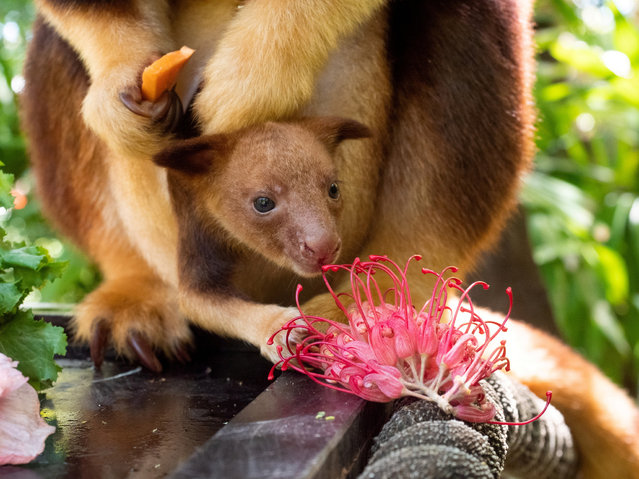
A Goodfellow's Tree Kangaroo joey with its mother at Sydney Zoo in Australia on January 22, 2021. The 28-week-old male joey, who is yet to be named, has only just begun to pop his head and shoulders out of his mum's pouch. (Photo by Taronga Zoo via Reuters)

A Goodfellow's Tree Kangaroo joey with its mother at Sydney Zoo in Australia on January 22, 2021. The 28-week-old male joey, who is yet to be named, has only just begun to pop his head and shoulders out of his mum's pouch. (Photo by Taronga Zoo via Reuters)
Details
31 Jan 2021 08:44:00